
OBMICA Trains Trade Unionists on Migration from a Gender and Rights-Based Perspective
August 2013--The ILO invited OBMICA to facilitate a training module in the workshop on labor migration in the DR entitled "Toward the construction of an inter-union agenda on labor migration with a gender perspective." The two topics covered were: a) Conceptualization of labor migration and its link with development and gender, and b) Migration context in the Dominican Republic
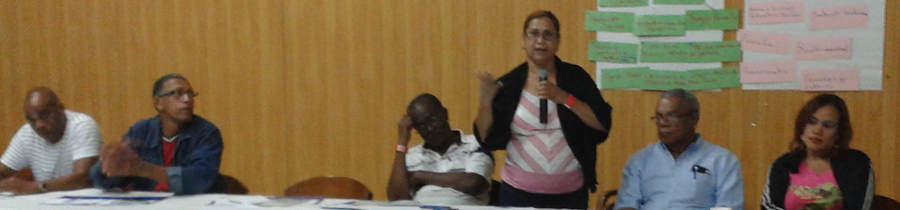
August 2013--The ILO invited OBMICA to facilitate a training module in the workshop on labor migration in the Dominican Republic entitled "Toward the construction of an inter-union agenda on labor migration with a gender perspective." The two topics covered were: a) Conceptualization of labor migration and its link with development and gender and, b) Migration context in the Dominican Republic. This awareness-raising exercise, carried out in Boca Chica on August 30 and 31, 2013, was an important prelude to the development of the union agenda for more effective promotion of the rights of migrant workers.
The most important trade union confederations in the country took part. The final document accounts for a wide range of topics addressed, including some of the thorniest ones such as social security, documentation, and migration regularization. Among other things, it makes concrete proposals on the need to complete the institutional architecture required to implement the new migration law, approved in 2004.
A very current issue promoted in the agenda is the follow-up to the completion of the process of ratification of Convention 189 on decent work for domestic workers, recognizing that the National Survey of Immigrants (ONE/UNFPA 2013) shows a significant number of Haitian women working in this occupation in the country.
The trade union view that persists regarding the situation of multiple vulnerabilities in the bateyes is noteworthy. This concern for those migrant workers who have historically been so important in the sugar industry and for their descendants seems very relevant. Let us remember that it was thanks in part to the support of Dominican trade unions that immigrant workers began to organize in these isolated and impoverished communities.
Finally, and as might be expected, there is a call to strengthen binational trade union action, perhaps the greatest challenge contained in this important commitment document of the Dominican trade union confederations.
To learn more about OBMICA's work on labor rights, enter here.