
Impacts of COVID-19 on the Haitian Migrant Population and Their Descendants in the Dominican Republic's Border Region with Haiti - Migracion y Desarrollo, volume 22, issue 42
Abstract. The COVID-19 pandemic revealed and deepened existing inequalities affecting Haitian migrants and their stateless descendants in the Dominican Republic. A key dimension of this inequality remains access to identity documentation, which is essential for health services and social protection. This article presents findings from a study in the southern border region and analyzes the structural precarity faced by this population.
Abstract. The covid-19 pandemic revealed and aggravated the existing inequalities affecting the Haitian migrant population and their stateless descendants in the Dominican Republic. An important dimension of social inequality continues to be access to identity documentation, given its importance for accessing health services and social protection programs. This article presents the findings of a study on the impacts of covid-19 on this population in the southern area of the Dominican Republic's border strip with Haiti.
The research focuses on impacts with regard to disease incidence and access to health services, access to vaccination, economic impact, access to education, social protection programs, voluntary and involuntary returns to Haiti, transnationalism, as well as the very processes of applying for and renewing documentation. It further demonstrates the crucial role of civil society in meeting the population's needs, even as the space for its dialogue and policy advocacy before the government was reduced.
Keywords: migrants, statelessness, undocumented status, social protection, vaccination, economic impact, education, civil society.
Abstract. The covid-19 pandemic revealed and deepened existing social inequalities for the Haitian migrant population and their stateless descendants in the Dominican Republic. An important dimension of social inequality continues to be access to identity documentation, given its importance for accessing health services and social protection programs. This chapter presents research findings from a study on covid-19 impacts on this population in the southern border region of the Dominican Republic with Haiti. Based on an analysis of the current situation of identity documentation, we proceed to analyze the structural precarity which exposes migrants and their descendants to multiple impacts of covid-19. The study focuses on the impacts with regard to prevalence of the illness and access to health services, access to vaccination, economic impact, access to education, social protection programs, and the impact on issuance and renewal of documentation. The study also demonstrates the crucial role of civil society in meeting the needs of the population, at the same time as space for dialogue and policy advocacy with the current government was reduced.
Keywords: migrants, statelessness, undocumented, social protection, vaccination, economic impact, education, civil society.
Covid-19 has revealed the pre-existing inequalities in every society, including those of the wider Caribbean. The 2020 Human Development Report The Next Frontier: Human Development and the Anthropocene (UNDP, 2021) points out that the Dominican Republic loses 21 points in the human development measurement due to growing inequalities. The levels of social inequality prevalent in the country increase the vulnerability of certain groups of people, not only because of income inequities, but also because of differentiated access to basic services, health, and social protection. Among these groups in a situation of vulnerability, migrant populations and their descendants stand out, especially those who find themselves in an irregular migratory situation or without documentation certifying their Dominican nationality.
According to the Economic Commission for Latin America and the Caribbean (ECLAC) (2016), there are three structuring axes of social inequality in Latin America: ethnic and racial inequalities and their intersection with gender inequalities; the chaining of inequalities throughout the life cycle; and territorial inequalities. In the Dominican context, where structural inequality is observed throughout its population, the condition of the Haitian population and its stateless descendants fosters a greater level of disadvantage.
In the Dominican Republic, a crucial dimension of social inequality continues to be access to identity documentation for migrants and their descendants born in the country, given its importance for accessing health services and social protection programs. This article presents the findings of a study carried out by a research team from the Center for Migration Observation and Social Development in the Caribbean (Obmica) on the impacts of covid-19 on the Haitian migrant population and their descendants in the southern border strip. As a research center for action, our purpose is to bet on the resumption of dialogue around the urgent issue of migratory regularization and access to civil registration for the Dominican population residing in the most marginalized areas of the country, not only as a human rights issue but as a pragmatic matter of recognizing the interdependence of our collective health and well-being.
Methodology
This qualitative study examined the impacts of covid-19 on the Haitian migrant population and their descendants residing in communities belonging to the Enriquillo subregion, in the Dominican-Haitian border strip. The Enriquillo subregion is located in the southwestern part of the Dominican Republic, made up of the provinces of Barahona, Pedernales, Independencia, and Bahoruco. The surface area occupied by these four provinces is 6,961.43 km². It is also characterized as being one of the poorest regions and having the lowest inequality-adjusted human development indices in the country (UNDP, 2013), despite the wealth of its contributions to national agricultural production.
In October 2020, an Obmica research team conducted 50 semi-structured interviews with people of different documentation profiles, all of them fathers or mothers of daughters and sons born in Dominican territory in the last five years. Table 1 summarizes the number of participants, by profile and gender.
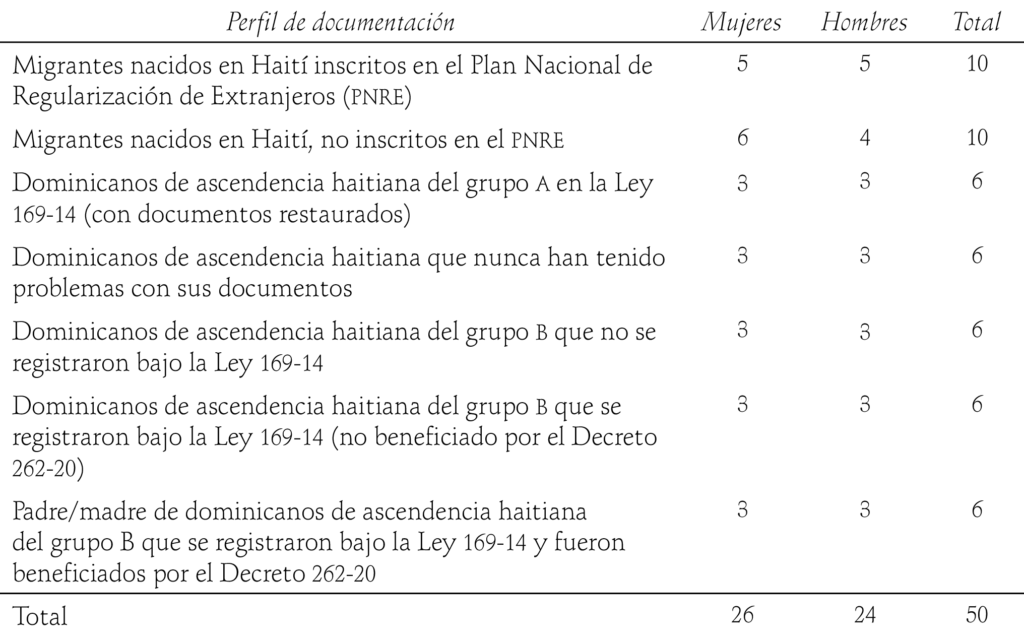
https://estudiosdeldesarrollo.mx/migracionydesarrollo/wp-content/uploads/2025/06/cuadro1ajp-300x188.png 300w, https://estudiosdeldesarrollo.mx/migracionydesarrollo/wp-content/uploads/2025/06/cuadro1ajp-768x481.png 768w, https://estudiosdeldesarrollo.mx/migracionydesarrollo/wp-content/uploads/2025/06/cuadro1ajp-1536x962.png 1536w, https://estudiosdeldesarrollo.mx/migracionydesarrollo/wp-content/uploads/2025/06/cuadro1ajp.png 2032w" sizes="(max-width: 710px) 100vw, 710px">
It is pertinent to clarify that the interviews were carried out in compliance with the rigorous health protocols in force. Likewise, the names used in the study are pseudonyms, with the intention of protecting the confidentiality of each of the persons interviewed, in accordance with the agreed consent arrangements.
In addition to the interviews, two focus groups were formed: one with eight mothers of girls and boys without civil registration who are at risk of remaining stateless; and the other with eight promoters and staff of the civil society organization Centro de Desarrollo Sostenible (Cedeso), based in Tamayo, Bahoruco, which since 2002 has provided guidance, humanitarian assistance, and legal accompaniment to the population.
Several key actors in the Enriquillo region and in Santo Domingo were interviewed, including representatives of civil registry offices, hospitals in the area and the Haitian consulate, international organizations such as the International Organization for Migration (IOM) and the United Nations High Commissioner for Refugees (UNHCR); along with professionals who work with organizations defending the human rights of migrants in other areas of the national territory.
The presentation of the findings focuses mainly on the population descended from migrants who still find themselves in a situation of statelessness, despite the efforts begun in 2014 and 2015 for the regularization of foreigners, on the one hand, and the naturalization of their descendants, on the other, which unfortunately have not achieved the expected results as sustainable solutions over time. The inclusion of the population born in Haiti in the study was a strategic decision due to the relationship that historical and contemporary migration bears to the generation of the risk of statelessness and the resulting social exclusion of their descendants born in the country.
Like every study, this one has its limitations. It is a relatively small sample that was interviewed at a given moment within a political and epidemiological context in full evolution. A change of central government had recently occurred after 16 years of governance by the Dominican Liberation Party (PLD), a change that was still producing effects in terms of personnel changes in public institutions. The administration of President Luis Abinader of the Modern Revolutionary Party (PRM) took power on August 16, 2020. Although this is a snapshot taken in time, the analysis turns it into an X-ray of what happens when a population that has been systematically excluded from society suffers the multiple shocks of a global pandemic. The research findings were validated at a workshop in Tamayo in May 2021, attended by key actors from the region.
Current status of identity documentation
Despite recent efforts to modernize its civil registry, migratory regularization, and naturalization, the Dominican Republic still faces relevant challenges in guaranteeing the human right to identity and nationality for the population descended from migrants. Before presenting the impacts of covid-19 on the concurrent processes of registration and documentation, it is worth explaining what these processes are and at what point we found ourselves when the coronavirus entered the country in March 2020.
In the 1990s, the civil registry and identity-card system was in a state of «virtual abandonment» (JCE, 2012). The Civil Registry Offices functioned in a nominally state-run manner, although «in reality they responded to a personal initiative and kept the Offices (…) as a kind of trust at the service of private interests» (JCE, 2012:5). This situation caused the civil registry books and records to be in outright deterioration and «mafias to traffic with impunity in the population's documents» (JCE, 2012:5).
It was not until 2007 that the JCE assumed control of all the Civil Registry Offices and prioritized the modernization and securitization of the identity management system. Starting in 2005, the digitization of records that were in a state of deterioration began. Later, in alliance with international organizations such as the United Nations Children's Fund (UNICEF) and the Organization of American States (OAS), more identity-card centers and other services began to open, and 60 JCE delegations were established in the country's most important hospitals with the intention of facilitating access to timely birth registration. In 2009–2010, late birth-declaration campaigns began to reduce under-registration, as the Dominican Republic had one of the highest rates of population under-registration in Latin America and the Caribbean (Brito, Corbacho, and Osorio, 2013). In addition, the country had begun to implement several social protection programs that required remedying under-registration in rural areas in order to enroll the poorest people.
By 2014, the registration situation had improved, going from 78% of children under five registered in 2009 to 88% (UNICEF, 2016). However, under-registration persisted and, therefore, so did the social exclusion of a significant segment of the Dominican population. As of February 2020, UNICEF data estimated that the under-registration rate was between 8% and 18% of the adult population in the Dominican Republic (UNHCR and OAS, 2020). It is clear that not all children have benefited from these efforts, especially when their mothers or fathers are of foreign origin or have an irregular migratory status.
The processes of modernizing the civil registry coincide in time with the practices of arbitrary suspension of identity documents and denationalization of people of Haitian descent, which have been brought before the Inter-American Court of Human Rights (IACtHR) and extensively documented (Riveros, 2014; Wooding, 2018; Petrozziello, 2014/2017; Hayes, 2021). There is a notable pattern in the practices of exclusion from the civil registry: every initiative to expand civil registry coverage and, by extension, the electoral roll, entails the exclusion of members of this group whom certain political elites have deemed inconvenient.1 In other words, the mechanisms created to modernize the civil registry —mobile units, the late-declaration unit, digitization, and biometric documentation— are the same ones that have been used to identify and denationalize those who, for decades, had been considered Dominican, according to the Constitution in force at the time of their birth in Dominican territory.
In previous studies we documented how the late-declaration campaigns that the Junta Central Electoral (JCE) had carried out jointly with the Ministry of Education, for example, had failed to remedy the informal practices and irregularities that have hindered access to civil registration for this population (Petrozziello et al., 2014, 2017). Others have observed that it has been in the context of the strengthening of social policy, through programs such as the Solidaridad card, that the Dominican State has excluded the population descended from migrants (Hayes de Kalaf, 2019, 2021). In contrast to the use of violence or discriminatory practices against migrants and their descendants, there was a biopolitical turn in the mode of anti-Haitian exclusionism within state structures (Martínez and Wooding, 2017), including the cancellation of birth certificates and identity cards or the refusal to issue documentation certifying the Dominican nationality of migrants' descendants.
Before the onset of the covid-19 pandemic, Law 169–14 was being gradually implemented. It was enacted in 2014 following the statelessness crisis caused by Constitutional Court Ruling 168–13, which ordered the erasure from the civil registry of all persons whose birth had been registered to migrant parents without regular migratory status between 1929 and 2007. Law 169–14 established a special regime that facilitates the recognition of some and the eventual naturalization of others, thereby dividing the affected population into two groups:
Group A: daughters and sons of non-resident foreign fathers and mothers born in national territory, during the period between June 16, 1929 and April 18, 2007, registered in the books of the Dominican civil registry on the basis of documents not recognized by the rules in force for such purposes at the time of registration.
Group B: daughters and sons of foreign fathers and mothers in an irregular situation, born in the Dominican Republic and who do not appear registered in the Civil Registry.
The implementation of Law 169–14, which was supposedly going to resolve the situation of statelessness, has been slow, partial, and full of administrative obstacles. Obstruction practices have been documented by several international bodies (IACHR, 2015:47–144). According to a recent regional study,
in the Dominican Republic it has become known that since the proclamation of Law 169–14 the registration of births of children born on Dominican soil to foreign parents or mixed couples has presented several challenges in meeting the requirement of various demands, which in some cases have been considered extralegal (UNHCR and OAS, 2020a:86).
Alongside Dominican civil society, international bodies —UNHCR, the United Nations Population Fund (UNFPA), UNICEF— and regional bodies —OAS, the Inter-American Commission on Human Rights (IACHR)— continue to bet on dialogue with the Dominican State with the purpose of concluding implementation and identifying solutions for those who could not avail themselves of the procedures established by the law.
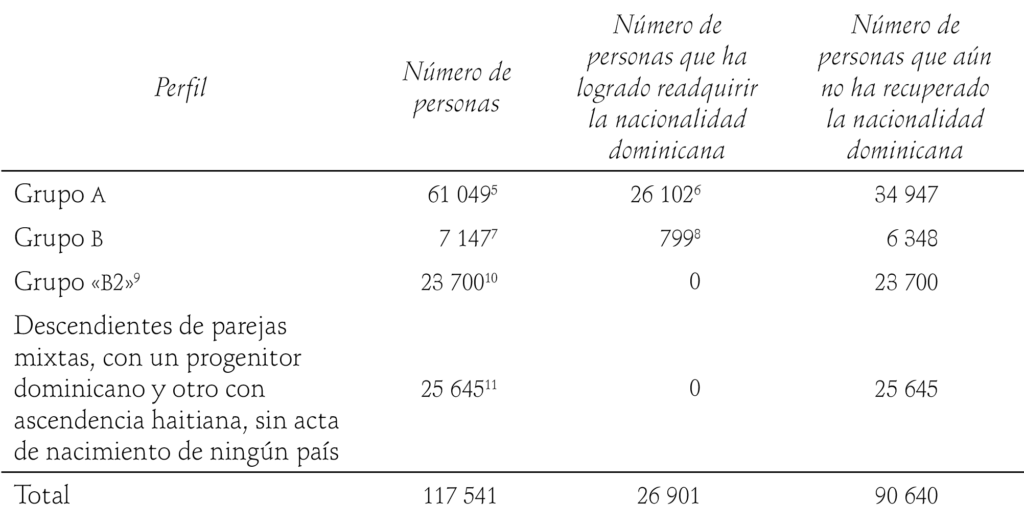
Of Group A, 34,947 people have not yet recovered their Dominican nationality as had been ordered in Law 169–14. In addition, there are people with suspended documents who do not appear on the list produced by the JCE. Of Group B, not a single person registered under the special regime established by Law 169–14 has been naturalized despite the presidential decrees that will be explained below. A large part of this group has remained with foreigner identity cards or regularization cards that have already lost their validity, without the competent institutions having defined the procedures for renewal and eventual naturalization.
During his final days in the presidency, in July 2020, former president Danilo Medina authorized the naturalization of 749 children and adolescents (NNA) by means of Decree 262–20, almost all of them accompanied by UNHCR and associated civil society organizations. As of June 2023, the Decree had still not been implemented and three actions of unconstitutionality had been filed against it, presented by individuals belonging to a small group of nationalists who have objected to any regularization and naturalization action since its inception. Apart from the 749 NNA, at least 1,829 people had filed their naturalization applications before the Ministry of Interior and Police (MIP). On April 30, 2021, the current president, Luis Abinader, signed Decree 297–21, granting Dominican nationality through naturalization to 50 people who applied to the Law 169–14 procedure.
However, Law 169–14 itself and its implementing regulation 250–14 have created a dead end for the population concerned, given that they refer to the ordinary naturalization procedure (established by Law 1683 of 1948, amended by Law 4063 of 1955), which requires a passport from the country of origin, among other requirements that are impossible to meet. It is therefore necessary that the terms under which Decrees 262–20 and 297–21 will be implemented be clarified transparently, and that the Executive Power carry out the naturalization of the rest of the registered Group B.
In addition to groups a and b there are at least two more groups who do not enjoy their right to identity and nationality: group B2 and descendants of mixed couples. UNHCR uses the term «group B2» to refer to the population universe made up of those people who met the requirements established in subparagraph b of the first article of Law 169–14, but who could not or did not wish to avail themselves of the registration procedure during the 180 days it remained open,2 and for whom there currently exists no legal pathway to access Dominican nationality.
Mixed couples is a term coined by Obmica in the publication Gender and the Risk of Statelessness for the Population of Haitian Descent in the Bateyes of the Dominican Republic (Petrozziello et al., 2014, 2017) that identifies the daughters and sons who have at least one Dominican parent and one foreign parent. When the mother is an undocumented foreigner, access to the Dominican civil registry is made difficult even if the father is a national with an identity card (Obmica, 2018).3 Today this case type is widely taken into account by the national and international actors who work on the subject; nevertheless, no efforts are yet observed on the part of the Dominican State to clarify the procedures to facilitate access to their national documentation.
In summary, the population at risk of statelessness in 2021 in the Dominican Republic was made up of several population groups. As can be seen in Table 2, it is estimated that approximately 90,640 people remain in this condition.4
Far from having resolved the statelessness crisis, the timid implementation of Law 169–14 and the indefinite postponement of decisions on pending files threaten to deepen the crisis. Babies keep being born and mothers in a situation of undocumented status or statelessness will not be able to register them, which will cause the intergenerational transmission of statelessness in a matrilineal manner (Petrozziello, 2019). The complementary study of the 2017 National Immigrant Survey (ENI) on descendants of immigrants in the Dominican Republic states:
While Dominican laws are currently clear as to whether or not descendants of immigrants have a right to Dominican nationality, the social reality is different; and the possibility that the number of children born and raised in the Dominican Republic who will never have Dominican documentation because they are descendants of parents in an irregular migratory condition will increase significantly is very real (UNFPA, 2018:43).
https://estudiosdeldesarrollo.mx/migracionydesarrollo/wp-content/uploads/2025/06/cuadro2ajp-300x154.png 300w, https://estudiosdeldesarrollo.mx/migracionydesarrollo/wp-content/uploads/2025/06/cuadro2ajp-768x395.png 768w, https://estudiosdeldesarrollo.mx/migracionydesarrollo/wp-content/uploads/2025/06/cuadro2ajp-1536x789.png 1536w, https://estudiosdeldesarrollo.mx/migracionydesarrollo/wp-content/uploads/2025/06/cuadro2ajp.png 2004w" sizes="(max-width: 643px) 100vw, 643px">
In addition to violating the child's right to a name and a nationality, it also prevents the country from meeting Target 16.9 of the Sustainable Development Goals (SDGs), which promises to «provide legal identity for all, including birth registration».
Not only does the lack of national documentation have a direct impact on the assistance people receive, the lack of documentation also prevents migratory regularization from being accounted for among migrants (Morales, 2020). Seven years after the implementation of the National Plan for the Regularization of Foreigners (PNRE), what is the current migratory status of the people who benefited from the Plan, especially in the case of the Haitian migrant collective? A study carried out by Obmica at the end of 2020 underscored the challenges that persist for the regularization of migrants with an irregular migratory status (Obmica, 2020).
The study in question shows that its implementation has not lived up to its stated objectives of granting regular status to those who enrolled in it. At the same time, it attests to an effort that should be valued, by giving it sustainability and seeking the stability of immigrants in the country through the granting of residency, whether temporary or permanent, and involving in the whole process the actors who have an impact on the migratory system (government institutions, business owners, unions, and civil society organizations, among others).
It should be noted that the competent authorities carried out the PNRE operation simultaneously with Law 169–14 on naturalization aimed at Dominicans denationalized by Ruling 168–13, a fact that could lend itself to confusion for the putative beneficiaries of the different processes. As of September 21, 2020, the resumption of overland deportations of persons suspected of not having a positive migratory status was authorized, putting an end to a moratorium under the pandemic.
A little less than half of the eligible people applied for the Plan (taking as a reference point the National Immigrant Survey, ENI, 2012), although most were approved, with emphasis on the collective of Haitian migrants. Within this collective, the percentage of women enrolled in the Plan corresponds approximately to their percentage (35%) within the Haitian collective, according to the 2012 ENI.
Few people received residency; the most common document was that of temporary workers, so that by the end of 2019 official sources reported approximately 200,000 people who would have to renew their documentation (or change status if applicable) in 2020 (Obmica, 2020a). The lack of clarity regarding the type of document granted and the processes to be carried out for its renewal or change of migratory category stands out, especially in 2019. Many social organizations and their representative networks undertook a process of judicialization for the reconsideration of emblematic cases, but these have not been answered by the MIP. It should be noted that the General Directorate of Migration made an important effort in 2020 to address the issue of document renewal, supported by IOM Dominican Republic, but it was unable to keep up in the challenging context of the pandemic.
Should sustainable solutions that align the Plan with the Migration Law (or its amendment and regulation) not be found, the modest gains in access to social security, promoted within the framework of the Plan's implementation, could vanish. In the worst case, there could be a regression to a situation of generalized irregularity, as was the norm before the Plan was launched. It is pertinent to underscore that many countries are being challenged by similar issues in the context of the pandemic, and there are some good practices of flexibilization from which lessons can be learned in Latin America and the Caribbean and in Europe.
Impacts of covid-19
The structural precarity in which the migrant population and their descendants find themselves left them exposed to multiple impacts of covid-19. The study examined impacts in several areas: 1. disease incidence and access to health services; 2. access to vaccination; 3. economic impact; 4. access to education; 5. social protection programs; 6. voluntary and involuntary returns to Haiti; 7. transnationalism; 8. documentation processes; 9. dialogue and the search for solutions.
By April 2021 the Ministry of Public Health had recorded 261,848 confirmed cases of covid-19 and 3,426 deaths since the first case on March 1, 2020. Haiti reported 12,918 cases and 251 deaths as of April 18, 2021. On a global scale, the Dominican Republic had handled covid-19 relatively well insofar as the number of deaths was lower than in other countries. As of April 19 Worldometer put deaths per million inhabitants at 313. According to these statistics there were fewer deaths in the Dominican Republic than in Italy (1,948), the United Kingdom (1,867), the United States (1,749), Brazil (1,754), France (1,547), Colombia (1,340), Argentina (1,306), Germany (964), Russia (728), and Canada (624), important tourism markets for the Dominican Republic with health systems more robust than the Dominican one.
Nevertheless, towards the end of April 2021, the United States had placed the Dominican Republic at Level 4 and had advised against travel to the country due to the supposedly high level of covid-19 (Travel Advisory, April 21, 2021). It should be added that, within the context of the insular Caribbean, the Dominican Republic was the epicenter of the pandemic, since it had more deaths per capita than other islands of the archipelago, in a situation where the Caribbean constituted the most tourism-dependent region in the world.
In 2021 the Dominican Republic remained under a state of emergency. The country's main urban agglomerations (around Santo Domingo and Santiago) had the highest covid-19 rates, and the border provinces, including the Enriquillo subregion, had a positivity rate below 5%. As of April 19, 2021, cases in the four provinces making up the subregion stood at the following figures: Barahona with 2,727, Bahoruco with 1,401, Independencia with 1,022, and Pedernales with 653. Like Greater Santo Domingo, the Enriquillo region had a resurgence of covid-19, except that the southern border provinces, due to poverty levels, had less access to health services than the capital area.
Among the health measures, those with the greatest impact were sanitary and epidemiological controls, whose compliance was achieved through the implementation of states of emergency; restrictions on mobility and gatherings were decisive in reducing the virus infection rate. Furthermore, the expansion of consultation services through the formation of networks, access to testing (PCR and rapid tests), ensuring the supply of medicines, the enabling of hospitals and clinics, together with targeted interventions by the Ministry of Public Health for case detection in communities, were part of the provision of health services directly related to the pandemic response.
Within the framework of this study, numerous interviewees reported discriminatory attitudes on the part of health service providers, since they had to remain in a second category compared to insured persons who receive priority attention. These accounts coincide with Martínez's research, especially regarding the discrimination felt by migrant women and descendants of migrants in their access to health services (Martínez, 2018).
The surging anti-migrant nationalist rhetoric impeded access to sexual and reproductive health services for women; the cost to the State of providing services to Haitian migrant women was even questioned (in practice, descendants are conflated with undocumented migrants). This led to a policy proposal by the Dominican Society of Obstetrics and Gynecology to charge for services of that kind. In November 2020, President Luis Abinader addressed the issue in his speech on his first 100 days in power, alleging that the Dominican health system could not sustain the cost of helping so many pregnant Haitian women (Listín Diario, 2020), a circumstance in which stateless descendants of Haitian migrants are included.
In recent years, hospitals along the border have been subject to inspection by border and military officials with the aim of seeking out pregnant women who may be «illegally» using services (Obmica, 2018a: 254–255), a situation that culminated in the apprehension and deportation of hundreds of pregnant and recently delivered Haitian migrant women at the end of 2021 (Petrozziello, 2023).
In order to understand the way in which the Haitian migrant population and the stateless population were taken into account in the response to the covid-19 pandemic in the Dominican Republic, three elements must be taken into consideration. First, the structural conditions of the Dominican Republic, since for several decades investment in health has been limited and affected pandemic preparedness. Second, the irregularity of the migratory status of a large part of the migrant population. The ENI-2017 shows that among the foreign population residing in the country, only 27.7% hold a card or sticker from the National Regularization Plan, 8.4% have a General Directorate of Migration card, 3.8% hold a Dominican identity card for foreigners, and 2.3% hold a Dominican identity card (ONE, 2018). This data reveals that irregularity is the predominant status among the foreign population in the Dominican Republic. Finally, social security coverage for immigrants in the Dominican Republic is low. According to ENI-2017 data, 86.9% of the immigrant population had no health insurance, a figure that rises to 95% among those born in Haiti (ONE, 2018).
The situation of the population descended from Haitian nationals is similar: according to ENI-2017, 80.9% have no health insurance. Protection for migrants and stateless persons within the Dominican response to the covid-19 pandemic has been reduced to care within the health system, with the limitations that derive from members of these groups not being covered by health insurers, the tests and referrals carried out within the framework of the Ministry of Public Health's interventions in sectors with high case incidence, and the receipt of food aid or medicines through unofficial humanitarian support.
At the outset, official discourse excluded undocumented persons from the national vaccine campaign (EFE, 2021), which created a hostile environment that fostered reluctance to be vaccinated among a population that already held certain taboos about the vaccination process, as is the case in many populations with low education levels. Faced with exclusion at the national level, some local governments adopted pragmatic measures in order to maximize coverage. For example, in May 2021, a local plan in Tamayo sought to include every adult, regardless of their documentation situation. In other places in the south of the country,12 with certification from local authorities regarding the person's de facto residence and age, all adults were included, regardless of their documentary status, in the spirit of the slogan of the International Organization for Migration (IOM): «Everyone affected by covid-19. Everyone mobilized for recovery. Everyone vaccinated equitably».
Despite local-level inclusion initiatives or «vaccine equity», the official exclusion of the undocumented population from the vaccination plan marked a jarring contrast with the discourses circulating at the start of the pandemic acknowledging: «We are all in this together». It made clear that social borders persist and that there is a risk of exacerbating pre-existing inequalities. Rather than recognizing our mutual humanity and collective interdependence with regard to public health, the opportunity to defeat the virus through mass vaccination turned into yet another exercise in migratory control and social exclusion of the descendant population.
Faced with this panorama, Obmica led a successful campaign for vaccine equity (AJWS, 2021). Together with a coalition of 13 civil society organizations, they managed to meet with officials from seven government agencies in June 2021, including the presidency. Not only did they ally with UNICEF to take advantage of the COVAX Mechanism facility, but they also managed to change the government's official position from exclusion to inclusion, while working to build a climate of trust among the previously excluded population.
Stateless persons and the Haitian migrant population lived in a precarious economic situation before the pandemic. Lockdown and curfew measures affected their ability to earn a living. For many months there was less work available (carpentry, construction, transport services, and paid domestic work, among others). Something similar happened to these people in informal work and street vending (lottery tickets, food), as they could not circulate or earn a living as before because there was less money circulating in the community. Many women in the paid domestic work sector were sent home for several months without compensatory pay, since contracts in that sector are recognized as being mostly oral. Other people kept working and, even with preventive equipment, were exposed to infection at their workplace. Some people reported lower wages in agriculture and in the sale of lottery tickets despite working the same number of hours as before the pandemic.
As a result, numerous families had difficulty covering basic needs. At the end of 2020 the national monthly basic basket cost 36,936.17 Dominican pesos, according to the Central Bank. As Pierre, a 34-year-old Haitian migrant enrolled in the PNRE, expressed when responding about the impact of covid-19: «One struggles to work and buy food. Now everything is expensive and there is almost no work».
Movement restrictions had more severe impacts on the economic rights of stateless persons or migrants in an irregular situation, since their means of earning a living suffered setbacks. Several men interviewed worked in the sugar industry, employed by the Central Sugar Consortium (CAC). The onset of the pandemic in the country overlapped with the so-called «dead time», at the end of the harvest, a period during which workers are obliged to seek another means of sustenance or perhaps return to Haiti if they are «congos» (recently arrived migrants who do not have as much rootedness in the country). All interviews were conducted in October, before the start of the next harvest at the end of 2020. As Alberto, one of the workers interviewed, a Dominican of Haitian descent from group b who registered in the PNRE when Law 169–14 allowed it, explained, «no. That crop has its season. They cut until they reach that time and then they stop. They did not stop because of covid, they stopped because they reached the target they had to reach. Because the rest keep working».
Another worker, Roberto, also a Dominican of Haitian descent from group b who registered in the PNRE when Law 169–14 allowed it, agrees:
Right now I'm not working because it's seasonal. I start on November 28 for the harvest. But they did give us protective equipment: gloves, mask, glasses, and boots (…) It was practically during the harvest that covid was declared and we finished the harvest in May. We finished it well. None of us got sick, we always kept our distance.
The accounts reveal little movement in construction, and the people interviewed relied instead on subsistence farming, as recounted by Jean, a 48-year-old migrant born in Haiti enrolled in the PNRE: «I work in construction, but right now things are a bit tough, you know one is getting on in years and I also suffer from sugar [diabetes], that has kept me from doing it (…) Well, when they lend me the little plot,13 I plant».
The narratives of the interviewees evidence labor immobility due to documentation issues, partly aggravated by the pandemic. Pablo, a 20-year-old Dominican man of Haitian descent from group B, who registered under the operation of Law 169–14 but was not benefited by the July 2020 decree, stated that he was stuck occupationally. He lived off subsistence farming, but aspired to become a «sanatero» with the CAC with a view to being promoted to monitor. He explained that with the PNRE card they were processing his application to work at the consortium as a sanatero. However, it did not allow him to advance, as he recounted that the job of sanatero is
pick up the pieces of cane that are left on the ground when the tractor passes and throw it onto the tractor. But if I had an identity card they were going to make me a monitor (…) The monitor looks after the cutters who are cutting the cane. The cutters have foot protectors because when they are cutting the cane and swing the machete, the machete can slip and cut their foot. So as a monitor, if they don't want to put on the protector, I have to call the boss if they don't want to wear it. And it's the boss who knows what he's going to do with those people.
Sylvie, a Haitian woman, mother of a beneficiary of the July 2020 decree, described the difficulty she had in getting in order with the PNRE:
The problem I have is that they are not changing the card, that's all. For me to get around the way I used to before, before I would buy plantains and sell them in the market, but now one can't buy other people's goods to sell, migration [General Directorate of Migration] runs after you, one can't sell like that, that's a setback for us. Well, if they don't change it like that, I'm going to be left out, because I'm not going to get a passport because I don't have money14 for that.
This feeling of regressing occupationally is reflected in the testimony of Luis, a 40-year-old Dominican of Haitian descent from group A, who technically has had his documents restored, but in practice problems persist. Due to the lack of access to his Dominican documentation, he lamented:
One can't work. Look, I have I don't know how much money saved in the AFP15 and it's all blocked. I have absolutely no right to anything, since one goes out without documents, one can't even go out to Barahona because it's a problem, one can't work. Now I would like to be at the company and how? Last year they threw me out. They did quite a lot for me, quite a lot, because they realized that while I was at the company. My case isn't a recent one, it's been five to six years. In the end they had to let me go.
Under such circumstances he chose to «concha»16 (do motorcycle-taxi work) on his own account, with all the insecurity that this means of earning a living carries in pandemic times. Antoine, on the other hand, a 39-year-old Haitian migrant, voluntarily withdrew from the consortium during the pandemic, understanding that his document was not robust enough to sustain the job in the long term. He obtained his due severance pay.17
Another testimony, from Violeta, a 27-year-old Dominican woman of Haitian descent from group A with her documents restored, recounted the problems of the pandemic regardless of being able to count on her Dominican documents. She was a lottery banker and experienced the problems of the closure of the lotteries during the pandemic, the partial reopening, and the impossibility of continuing with a complementary street-vending job:
At first I went about three months without working. I have had the Verifone for a year and seven months, and I went about three months without working, that affected me a lot because I had to pay the bank, had to pay the rent for the house, buy milk for the girl. After the three months I went without working, they put me back to work, they gave me back the Verifone. They cut my salary in half, that is, I was earning 3,500 pesos, it was almost cut in half, they paid me 2,000 pesos. Because they said it was just one lottery, that the other lotteries were closed, that they were going to pay me 2,000 pesos like that. And I couldn't go sell the sweets because I sold the sweets at the payout point. Then after that illness came up I said: «now I'm not going to be able to go out into the street because I have a small girl. My girl is two years old and my mother is a sick person and I can't go out into the street. I had to resign myself and take the 2,000 pesos from the Verifone, which is a whole day I have to walk, from 10 in the morning until 3 in the afternoon. And that has hit very hard because there are people who used to be able to spend their day out in the fields and they weren't going because they said that if there is a vulnerable person at home, one can't be going out so much like that».
On the other hand, the change of the government in power in the midst of the pandemic also had its impact, when the Modern Revolutionary Party (PRM) took power, taking over from nearly two decades of government by the Dominican Liberation Party (PLD). Clara, a 36-year-old Dominican woman of Haitian descent with her documents restored, explained that her job as janitor/cleaner at a school was in limbo due to the health crisis and the closure of schools. In addition, she understood that because of the change of the party in power she was going to lose her job when the schools possibly reopened again in 2021: «No, sometimes they call me to go clean, but you know that's because of the parties. Sometimes we have to go clean, but after December is over they're going to bring in someone else to work».
Several workers consulted spoke of the inconveniences caused by the lack of transportation; they alluded to the months in which the marketing of their products was problematic, partly due to a closure of the Dominican-Haitian border and interruptions to the biweekly border markets. Maxime, a 36-year-old Haitian migrant enrolled in the PNRE, described the negative impact on this in relation to his plantain business: «A lot, we went about four months there without being able to leave the house, then they give one a chance with a permit paper. We had to go out on the truck to sell on market days, we spent about four months sitting there at home just eating».
Benito, a Dominican of Haitian descent from group b, who did not register under the operation of Law 169–14, echoed the same difficulty, underscoring: «Covid paralyzed everything, there was no transport or work. If one harvested crops, oranges, whatever, there was no way to take it to the city, which is where they are sold. And that left one without work».
According to the interviews, there was limited access to education, depending on the documents people possessed and the discretion of school principals in some cases, in the context that preceded the health crisis. Although the Dominican authorities tried to level out access problems for students in public schools, few people had been able to continue their daughters' and sons' studies, or their own studies, during the pandemic.
Exceptionally, Margarita, a 39-year-old Dominican woman of Haitian descent who had never had problems with her papers, was able to organize herself to continue her daughter's studies. The education graduate recounted: «They sent the class by WhatsApp and, for my girl to be able to finish the school year, I helped her. We did the homework together and sent it back to the teacher».
Most of the interviewees state that the television and radio offerings from the authorities were undercut by difficulties in access to electricity or internet. Some parents consulted did not fully understand the educational offering, partly due to language obstacles for migrants, nor did they feel able to help their daughters and sons due to the limitations of their own education. Without a doubt, the existing inequalities regarding education widened.
Before the pandemic, scholars had begun to examine the issue of the possible exclusion of marginalized populations from innovative social protection programs. In the case at hand, Eve Hayes underscores the possible shortcomings concerning legal identity practices, promoted by the World Bank, the United Nations system, and the Inter-American Development Bank (IDB) (Hayes, 2021). She warns that policies that encourage the mass registration of native populations descended from migrants can also bring up the thorny issue of nationality, which destabilizes the long-standing identities of people with acquired rights to the nationality of the country where they were born.
This tendency toward the exclusion of certain populations from social protection that Hayes portrays in the case of the Dominican Republic was aggravated during the pandemic, as many of the interviewees stated. Both migrants and stateless persons who lack Dominican documentation had been left out of the expanded social protection programs implemented with the intention of mitigating the impact of the pandemic.
Regarding economic measures, these were mainly linked to stimuli to mitigate the loss of income of companies and individuals, especially for the protection of employment. Regarding companies, the list of measures showed a relaxation of the payment of taxes to the State arising from their operations, as well as of other financial responsibilities. As for the measures aimed at individuals, these included programs that ensured part of the income of formal workers through state subsidies (the «FASE I and II» Program) and those aimed at informal workers («Quédate en casa» and «Pa' ti»). Among the measures considered cross-cutting are those related to social and humanitarian protection services, such as the expansion of benefits derived from the «Solidaridad» programs, the delivery of food rations in communities, among others; also the health protocols that safeguarded workers' health in the de-escalation phase of the cessation or reduction of economic activities, and those stimuli for essential sectors such as food production:
With the measures taken in March to confront covid-19, 75% of the PNRE population has lost its income. The remaining 25% corresponds to the food sector across its entire production and distribution chain, as well as domestic service, which has been less affected. Three out of every four PNRE migrants, close to 144,413, have lost their income (…) The PNRE population that has lost income and jobs is not covered by the economic-impact mitigation measures; «Quédate en casa», FASE, and «Pa' ti» are directed at the Dominican population in a condition of poverty and at those who have lost their formal jobs (IOM Head of Mission, Santo Domingo, in País Dominicano Temático, July 2020).
Among the interviewees, their inclusion in the measures aimed at alleviating the effects of covid-19 depended crucially on the type of documentation and legal status they had. Regarding ineligible people, NGOs and international humanitarian organizations helped a portion of the people in marginalized groups, although not comprehensively. It seemed that the government relied on this kind of unofficial, complementary aid for stateless persons or those in migrant status, with the purpose of exempting itself from state responsibilities toward people who reside in its territory but who do not currently hold Dominican documentation.
Nadia, a 25-year-old stateless woman with three stateless children, lamented the exclusion of undocumented people from the government programs to mitigate the economic impact of covid-19. Despite having registered to naturalize as Dominican under the operation of Law 169–14 in 2014 and having received the regularization document, she did not appear on the list of 50 people to whom the president has granted naturalization, among the 7,147 registered descendants of Haitian migrants who were approved in 2014 and 2015. Nadia's status had expired and it was not clear how to renew her status with a view to proceeding to naturalize as Dominican. She felt discriminated against for not receiving official help during the coronavirus crisis:
In this pandemic the government has helped many people. Many people who have their identity card get their monthly food brought down and funds put on their card. And whatever comes in is given to them because they're the ones who have documents. And whoever doesn't have documents gets nothing. My mother-in-law [Dominican] gets funds put on her card. And the neighbors too. When they're going to give out something around there, they say it's for those who have documents, whoever doesn't have documents shouldn't come. And I feel bad. Sometimes I feel sorrow too. Sometimes I say, «look how they're bringing down food for the people who have identity cards, and if I had a card too they would have put funds on it too and I would have provided for my children».
Jean, a 48-year-old migrant man in the PNRE with his residency in the country, has the disappointment of not receiving government assistance:
We who are in the Plan [PNRE] (…) we who have residency, I thought they would help us, but they haven't helped us (…) I thought that at least one day they would say to you: «take a pound of sugar», but no (…) No, because my card is a foreigner's card. They send it directly to your card, there are those who have the «Comer es primero» card, those people are benefiting, but us as foreigners».
By contrast, Margarita, a 39-year-old Dominican woman of Haitian descent who had never had problems with her documents, experienced rather the positive side of government assistance, noting that
the «Quédate en casa» program has helped quite a few people in the community. My mother doesn't have it, but I do. So with mine we buy and share here at my mother's house because my husband is in the capital. The «Pa' ti», that one came through for my mother. They give her five thousand pesos a month. And some other people in the community who don't have «Quédate en casa» got the monthly «Pa' ti», they get their five thousand pesos. And another aid for people over 60 who were in Quisqueya Aprende Contigo18 got a pension of 6 thousand pesos a month.
People benefiting outside of government programs sometimes were not clear as to the source of the outside aid, although several people mentioned Cedeso in collaboration with Oxfam,19 World Vision,20 especially in support of sponsored children, and the Compassion International program, which also worked with the sponsorship of children.21 Other people mentioned one-off aid from some church.
Furthermore, Jean also expressed that the Dominican State did not take much action on the matter with certain groups in society. He explained that the little help that appeared came in the following way: «Sometimes when Father God passes through some institution he may help us to eat, but directly from the authorities here (…) well, only at the school. When they cook, they come, they distribute it to the children, they give the children cooked food».
People who do have their documentation and obtain state benefits in the context of the pandemic viewed this alternative charitable aid positively. As Mateo, a Dominican man of Haitian descent who had never had any problem with his documents, opined,
about a month ago I saw that Cedeso made an aid for people who don't have documents. It's a good initiative because, truthfully, they don't have the same privileges as those of us who have documents, some of us participating in FASE, others in «Quédate en casa». Since they don't have any kind of protection, I think it's a good thing that Cedeso has done with that.
The Dominican government committed at the beginning of 2007 to important reforms of its social assistance programs. An effort to locate and provide documentation to poor people who had been excluded from social services for lacking legal identity documents was key. Strengthening the objectives of the social programs, particularly cash transfers, was another goal. The government identified approximately 400,000 poor individuals who would be eligible for social assistance programs (subsidized health insurance, cash transfers, among others), but who had been excluded by virtue of not having legal identity documents (World Bank, 2017).
The purpose of the Social Protection Investment Project was to improve the coverage, scope, and effectiveness of social protection programs in the Dominican Republic. However, in 2007 an incipient denationalization process was undertaken against many Dominicans of foreign (mostly Haitian) descent, based on JCE resolutions (2007a, 2007b). That is to say, the authorities readied themselves to provide Dominican legal identity to certain people for the first time, while taking advantage of the exercise to exclude other Dominican citizens of Haitian descent who had already acquired their Dominican nationality bona fide and found themselves under the threat of being stripped of their nationality. This process was capped off with Ruling 168–13. These pre-existing inequalities have been aggravated during the pandemic, as has been demonstrated in the present study, highlighting what Hayes had already conceptualized in her research (Hayes, 2021).
This observation coincides with what was observed in other countries during the pandemic, notably in Kenya, Uganda, and India, where the digitization of identity can have effects on the distribution of humanitarian aid through the exclusion of certain populations, including their access to vaccines in response to covid-19 (Privacy International, 2021). In addition, it is consistent with a previous study carried out by Obmica in Santo Domingo (Morales, 2020), which examines the disadvantaged situation of the Haitian and Venezuelan populations when it comes to disaster risk reduction, both of natural origin and of a health-related kind, in the urban context of Santo Domingo Norte.
On the other hand, there are countries that undertook the regularization of migrants in the midst of the pandemic due to the urgency of enabling their access to social protection. In the region, the example of Uruguay stands out, which has integrated a human rights approach into its migratory policy and which recently took advantage of humanitarian aid delivery operations in order to facilitate the regularization of migrants without national documentation. When the Ministry of Social Development was delivering food baskets to people in a situation of vulnerability, the number of migrants who did not have an identity card because they had not started the residency procedure was surprising. Instead of denying them assistance, a joint plan was put together with the Ministry of Foreign Affairs to document everyone.22
Regarding the context of the insular Caribbean, on occasion people who find themselves outside of formal social assistance programs may have chosen not to become visible for fear of probable detention or deportation (or even expulsion «from their own country», in the case of people born in Dominican territory) to Haiti if they did not have documentation certifying their status in national territory. There was a partial moratorium on deportations at the start of the pandemic. Upon taking power, the new government in office officially ordered the resumption of overland deportations as of September 2020.
It should be clarified that the border was not entirely impenetrable during the health crisis. In fact, the guidelines of the World Health Organization (WHO, 2020) vindicated the Dominican Republic and Haiti in maintaining a certain degree of border openness, unlike others in the region with negative consequences for low-income migrants, specifically for people who wanted to return «home». Official figures, reported by IOM Haiti in support of officials on the Haitian border, accounted for more than 200,000 spontaneous returns from March 17, 2020 to November 15, 2020 (IOM Haiti, 2020). In addition, official statistics from the General Directorate of Migration (DGM) reported 23,664 overland deportation events in 2020, presumably the vast majority when deportations resumed at the end of September 2020 (Listín Diario, 2021a). Furthermore, the Dominican Republic's Ministry of Defense reported that 31,116 people (mostly Haitian) were detained at the border in 2020, thanks to the work of the Specialized Land Border Security Corps (Cesfront).23
Despite the significant flow of return migration caused by the pandemic, within the group of migrants interviewed only one migrant, Olivier, 55 years old, not enrolled in the PNRE, had returned to his country for a specific health issue and had to go through limited health protocols at the border: «Thank God I went because I had a stomach illness problem, God sent me and brought me back (…) Yes, there's water, alcohol for washing hands and they have masks, they were giving them out for free [at the border]».
Nevertheless, numerous migrants recounted experiences of arbitrary detentions and deportations of which they had been victims or which they had witnessed, especially before the pandemic, and what they can foresee due to the expiration of their current documentation. Testimonies indicated that there was a certain discretion on the part of the authorities in deporting people with expired documents. Martine, a 26-year-old migrant woman enrolled in the PNRE, shared the following reflection: «They say that if you don't have papers they send you to Haiti and if the papers are expired they also send you. I've seen that they deport those who don't have documents, but I haven't seen them pick up people who have an expired card».
Another Haitian mother interviewed within the framework of a focus group did not seem as calm and recalled what President Abinader had emphasized, noting: «I think it's coming harder because he says that whoever doesn't have documents, they all go to Haiti, no one without documents in this land».
She also recalled the disrespect that can exist for the specific needs of migrant women when she spoke of another difficult moment from the past: «A lady who is Haitian, she had just given birth, she went to the market and left the child, with the newborn at home, and Migration [General Directorate of Migration] came by and took that lady away, that lady was crying, even so they didn't leave that lady alone and they took her away».
In the present study, both officials of the Haitian consulate in Barahona and the social organizations that accompany migrants shared with us testimonies that in October 2021 pregnant Haitian women had been deported, and even migrant women about to give birth in public health facilities felt fear of possible deportation after delivery. This fact was denounced by Dominican civil society (MOSCTHA, 2021; Obmica, 2021), some feminists (Medrano, 2021; Suero, 2021), the United Nations in the Dominican Republic (2021), and the Inter-American Commission on Human Rights (2021), among others.24 It should be noted that these are illegal deportations, since Dominican legislation prohibits the detention (which can lead to deportation) of pregnant women or breastfeeding mothers.
In addition to this, the treatment of documentation by migration officials or other security forces was not uniform. Several people from group B, who registered under the operation of Law 169–14 as if they were foreigners, in order to later naturalize as Dominicans, recounted a lack of respect for the documents issued by the State in that process. Alberto, a 46-year-old Dominican of Haitian descent from group B who registered when Law 169–14 allowed it, not benefited by the recent decrees, shares his experiences in this regard:
Documentation is important for many things: for one to walk around freely. Sometimes one walks around like thieves, walks around as if one were a fugitive, one has to be watching up and down to see if Migration [General Directorate of Migration] is coming and grabs hold of you. Because if they grab hold of you, as in our case, they take us away and we're going to go through a thousand and one hardships because we don't know where we're headed. We were born here and we were raised here. We have never been to Haiti.
Many of the interviewees alluded to a kind of racial profiling that operates at the level of certain security force agents, insofar as they detain people or question them based on a presumed documentary status that they base on the person's skin color. A mother participating in the mothers' focus group stated:
I believe that here anyone who is dark-skinned is discriminated against, there's a lot of racism here because I've gone to the capital a lot because I have my sister there and I have relatives, and I see that sometimes many dark-skinned people pass by who are Haitian nationals, but because of skin color no one stops them, because of skin color they don't say anything to them and they don't know any Spanish and they carry on straight ahead, they go right after the dark-skinned one. «Give me your papers, moreno», simply because of skin color.
In general, the people interviewed and their families had experienced the first months of the pandemic as a truce, in the words of Edwige, a 46-year-old migrant woman in the PNRE: «What has given us a breather has been the coronavirus, that they [the General Directorate of Migration and the auxiliary military institutions] have stopped a bit».
Unfortunately, the deportation moratorium was not extended despite the demands of civil society organizations, as the pandemic persisted with all the aftereffects it had brought (REDH Jacques Viau, 2020). In the last three months of 2020, Cedeso reported that it had been able to intervene, in dialogue with local authorities and international organizations, in 49 events in which migrants or descendants of migrants were facing undue migratory control in the Enriquillo subregion.25
The circulation of people, goods, and money in the border context is a fundamental strategy for earning a living. Due to the crisis, the migrants interviewed sent less money in transfers or nothing at all during the pandemic, although they acknowledged the difficult situation their families in Haiti were going through. The World Bank explained that remittances from the Dominican Republic to Haiti are even more important than remittances sent from the United States, insofar as they reach the poorest quintile of the population in Haiti (World Bank, 2012).
Claire, a 50-year-old migrant woman enrolled in the PNRE, who has lived in the Dominican Republic since 2004, described the economic effects of the health crisis and her inability to help her family in Haiti:
I have three sisters, four brothers in Haiti, they can't [earn a living], but every so often I send them a little money, but this year I haven't been able to, that has caused me a lot of problems. They call me to tell me the situation is tough. They know I'm in another country, I should work to help them. This year is worse, I can't and that hurts me.
This situation contrasted with the remittances sent by Dominican migrants in the United States to their relatives in the Dominican Republic during the pandemic. Despite projections of a decline in remittances on a global scale, some countries had not felt this trend. For example, the Bank of Mexico (2020) reported that July 2020 saw the highest level of remittances ever reported. Something similar happened in the Dominican Republic, which reported receiving up to 0.5% more remittances in the first six months of 2020 than in the same period in 2019 (Pew Research Center, 2020). The foregoing can be explained in part because migrants in the global North were able to have access to government measures to alleviate the effects of covid-19, in contrast to the exclusion of migrants from such measures in the Dominican Republic. On the other hand, the countercyclical nature of remittances has been observed when the migrant population takes into consideration the hardships of their families in the country of origin; even if they initially decrease, they recover and even surpass the remittance flows recorded in 2019 (UNDP, 2020).
In the Dominican Republic, Civil Registry services were suspended during the first period of the state of emergency between March and May 2020; they reopened in June 2020 with new hygiene and prevention protocols. The JCE delegations located in hospitals were also closed (UNHCR and OAS, 2020b:17). The JCE informed the public about plans to resume services through its website and institutional social media, but in contrast to other countries in the region, it did not communicate via WhatsApp, community leaders, or press releases (UNHCR and OAS, 2020b). The closures postponed the registration of births for babies born during the state of emergency, which caused a backlog of files to be processed.
The Dominican government's plan to address the existing backlog involves offering services in decentralized locations and extending operating hours (UNHCR and OAS, 2020: 27). One good practice is the extension of the time allowed to register vital events in a timely manner. Presidential Decree 137–20 modified the time allocations with the intention that any vital event occurring between January 21 and July 3, 2020 could be registered without penalty for delay up to 60 days after July 3, 2020. However, the extension of time limits does not apply in the case of people who have not been able to naturalize and who instead continue to be subject to denationalization.
An example of this is Marcos, a young registered group b man who became a father during the pandemic. He wanted to know if he could use the documents he had acquired when he registered for Law 169–14 (birth certificate, foreigner's identity card, and regularization card, now expired) for the purposes of declaring his son, but «when the pandemic began everything was closed». Although they live in a batey belonging to Independencia, his wife had to travel to Barahona to give birth at the Jaime Sánchez hospital because of the pandemic. Nor were they able to register the birth of their nine-month-old son, because the civil registry office questioned the validity of his wife's identity card. Apparently the Civil Registry system questions the migratory situation of the great-grandmother on the maternal line, demonstrating how denationalization continues in a matrilineal manner (Petrozziello et al., 2014, 2017, 2023).
In a complementary manner, the procedures for renewing regularization documents for migrant fathers and mothers, which could eventually favor the naturalization of their stateless daughters and sons, were affected. The closures, curfews, and other mobility restrictions prevented Haitian migrants and their descendants from recovering civil registry documents for themselves and their children. According to one participant, «after the coronavirus came in, people don't go out, that's why I haven't been able to go to the Junta [Junta Central Electoral] to get it».
The new covid prevention protocols limited the number of people who could congregate, which complicated the process of providing and receiving the service. Haitian migrant parents reported that they had difficulties obtaining passports and renewing their regularization status due to the pandemic-related office closures. This, in turn, negatively affected their ability to meet the documentation requirements required for registering the birth of their children.
The economic impact of the pandemic on Haitian migrant parents and stateless persons who were already living in poverty put civil registration out of reach. Costs linked to local transport had increased at a time when many were unemployed and could not access government assistance programs due to their own documentation problems. One person interviewed stated: «Right now the money problem is worse than the covid-19 problem because if I had money I could go to the office [Oficialía]». Another affirmed the same: «If the office [Oficialía] opened it wouldn't stop me, but it's the money I don't have to run the errands. I would be happy if the children had papers so they could get around, so they'd be free in the country, they're in this country».
In addition, the study revealed that arbitrary investigations and practices of document cancellation and denationalization continued, under the pretext of modernization and securitization of the Civil Registry. Spelling errors, duplications, and cardboard identity cards scattered across the countryside during past electoral eras abound (Riveros, 2014). However, when it comes to racialized and ethnically Haitian people, the errors become insurmountable because the authorities brand them as «fraud» and justify the suspension of documents as if it were a «cleanup of the Civil Registry» (JCE, 2009:25).
Consider the example of Mrs. Angelina, a group A descendant and mother of nine children whom she had not declared. Through the accompaniment of one of the social organizations, she managed to obtain her birth certificate and identity card in a late-declaration process in 2016 and began the procedures for the late declaration of her children, some of whom had reached the age of majority, who attended so that their biometric data could be taken, supposedly to make sure they had not obtained any other document beforehand. This data would become part of a file that would not proceed. By 2019 Mrs. Angelina's identity card had already been cancelled along with the entire process for her children. The reaction of those who accompanied her was one of surprise:
So one says, «but what happened», it's not a certificate from 2000 that was made with the Ruling, but it was after the Ruling. She already complied with the procedure and the test and it turns out they come to cancel her certificate. It all comes to a head the moment she tries to declare her children, and that's what happens; I even told her: «Look, you're going to go through with this, but you have to know that even the children you have, you're going to subject them to that torture within the Junta».
Thus, instead of identifying solutions that safeguard the best interests of the child and protect the human right to identity, in line with what has been recommended by the Committees on the Rights of the Child and Migrant Workers,26 exclusionary practices continue to prevail.
Another development that occurred during the pandemic, at the end of the term of then-president Danilo Medina, was the issuance of Decree 262–20 in July 2020, which authorized the naturalization of 749 registered group b children and youths. Almost all the people benefited by the decree received the accompaniment of several social organizations working on the subject, including Cedeso, our counterpart in this study. However, both the organization and the beneficiary families had no knowledge of when or how they would receive the documentation certifying their status as naturalized persons.
Antoine, for example, is a 39-year-old Haitian migrant, 21 of which he had worked in the agricultural sector in the country, and enrolled in the PNRE. He is the father of six children born in the Dominican Republic, three with birth registration and three without. His wife is also from Haiti and holds a passport and PNRE sticker. The three unregistered children were born between 2010 and 2012, after the entry into force of the new Constitution that restricts jus soli and before the PNRE. Antoine and his wife managed to register the youngest, born in 2017, when the regularized sticker was valid in their passports, and thanks to Cedeso's accompaniment they were able to register the children born in 2004 and 2008 for naturalization through Law 169–14. The latter are the ones listed by name as beneficiaries of Decree 262–20. Regarding his current situation, Antoine commented:
I have the certificate there for when they ask me for it, I don't know if they're going to change it to give the child the real documents of the country [he refers to the foreigner's birth certificate issued by the Dominican authorities]. They told me that they gave it and that one can get the child's papers, but that they won't have the same right as those children whose parents have a Dominican Republic identity card. But they told me it's a birth certificate, it's at home. Now I don't know what will come later for them, but the youngest ones are still not declared, but for those who benefited [from Decree 262–20] I don't know if they're going to give them another paper, if they're going to come with a better one.
The uncertainty about the implementation procedures of Decree 262–20 was evident from within the JCE itself, which received the list of the 749 beneficiaries of the Decree on August 4, 2020, from the then Vice Minister of Migratory Management and Naturalization of the MIP, Mr. Luis Fernández. However, the JCE had not received guidelines about the procedure to follow in these cases, although it was anticipated that they would continue with the practice of transcription to a special registry. Thus, the beneficiaries of the decree who have reached the age of majority would receive a foreigner's identity card valid for one year, to then renew it once and then be transcribed into a special registry with the purpose of later granting them the Dominican identity card. Once again, the cumbersome processes through which the delivery of documentation certifying their Dominican nationality is indefinitely postponed in time are observed.
At the end of April 2021, President Luis Abinader issued another Presidential Decree, 297–21, granting Dominican naturalization to 50 more people who had registered as part of group B under the operation of Law 169–14. At the time of writing this text, the civil society organizations that accompany the population were analyzing which of the people on the decree's list corresponded to the cases they handle and what the next steps would be.
It is worth recalling that Law 169–14 stipulates that people who registered under the so-called group b could opt for naturalization after a period of two years had elapsed (the process should have begun in 2016). However, with almost a decade having now passed, no administrative procedure has been defined to make it effective.
It is necessary to underscore that a continuity is observed in the conflicting positions among government actors on how to proceed. The Vice Minister of Interior and Police for Migratory Management, Juan Manuel Rosario, stated before the press on May 20, 2021, his opposition to the 75027 children of Decree 262–202 being naturalized without their parents also being naturalized. He likewise denounced the work of identifying «group B2» people that several organizations have carried out after the closure of Law 169–14: «We would never in our lives approve of a foreigner being granted a status, however much international pressure there may be, and being granted a migratory status that is not in accordance with the law and the interests of the Dominican Republic».28
At the same press conference, Mr. Rosario considers it a matter of national security and sovereignty and explained that he had ordered a procedural audit of the files deposited in the PNRE, with a view to nullifying the country's great effort to regularize the migrant population and create a pathway for the naturalization of their descendants.
Dialogue and the search for solutions
Among the civil society organizations (CSOs) that accompany the population, there is a perception that the space for policy advocacy and dialogue with the government in office has been reduced. During the pandemic, CSOs were focused on channeling the assistance of international organizations to affected communities, thereby operating in a parastatal manner in order to make up for the shortcomings faced by this socially excluded population. Consequently, they have close knowledge of the needs of that population and are willing to resume dialogue in search of solutions that value collective well-being in pandemic times.
It should be recalled that several dialogue tables between civil society and the government operated on issues of migration and nationality in 2017 and 2018, but the deliberations were inconclusive and were not continued by the State since before the pandemic. The State undertook these important gestures of collaboration with the IACHR and civil society through working tables that contributed to the Dominican Republic being removed from Chapter V (countries that least comply with human rights) of the annual reports that the Commission published between 2017 and 2019. However, Dominican civil society has highlighted that these exchanges have not led to concrete responses to the various problems raised by Ruling 168–13 and the implementation of Law 169–14. In 2020 the work of the tables was not resumed, nor was it in 2021 to date.
Conclusion
Our research demonstrates how the covid-19 pandemic aggravated the existing inequalities for the Haitian migrant population and their stateless descendants in the Dominican Republic. We began with an analysis of the persistence of problems in access to identity documentation and statelessness, and described the impacts of the pandemic with regard to disease incidence and access to health services, access to vaccination, economic impact, access to education, social protection programs, voluntary and involuntary returns to Haiti, transnationalism, as well as the very processes of applying for and renewing documentation.
It should also be highlighted that civil society, together with international organizations, has played a crucial role in meeting the population's needs and in its advocacy for the inclusion of the migrant and descendant population in the vaccination campaign. If the public health system was suffering from major deficiencies before the pandemic, today it is much worse. Regarding reproductive health, this has also been seriously affected, as set out by the Pan American Health Organization (PAHO, 2021). Civil society has had to devote itself fully to the parastatal work of guaranteeing the right to health for a segment of the population that continues to be structurally and systematically excluded, specifically Haitian migrant women (Obmica, 2023).
References
United Nations High Commissioner for Refugees (UNHCR) and Organization of American States (OAS) (2020a). «Estudio regional sobre inscripción tardía de nacimientos, otorgamiento de documentos de nacionalidad y apatridia». Retrieved from https://www.clarciev.com/Estudio-Regional-sobre-inscripcion-tardia-de-nacimientos-otorgamiento-de.html
United Nations High Commissioner for Refugees (UNHCR) and Organization of American States (OAS) (2020b). «Respuesta de Emergencia de las Oficinas de Registro Civil e Identificación durante la Pandemia del covid-19: Impacto, buenas prácticas e iniciativas innovadoras implementadas en América Latina y el Caribe». Retrieved from http://www.oas.org/es/sap/dgpe/puica/docs/Respuesta-emergencia -rc-pandemia-covid-19.pdf
American Jewish World Service (AJWS) (2021). «Winning the fight for vaccine equity in the Dominican Republic». Retrieved from https://ajws.org/blog/winning-the-fight-for-vaccine -equity-in-the-dominican-republic/
World Bank (2012). «Haití, República Dominicana: Más que la suma de las partes. Un estudio sobre las relaciones económicas bilaterales». Santo Domingo Office.
Brito, S., Corbacho, A. and Osorio, R. (2013). El registro de nacimientos: la llave para la inclusión social en América Latina y el Caribe. Washington DC: Inter-American Development Bank.
Economic Commission for Latin America and the Caribbean (ECLAC) (2016). «La matriz de la desigualdad social en América Latina». Retrieved from https://www.cepal.org/sites/default/files/events/files/matriz_de_la_desigualdad.pdf
Inter-American Commission on Human Rights (IACHR) (2015). «Informe sobre la situación de los derechos humanos en la República Dominicana». Retrieved from www.oas.org/es/cidh/informes/pdfs/RepublicaDominicana-2015.pdf
Inter-American Commission on Human Rights (IACHR) (April 1, 2021). «La CIDH llama a los Estados de la región a adoptar políticas migratorias y de gestión de fronteras que incorporen un enfoque de derechos». Retrieved from www.oas.org/es/cidh/jsForm/?File=/es/cidh/prensa/comunicados/2021/082.asp
Inter-American Commission on Human Rights (IACHR) (2021). «CIDH expresa preocupación por las mujeres embarazadas expulsadas en República Dominicana y llama al Estado a garantizar el acceso a mecanismos de protección y servicios de salud reproductiva». Retrieved from https://www.oas.org/es/cidh/jsForm/?File=/es/cidh/prensa/comunicados/2021/320.asp
EFE (March 11, 2021). «Excluidos de las vacunas, los haitianos sufren un nuevo estigma en República Dominicana». Santo Domingo. Retrieved from https://www.efe.com/efe/america/sociedad/excluidos-de-las-vacunas-los-haitianos-sufren-un -nuevo-estigma-en-republica-dominicana/20000013–4485548
Hayes de Kalaf, E. (2019). «Making foreign Legal identity, social policy and the contours of belonging in the contemporary Dominican Republic». In Cruz-Martínez, G. (ed.), Welfare and social protection in contemporary Latin America. New York: Routledge.
Hayes de Kalaf, E. (2021). Legal identity, race and belonging in the Dominican Republic: from citizen to foreigner. London: Anthem Press London.
Institute on Statelessness and Inclusion (2020). «Statelessness in a Global Pandemic: impact report 2020». Retrieved from https://files.institutesi.org/Covid19_Stateless_Impact_Report.pdf
International Organization for Migration (IOM) (2020). Displacement Tracking Matrix (DTM). Retrieved from https://displacement.iom.int/system/tdf/reports/iom_Flow%20Monitoring_covid-19_Bi-Monthly %20SitRep%20No.%2027.pdf?file=1&type=node&id=10399
Junta Central Electoral (JCE) (2009). «Líneas estratégicas Registro Civil identidad ciudadana». Retrieved from https://issuu.com/publicacionesjce/docs/lineasestrategicas registrocivilidentidadciudadana
Junta Central Electoral (JCE) (March 29, 2007a). «Estricto cumplimiento a la Ley No. 659 sobre actos del Estado civil y sus modificaciones al firmar las actas de nacimiento o cualquier documento». Circular No. 017 to the Civil Registry Officers. Retrieved from https://www.acnur.org/fileadmin/Documentos/bdl/2012/8902.pdf
Junta Central Electoral (JCE) (December 10, 2007b). «Resolución que establece el procedimiento para suspender provisionalmente la expedición de actas del Estado civil viciadas o instrumentadas de manera irregular». Retrieved from https://www.acnur.org/fileadmin/Documentos/bdl/2012/8899.pdf
Junta Central Electoral (JCE) (2012). «Avances tecnológicos Registro civil y cedulación». Retrieved from https://issuu.com/publicacionesjce/docs/avances_tecnol__gicos_ registro_civi
Listín Diario (November 25, 2020). «Luis Abinader: ‹La salud dominicana no puede y no soporta la cantidad de (parturientas) haitianas›. Retrieved from https://listindiario.com/la-republica/2020/11/25/645670/luis-abinader-la-salud-dominicana-no-puede-y-no-soporta-la-cantidad -de-parturientas-haitianas
Listín Diario (February 3, 2021a). «Más de 20 mil extranjeros fueron repatriados en 2020». Retrieved from https://listindiario.com/la-republica/2021/02/03/655454/mas -de-20-mil-extranjeros-fueron-repatriados-en-2020
Listín Diario (January 8, 2021b). «Abinader sobre vacunación a migrantes: ‹El compromiso del país es vacunar a dominicanos›». Retrieved from https://listindiario.com/la-republica/2021/01/08/651599/abinader-sobre-vacunacion-a-migrantes-el-
compromiso-del-pais-es-vacunar-dominicanos
Martínez, C. (2018). «Caminando sobre mis pies: discriminación en el acceso a servicios de salud para las mujeres en los bateyes». Estudios Sociales, 41(156). Retrieved from https://estudiossociales.bono.edu.do/index.php/es/article/view/29
Martínez, S. and Wooding, B. (2017). «El antihaitianismo en la República Dominicana: ¿un giro biopolítico?». Migración y Desarrollo, 28(15), pp. 95–123.
Medrano Mercedes, F. (November 14, 2021). «Feminista Sergia Galván abre fuego contra el ministro SP y defiende a las mujeres de Haití». El Orientador. Retrieved from http://www.elorientadorrd.com/2021/11/feminista-sonia-galvan-abre-fuego.html
Morales, M.A. (2020). «Estudio sobre migraciones, vulnerabilidad y reducción de riesgos de desastres con énfasis en colectivos en situación de mayor vulnerabilidad (migración haitiana y migración venezolana con enfoque de género y niñez)». Obmica. Retrieved from OBMICA_Policy_Brief_cerrando_brechas_Octubre_2020-comprimido.pdf
Movimiento Socialista de Trabajadoras y Trabajadores de la República Dominicana (MOSCTHA) (November 18, 2021). «Desmontando los fake news del gobierno contra las mujeres haitianas». Retrieved from https://mst-rd.org/2021/11/18/desmontando-los-fake-news-del-gobierno-contra-las-mujeres-haitianas/
United Nations-Dominican Republic (2021). United Nations System in the Dominican Republic. Press release. Retrieved from https://dominican republic.un.org/es/158598-comunicado-de-prensa
Obmica (2018). Facilitando el acceso al registro civil dominicano a descendientes de parejas mixtas: protocolo para su acompañamiento legal. Santo Domingo: Editora Búho. Retrieved from Protocolo-2018-FINAL.pdf
Obmica (2018a). Estado de las migraciones que atañen a la Republica Dominicana 2017. Santo Domingo. Retrieved from 2017-FINAL-Estado-de-las-migraciones-RD-2017-digital.pdf
Obmica (2020). «Sacando balance: La regularización de migrantes en República Dominicana». Boletín, 10(4). Retrieved from Boletin_Obmica_dic-2020_compressed.pdf
Obmica (2020a). «Gobernanza de las migraciones en República Dominicana». In Estado de las migraciones que atañen a República Dominicana 2019. Retrieved from https://docdro.id/43dm5sg
Obmica (2021). «Uno de los gestos humanitarios más importantes de la última dedada. Acogiendo la población venezolana». Boletín, 11(1). Retrieved from Boletin_Obmica_Marzo_2021.pdf
Obmica (2021). «Deportación de mujeres embarazadas y lactantes consterna a República Dominicana». Retrieved from /index.php/actualidad/372 -deportacion-de-mujeres-embarazadas-y-lactantes-consterna-a-republica-dominicana
Obmica (March 17, 2023). «Obmica lanza proyecto MigraSalud: protegiendo el derecho a la salud desde el ámbito local al nacional en República Dominicana». Retrieved from /index.php/actualidad/429-lanzamiento-proyecto -migrasalud
National Statistics Office (2018). Second National Immigrant Survey in the Dominican Republic (ENI-2017).
World Health Organization (WHO) (2020). Handbook for public health capacity-building at ground crossings and cross-border collaboration.
País Dominicano Temático (2020). «Impacto de la covid-19 en los sistemas sanitarios, económicos y políticos». País Dominicano Temático, 3(9). Retrieved from https://paisdominicanotematico.com/wp-content/uploads/2020/09/Pais-Dominicano-Ed-9-Digital-ok-1.pdf
Pan-American Health Organization (PAHO) (2021). «Covid-19 is inflicting «devastating» impacts on women, PAHO Director asserts». Retrieved from https://www.paho.org/en/news/26–5–2021-covid-19-inflicting-devastating-impacts-women-paho-director-asserts
Petrozziello, A.J. (2023). Birth registration as bordering practice: a feminist analysis of migration governance & the production of statelessness (doctoral thesis). Balsillie School of International Affairs/Wilfrid Laurier University, Waterloo, Ontario, Canada.
Petrozziello, A.J. (2023a). «La problematización de las ‹parturientas haitianas› y otras estrategias de control fronterizo». In Miradas desencadenantes: Voces que desafían, Conferencias Dominicanas de Estudios de Género, Specialized Training Institute/United Nations High Commissioner for Refugees: Santo Domingo.
Petrozziello, A.J. (2019). «(Re)producing statelessness via indirect gender discrimination: descendants of Haitian migrants in the Dominican Republic». International Migration, 47(1), pp. 213–228. DOI: 10.1111/imig.12527.
Petrozziello, A.J. et al. (2014 and 2017). Género y el riesgo de apatridia para la población de ascendencia haitiana en los bateyes de República Dominicana. Santo Domingo: Editora Búho. Retrieved from /index.php/publicaciones/libros/192-genero-y-el-riesgo-de-apatridia-para-la-poblacion-de-ascendencia-haitiana-en-los-bateyes-de-la-republica-dominicana-segunda-edicion
Pew Research Center (August 31, 2020). «Amid covid-19, remittances to some Latin American countries fell sharply in april, then rebounded». Retrieved from https://www.pewresearch.org/fact-tank/2020/08/31/amid-covid-19-remittances-to-some -latin-american-nations-fell-sharply-in-april-then-rebounded/
United Nations Development Programme (UNDP) (2020). Informe sobre desarrollo humano 2020 panorama general. La próxima frontera El desarrollo humano y el Antropoceno. New York. Retrieved from http://hdr.undp.org/sites/default/files/hdr_2020_overview_spanish.pdf
United Nations Development Programme (UNDP) (December 2, 2020). Cuenta conmigo: covid-19 y la Resiliencia de los Flujos de Remesas hacia ALC. Retrieved from https://www.latinamerica.undp.org/content/rblac/es/home/presscenter/director-s-graph-for-thought/stand-by-me–covid-19-and-the-resilience-of-remittance-flows-to-.html
United Nations Development Programme (UNDP)-Dominican Republic (2013). Mapa de desarrollo humano de la República Dominicana. Retrieved from https://dipecholac.net/docs/files/530-pnud-do-mapadhrd.pdf
Privacy International (March 29, 2021). «Exclusion by design: how national id systems make social protection inaccessible to vulnerable populations. Retrieved from https://privacyinternational.org/long-read/4472/exclusion-design-how-national -id-systems-make-social-protection-inaccessible
Prospect (February 18, 2021). «Deportation as usual as Biden struggles to reshape Immigration Policy». Retrieved from https://prospect.org/justice/deportation-as -usual-biden-struggles-to-reshape-immigration-policy/
Red de Encuentro Dominico Haitiano Jacques Viau (REDH-JV) (September 22, 2020). «Urge prorrogar las deportaciones». Retrieved from /proyectos/trato-digno2020/09/
Santana Nina, P.M. (2022). «Informe preliminar: investigación sobre implementación de la Ley No. 169–14». Participación Ciudadana. Retrieved from https://pciudadana.org/wp-content/uploads/2022/10/Informe-Ley-169–14–2.pdf?mc_cid=fdd59cd930 &mc_eid=5fc38751a8
Suero, J. (November 17, 2021). «Lilliam Fondeur dice aumentará mortalidad materna por medidas contra parturientas». Hoy. Retrieved from https://hoy.com.do/lilliam -fondeur-dice-aumentara-mortalidad-materna-por-medidas-contra-parturientas/
United Nations Population Fund (UNFPA) (2018). «Descendientes de Inmigrantes en la República Dominicana». ENI-2017 Complementary Study, Second National Immigrant Survey, written by Rosario Espinal for the United Nations Population Fund, Dominican Republic.
World Health Organization (WHO) (2020). Handbook for public health capacity building at ground crossings and cross-border collaboration. Retrieved from https://www.who.int/publications/i/item/handbook-for-public-health-capacity-building-at-ground -crossings-and-cross-border-collaboration
Wooding, B. (2018). «Haitian immigrants and their descendants born in the Dominican Republic», Oxford Research Encyclopedia of Latin American History. DOI: https://doi.org/10.1093/acrefore/9780199366439.013.474
World Bank (April 17, 2017). «Including the excluded: improving social protection services in the Dominican Republic». Washington. https://www.worldbank.org/en/results/2017/04/10/improving-social-protection-services-dominican-republic
1 Civil society organizations in the Dominican Republic, as well as the National Human Rights Commission, have documented the systematic exclusion of the population of Haitian descent at key moments, such as the replacement of identity card plastic prior to the 2016 electoral contest, a fact that violated the population's political rights.
2 The law established a period of 90 days for registration, but in practice it was extended by 90 more days.
3 To learn more about the issue and the ongoing efforts to resolve it, see the video «Libertad: la historias de las y los hijos de parejas mixtas» (Obmica, 2019), at https://youtu.be/NPy98MEZztU
4 A recent report commissioned by the civil society organization Participación Ciudadana produced a slightly higher estimate of the population remaining in a situation of statelessness in the Dominican Republic: 91,700 (Santana, 2022).
5 JCE list, August 2020. It is important to mention that there are people from group a whose birth records have not yet been audited by the JCE and, therefore, do not yet form part of this official list. It is also possible that some people have passed away.
6 Figure updated by the JCE in August 2020.
7 Information published by the Ministry of Interior and Police (MIP) on the number of people approved. The figure includes 588 flagged persons who managed to complete their files before September 30, 2019.
8 Decree 297–21 granting ordinary Dominican naturalization to several foreigners. Official Gazette 11018 of April 30, 2021, and Decree 262–20 of July 2020.
9 The categorization refers to the group of stateless persons, with the same profile as the so-called group B, who did not register during the 180-day period in which registration was permitted in 2014 and 2015.
10 National Statistics Office, 2017 National Immigrant Survey (ENI-2017). The survey estimated that the population descended from both Haitian national parents, born in the country before the entry into force of the Constitution on January 26, 2010, amounted to 86,769 people, of whom more than 23,700 lack a birth certificate. Between 2015 and 2019 UNHCR carried out a biometric registration exercise of the population that had not availed itself of Law 169–14, thereby managing to identify 11,100 people of this profile.
11 Statistical projections based on the ENI-2017.
12 Information provided by Cedeso, on May 3, 2021.
13 In the Dominican Republic this is a small plot of land dedicated to crops, mostly for self-consumption.
14 Slang in the Dominican Republic meaning money.
15 An AFP, or pension fund administrator, is a financial company whose main objective is to manage the personal accounts of affiliated workers and grant them a pension when they finish their working life, whether due to retirement, disability, old age, or a workplace accident.
16 Slang in the Dominican Republic for the paid work of transporting people by motorcycle.
17 Fear of dismissal for using someone else's documents was mentioned several times in the interviews.
18 For more information see the Quisqueya Aprende Contigo National Literacy Plan, at https://minpre.gob.do/transparencia/proyectos-y-programas/plan-nacional-de-alfabetizacion -quisqueya-aprende-contigo/
19 About Oxfam, see https://www.oxfam.org/es/que-hacemos/donde-trabajamos/paises/republica-dominicana
20 See https://www.worldvision.org.do/
21 See https://www.compassion.es/republica-dominicana.php
22 Personal communication between the author and a Uruguayan government official, October 2020.
23 Ministry of Defense to Obmica, May 21, 2021.
24 See Obmica, «Deportación de migrantes haitianas embarazadas: Dossier de prensa,» updated as of December 1, 2021. At /index.php/actualidad/373-deportacion-de-migrantes -haitianas-embarazadas-dossier-de-prensa
25 Trato Digno Project, see at /proyectos/trato-digno
26 See Joint General Comment No. 4 (2017) of the Committee on the Protection of the Rights of All Migrant Workers and Members of Their Families and No. 23 (2017) of the Committee on the Rights of the Child on State obligations regarding the human rights of children in the context of international migration in countries of origin, transit, destination, and return (CMW/C/GC/4−CRC/C/GC/23), at https://digitallibrary.un.org/record/1323015?ln=en
27 In reality, this refers to 749 people, since one of them appears duplicated on the list.
28 For more information see https://hoy.com.do/mip-audita-regularizacion-extranjeros-por -irregularidades/