
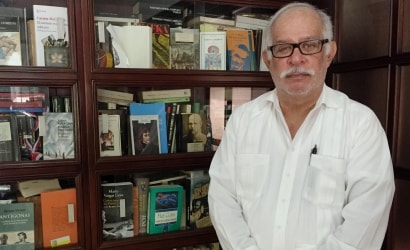
Wilfredo Lozano, Founder of OBMICA: "OBMICA Was Born from the Scarcity of Systematic Reflection on Migration in the Country"
The sociologist and political scientist spoke with us to tell us how the OBMICA project began and what challenges lie ahead for the Observatory, civil society, and the actors converging around migration. What conditions made it possible for the OBMICA initiative to see the light?
What conditions made it possible for the OBMICA initiative to see the light?
The idea of the observatory did not come from Bridget or me: it was an idea of Frank Baez, who envisioned opening an observatory as an annual publication, which is what we know today as State of Migration, OBMICA's flagship publication. After a seminar that Bridget and I organized, which resulted in "The Remains of Insular Development," we saw that it was feasible to shape that idea in an even broader sense than Frank Baez had thought, and that is when we began to work in that direction. Initially, the project had sponsorship on the one hand from FLACSO and on the other from UNIBE, through the Centre for Research and Social Studies, and over time OBMICA created its own institutional profile.
What spaces for reflection on migration predate OBMICA?
This type of initiative does not arise from one person's head alone. In that sense, there are historical issues to take into account. On the one hand, there was recognition that there were few systematic reflections on migration in the country and that an institutional space had to be created to take on the task of strengthening migration studies. Secondly, and what ended up becoming most relevant, research on migration in the country is weak and it was increasingly necessary not only to study migration but also to generate public policies. There was an urgent need to address migration not only from the knowledge perspective that interests academia but also around the need to generate initiatives capable of ordering the migratory phenomenon.
In 2004 the Migration Law was approved, a piece that Frank Baez and I designed in its first part together with Carmen Amelia Cedeno, and from there a new type of debate on migration emerged, where the urgency of launching migration policy initiatives became clear. The efforts of conservative thought in this country to halt the recognition of the rights of descendants of immigrants born here, together with resistance to complying with other parts of the law, generated a series of actions by the State that caused international scandal and concern, giving even more force to the idea of working along this path.
In addition, there was a growing awareness that civil society had to generate reflective and forward-looking initiatives to accompany the advocacy efforts being made by immigrant groups. All this helped OBMICA not only to emerge, but to consolidate itself as an institution.
What progress has there been in the country in this decade, and in OBMICA, in terms of public policies on migration and the right to nationality?
The question can be answered in several ways: from a radical perspective one can say that little progress has been made and therefore almost everything remains pending. A more optimistic perspective says there have been no radical advances that change the course in which the government has managed immigration, but there has been progress. I would say that, as Goethe says, nature tends toward balance. There is a historical resistance on the part of the State to assume the migration issue organically in its agenda, as a central point of its program of development, citizenship, and democratization.
What do you think are OBMICA's main achievements?
I would mention the three most important things OBMICA has achieved in these 10 years. First, through its research, obtaining greater concern for the issue.
Second, the systematization of information through its yearbooks, which has made it a mandatory reference source for the study of migration as a whole, even on the part of official agencies that some years ago rejected OBMICA and which today seek that information every time it comes out.
And finally, OBMICA has placed the issue of gender on the map of the migration debate.
According to you, what contributions of OBMICA in dismantling imaginaries in public opinion can be highlighted?
It is a difficult issue and OBMICA has made a valuable effort with initiatives of dissemination, education, and journalist training, among other things.
However, that is only one component of the problem. OBMICA has to understand that its capacities to confront this are limited. This is a task that requires a broader effort and alliances among democratic actors interested in the migration issue. I think that neither the organizations nor OBMICA have reflected with the flexibility this requires, or with the openness demanded by the need to unify efforts, something that reduces the effectiveness of the work. If there is no unified effort, it becomes difficult for a different voice in communication and public opinion to be present. If the organizations working on the issue came together, the impact would be effective.
What remains pending?
OBMICA must make an effort to connect more and better with the main reference sphere of emigration, namely Spain and the United States.
OBMICA has to connect with international universities working on the issue in order to recover the theme of emigration and its consequences. In addition, it must connect with the Dominican diaspora abroad. OBMICA has to make an effort to generate certain capacities for links within the different Dominican diaspora communities. It seems to me that this is an important component of the migration phenomenon in the world in order to generate policies not toward immigrants, but toward emigrants.