A Look at the Recent Haitian Presence in Mexico
Martha Luz Rojas Wiesner, El Colegio de la Frontera Sur, Mexico. The 2016 milestone. At the end of 2016, the presence of Haitians in Tijuana, Mexicali, and other cities in northern Mexico became visible.
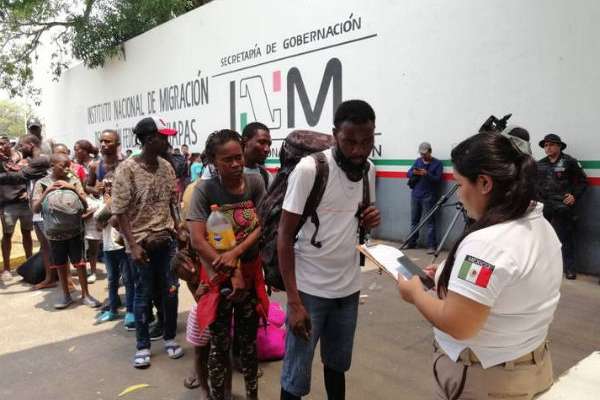
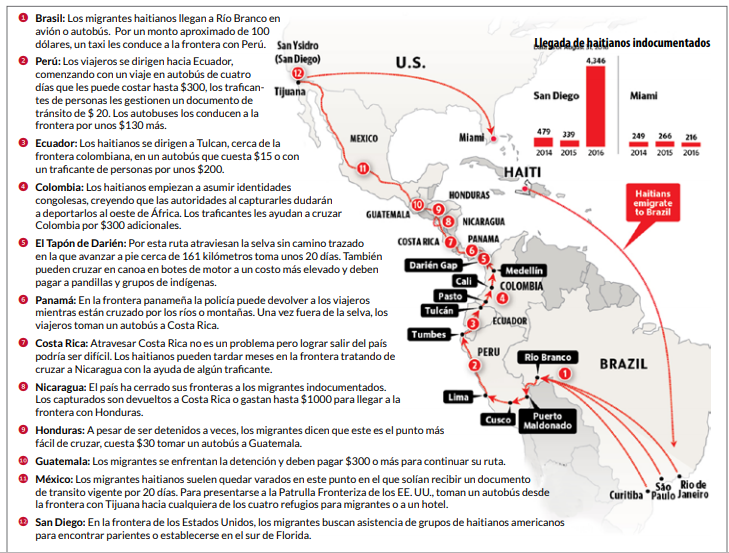
The 2016 milestone. At the end of 2016, the presence of Haitians in Tijuana, Mexicali, and other cities in northern Mexico became visible. During several months of 2016, an unusual and unprecedented arrival of Haitians into Mexico had taken place through its southern border, especially through the city of Tapachula, where most had turned themselves in to migration authorities in order to request an exit permit that would allow them to reach northern Mexico and attempt entry into the United States.
Haitians who arrived in Mexico during 2016 through its southern border, especially from the month of May onward, used one of the migration routes from South America to the United States. Along those corridors travel not only migrants originating in the same region but, more noticeably, people from Asia and Africa, as well as from the Caribbean.
Post-earthquake Haiti 2010. During the 2010s, several South American countries also recorded the arrival of Haitians fleeing, among other causes, the disasters caused by the earthquake in 2010, the cholera epidemic in 2010, and Hurricanes Isaac (2012), Sandy (2012), and Matthew (2016), as well as poverty, social and economic vulnerability, and political instability in Haiti.
According to the Regional Diagnosis on Haitian Migration (2017) in Mercosur countries, the greatest presence of Haitians in 2016 in that region was recorded in Brazil, Chile, and Argentina. As a result of unemployment and the economic crisis in Brazil, part of the Haitian population left by land toward North America, and migrant-smuggling networks operated in that movement. It is therefore probable that this influenced the fact that, together with migrants in transit from the Democratic Republic of the Congo, some Haitians arriving in Tapachula in 2016 turned themselves in to Mexican migration authorities as if they were from that African country.
Precarious regular migration status
The Citizen Council of the National Migration Institute intervened so that the INM would authorize Visitor Cards for Humanitarian Reasons for those who, starting in September, could no longer enter the United States. The CC-INM clarified that some Haitians had felt compelled to mention an origin other than their own, trying to avoid possible prejudice against them, but also that there had been failures in recording origin in the exit permits: Mexican migration officers assigned Congolese origin without asking the relevant question, while other cases were recorded as stateless. These situations had been used as an argument to deny their regularization in Mexico.
The humanitarian cards were issued for one year, after which most of the beneficiaries were left in an irregular migration situation. Subsequently, with the support of civil society organizations, regularization has been achieved, but this is neither a generalized situation nor applicable to Haitians in other cities such as Tapachula. How many are there? It is roughly estimated that there are at least 12,800 Haitians in Mexico, considering that between October and December 2016 there were 8,182 records and between 2017 and July 2019 there were 4,630. Part of this population did manage to obtain authorization to enter the United States. Another part was deported by U.S. migration authorities and a small number by Mexican authorities.
Before 2016, the number of apprehension events involving people from Haiti was very low, 77 events in 2015, placing Haiti in position 21 by nationality nationwide. In 2016 this figure rose considerably to 17,078, ranking fourth. In 2017 it dropped to 1,190 apprehensions, ranking sixth; in 2018 it fell further to 464, ranking fourteenth; but from January to July 2019 there was a rebound, with 2,976 apprehensions, ranking fifth. Despite these rankings, the percentage relative to the total apprehensions before the INM is very low; only in 2016 was the proportion close to 10%. Most of these apprehensions by migration authorities are recorded in Chiapas, the state bordering Guatemala through which the largest proportion of migrants enter Mexican territory.
How do they live and work?
In Mexico, some studies have been conducted on this Haitian population and news has circulated through different media about the conditions they face in both northern and southern Mexico. In Tijuana and Mexicali, for example, attention has been drawn to the time Haitians have spent in Mexico since September 2016 and the challenges this implies, particularly for those who considered their stay there to be temporary.
Waiting time, the need to work to support their families, and other factors have led some people to reconsider their stay and settle in some way in these cities. However, there is uncertainty, because job opportunities are not only limited but working conditions are precarious; there are difficulties in accessing employment due to lack of documents or the type of document that does not authorize paid work. In addition, there are language difficulties, as well as problems accessing decent housing, health care, and education.
In Tapachula, the situation seems even more uncertain, since most people do not have documents and the city offers far fewer job options, in an urban center where stranded people from Guatemala, El Salvador, and Honduras, as well as from the Caribbean, especially Cuba, from Asia and Africa, are also waiting for a decision on their refugee claims or for an exit permit to continue north through Mexico hoping to reach the United States, in a highly restrictive scenario resulting from the redefinition of Mexican migration policy and pressure from the U.S. government to curb migration. A forthcoming installment will go into more depth on the current situation in Tapachula for Haitian and Cuban workers and their families as a consequence of the new hard-line panorama from north to south of the Rio Grande and its domino effect in the region.