
A Panel in Havana Recalls the Events of 1937
May 24, 2017. OBMICA recently took part in the International Colloquium Cultural Diversity in the Caribbean, held in Havana, Cuba, at Casa de las Americas from May 22 to 26, where the theme of memory and border conflicts was addressed from various angles.
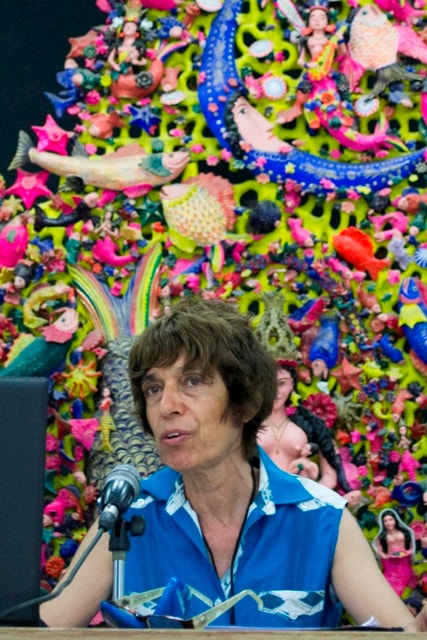
May 24, 2017. OBMICA recently took part in the International Colloquium Cultural Diversity in the Caribbean, held in Havana, Cuba, at Casa de las Americas from May 22 to 26, where the theme of “Memory and Border Conflicts” was addressed from several perspectives. Within this framework, director Bridget Wooding participated in the opening panel, titled “The 1937 Massacre in the Caribbean's Cultural Memory,” where she offered an overview of the current bilateral context, 80 years after the historic incident orchestrated by the government of Dominican dictator Rafael Leonidas Trujillo.
Alongside Wooding, several experts also participated with approaches ranging from the artistic to the legal. In that regard, University of Essex professor Maria Cristina Fumagalli described the 1937 massacre as one of the high points in the Dominican-Haitian border conflict, weaving together artistic and literary references. The expert, author of On the Edge: Writing the Border between Haiti and the Dominican Republic, further stated that the act orchestrated by Trujillo finds a kind of continuation in the stripping of Dominican citizenship from descendants of Haitians by the Dominican state through Constitutional Court ruling 168-13.
For her part, Bridget Wooding stated that the situation remains a matter of concern because neither the National Plan for the Regularization of Migrants in an Irregular Situation (PNRE), launched in 2014, nor Naturalization Law 169-14 has produced the desired effects, respectively for the immigrants concerned and for their descendants born in the Dominican Republic with the right to Dominican nationality under the Constitution in force at the time of their birth. It is a situation marked by a certain dynamism in migration and nationality policies but without clarity regarding their sustainable impact.
The director of OBMICA, who prepared her intervention on the basis of reflections shared with Cuban-American ethnologist Samuel Martinez, clarified that “the logic of Ruling 168 is not ethnic cleansing, nor modern slavery, nor even the mandatory enforcement of migration law,” but rather, she said, the “legalization of the denial of citizenship and rights.”
She added that blocking the access of descendants of Haitians to ladders of socioeconomic advancement, such as education and travel abroad, “will hinder their ability to realize their full human potential and, therefore, will confine them, without guards, locked gates, or fences, to lives of subordination, unjust exploitation, and poverty.”
She concluded by stating that conservative sectors have countered a pro-rights legal strategy with a reactionary “juridicalization” of anti-Haitian exclusionism. She explained that in the current context it is not only the oppressed and the undocumented who are being excluded as “Haitians,” but also applicants and even those who until now had papers as citizens. “It is as if the border their ancestors crossed years ago had folded back in the form of a legal and bureaucratic ghost and, metaphorically speaking, had crossed them once again.”
In addition to OBMICA director Bridget Wooding and Professor Fumagalli, the panel included Frantz Voltaire, director of the International Center for Haitian, Caribbean, and Afro-Canadian Documentation and Information (CIDIHCA); Dominican jurist Edgar Ramirez; Simone Rodrigues of the University of Brasilia; and Camila Valdes Leon, moderator and director of the Caribbean Studies Center at Casa de las Americas.