Blazing a New Trail: Seven Milestones of OBMICA in These 10 Years of Life
OBMICA has worked tirelessly over this decade to strengthen the national debate on migration. This article lists some of our main achievements. Yearbooks.
Yearbooks. For seven years (2011-2017), OBMICA has compiled statistics on migrant flows to and from the Dominican Republic and within the insular Caribbean; it has monitored the evolution of migration policies and practices, and the human rights of migrants and their descendants. State of Migration concerning the Dominican Republic, in its seven editions, is available at obmica.org.
To mark OBMICA's tenth anniversary, we are launching an interactive portal that seeks to make navigation through these data, contained in seven years of printed observatory work, enjoyable and only a click away.
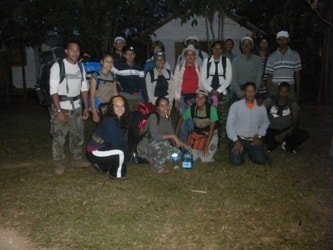
Pioneering research on migration, the environment, and climate change. OBMICA has carried out original research in the Dominican Republic, placing it in dialogue with comparative research in Haiti, in projects funded by the EU and IOM. The photo above is one piece of evidence of that effort.
Original research on gender, migration, and human rights. The studies have focused on violence against Haitian migrant women and girls at the border, the labor and human rights of Haitian migrant women in paid domestic work, the trafficking of Dominican and Haitian women, and gender and the risk of statelessness for descendants born in the Dominican Republic to Haitian migrants.
Policy advocacy through international bodies. OBMICA has contributed to alternative civil society reports to UN human rights bodies such as the UPR, CEDAW, CERD, and the Committee on Economic, Social and Cultural Rights. It was the only Dominican CSO accredited to the process of drafting the Global Compacts on migration, finalized in 2018. We supported the IACHR hearing in the Dominican Republic in 2018, which made visible the new Venezuelan migration across Latin America and the Caribbean and the urgency of a humanitarian and comprehensive response to this so-called "survival migration."
Research-action to facilitate access to the Dominican civil registry for the children of ethnically mixed couples. After realizing that Dominican fathers faced obstacles in registering their children when the mother is foreign or undocumented, OBMICA, together with the Movimiento de Mujeres Dominico-Haitianas (MUDHA), learned from legally accompanying mixed families. A video protocol (2018) is the tool that resulted from the initiative to help scale up the successful field experience.
Monitoring deportations and due process. OBMICA has monitored the forced return migration of Dominican nationals from the United States, initially with a video clip released in 2011 entitled "Give Me the Opportunity." In 2018, together with Rutgers University, OBMICA organized a symposium on deportations in the Americas, including our own original research on land deportations on the island after the close of registrations for the PNRE.
A cultural turn on Haitian migration. Collaborations with photographers, videographers, journalists, and experts in cultural studies have allowed us to contextualize and refocus these issues through exhibitions, the launch of documentaries, concerts, and discussions of artistic and literary production on the Dominican-Haitian border.
Our director's editorial: "It is vital to take a more measured look at regional migrant flows that affect our daily reality"
 The year 2019 marks OBMICA's tenth anniversary, and this bulletin, from March 2019, includes several articles that seek to place the Observatory's work in historical perspective. While our origins lie in concerns about migration dynamics on an island-wide scale, currently it is vital to take a more measured look at regional migrant flows that affect our everyday life. "Illegal, Me?" a stand-up comedy show produced by Miguel de la Cruz and the Venezuelan Lendry Williams in Santo Domingo in March, compares the reception of migrants from Haiti with that of migrants from Venezuela in the Dominican Republic. The old overlaps with the new. According to the second National Survey of Immigrants (ONE 2018), Haitian immigration has maintained a normal growth rate over the last five years, while new Venezuelan immigration multiplied sevenfold over the same period. This latest figure is consistent with what has been reported in many other countries in the region, considering that in recent years 3.4 million Venezuelans have moved from their country to other destinations, mostly within the region.
As is well known, the National Plan for the Regularization of Foreigners (PNRE) arrived too late for this new Venezuelan immigration, since the exponential increase in the last five years reached the country after the cutoff date required by the Plan, October 2011. Other experiences in Latin American and Caribbean countries suggest that it is necessary to be creative regarding official responses to the situation of Venezuelan emigrants. A policy brief by Betts (2019) on the situation of Venezuelans in neighboring Colombia emphasizes that it is important to characterize this exodus appropriately. Indeed, Betts argues that "survival migration" is a term that encompasses situations in which people flee failed or fragile states but are not recognized as refugees. Regardless of the label, it is important to ensure that both host states and displaced Venezuelans receive the full support of global refugee governance, including through UNHCR engagement and the application to displacement of development-based approaches, sharing responsibilities at the international scale as contemplated in the Global Compact on Refugees and the Comprehensive Refugee Response Framework (CRRF). The most appropriate governmental response to this population in the country remains a pending task, bearing in mind that recent data from the International Organization for Migration place 89.75% of Venezuelans living in national territory in an irregular migratory status.