Taking Stock: Four Years after Constitutional Court Ruling 168-13
September 23, 2017. Four years have already passed since the Dominican Constitutional Court issued a ruling that has affected the lives of tens of thousands of people: ruling 168/13 and its effects on a very broad population that Law 169-14 has not fully helped. Since the promulgation of Ruling No.
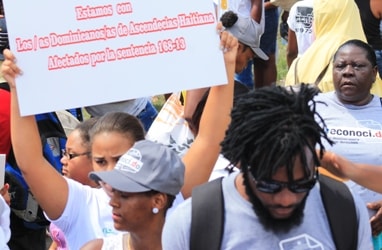
Since the promulgation of Ruling No. 168 by the Constitutional Court (TC) on September 23, 2013, OBMICA has been monitoring the situation of the people affected by it. On this fourth anniversary, affected persons and supporters of their cause were unable to hold a civic gathering on September 23 to commemorate the day of the struggle against statelessness, because the effects of Hurricane Maria were still being felt that day. Paradoxically, four years after the ruling, its effects also remain for a large part of the affected population, despite Law 169 adopted in 2014 to mitigate its impact.
We recall that Law No. 169-14, which “Establishes a Special Regime for Persons Born in the National Territory Irregularly Registered in the Dominican Civil Registry and on Naturalization,” had been promoted by the Executive Branch in an effort to find a way to correct the main effect of the ruling. That effect was the mass stripping of Dominican nationality from people who were entitled to that right at the time of their birth in the country under constitutions prior to that of 2010. Although the consensus solution in the text of Law 169 starts from the premise that the persons subject to the ruling were not entitled to Dominican nationality because of the irregular migration status of their parents, so as not to contradict what the Constitutional Court had established, civil society organizations supported its implementation, though with reservations. They thus recognized that it established a mechanism for accrediting or validating Dominican nationality for stateless persons. The beneficiaries of Law 169 were classified by the law into two groups, giving rise to differentiated treatment:
a) Persons in the so-called group A, who had been registered in the civil registry up to April 18, 2007 and for whom the law provides the delivery of documents accrediting them as Dominican.
b) Persons in group B, who were not recorded in the civil registry, for whom a process was established beginning with their registration in the foreigners' register, followed by their registration in the National Plan for the Regularization of Foreigners, with the option of naturalization after two years had passed since obtaining a migration category through the process.
Below is a summary of the implementation of Law 169-14 over the last twelve months, starting from the fact that the government defends its successful application and maintains its commitment to delivering documents to persons in Group A and Group B. Although the state's position regarding people left without a nationality solution under Law 169-14 remains ambiguous, some perspectives on possible outcomes for them are offered.
Delivery of documentation to persons in Group A
In January 2017, the President of the Central Electoral Board (JCE) told the press that 13,495 people in group A, out of a total of 55,000 included in the official list published at the end of May 2015 of certificates audited and authorized for delivery, had recovered documents under Law 169. This figure suggests that the majority of potential beneficiaries of this law had not obtained their documents. More than three years after the civil registry audit was completed, these results point to the need to resume dialogues between authorities and organizations working with beneficiaries in order to identify and resolve the main challenges posed by the implementation of Law 169-14. It should be remembered that the latter provides for expedited delivery without administrative burden for people in this group.
Documentation situation of persons in group B
When the six-month deadline to avail themselves of the special regime contemplated in Law 169 for persons in group B came to an end in early February 2015, only 8,755 of them had gained access. Among these, not all had been able to submit complete files. Taking into account that, according to data obtained through the National Survey of Immigrants, at least 78,042 descendants of foreign fathers and mothers did not have a Dominican birth certificate, it appears that the persons in group B registered under Law 169-14 represent a significant minority among those affected by the ruling who lacked a Dominican birth registration. One of the main concerns raised by group B persons who managed to seek protection under Law 169 is that only about half of them had been able to obtain their regularization cards. Organizations also report that those who have received their cards in recent months obtain them with an issuance date of 2017, which in practice extends the period for applying for naturalization to four years after the registration process ended. Although the authorities have confirmed the formation of a commission that would be working to define the naturalization process for beneficiaries of Law 169, people currently eligible to opt for such naturalization still do not have a clear route toward it and therefore remain without a nationality and without effective access to other rights.
Other persons affected by Ruling 168-13 without a nationality solution under Law 169-14
In addition to persons in group B who were unable to register in the process provided by Law 169-14 within the prescribed deadlines, organizations have identified other profiles of persons affected by Ruling 168-13 who were also unable to seek protection under the law. Some examples include persons born in the Dominican Republic before the promulgation of the new 2010 constitution in the following situations: a) they appeared in the Dominican civil registry, though as foreigners, and because they had a birth record they could not avail themselves of the naturalization regime provided by the law; b) an ordinary late-declaration process had been initiated for them and they were later entered in the foreigners' register; c) they are descendants of persons in group B who were unable to avail themselves of the special naturalization regime; d) they were born between April 18, 2007 and January 25, 2010 and do not have a legal mechanism for the recognition of Dominican nationality.
Final assessment and future perspectives
Recognizing that a considerable amount of time has passed since the implementation of Law 169-14 began, the relatively low number of persons in group A who have recovered their identity documents, and the fact that no person who qualifies in group B under Law 169 has been able to obtain an effective nationality solution to date, regardless of whether they were registered or not, all show that the law has ultimately not produced the expected effects. There is currently no route leading to access to Dominican nationality for the vast majority of the population affected by the ruling. Therefore, it is increasingly necessary to build a national consensus around other solutions. In 2014, the government achieved an important consensus that showed it is indeed possible to advance in building fair solutions when there is political will and determination. Today we find ourselves in a situation where the failure of the law and the existence of statelessness are denied, yet at the same time the door is not fully closed to the discussion of cases proving otherwise. As the State of Migration 2016 report concludes, “for the affected persons, the generation of this evidence with a view to achieving durable solutions is a light at the end of a tunnel that, in the meantime, leaves them in an uncertain situation and without guarantees that they can fully exercise their fundamental rights.” The real challenge is how willing we are, as a nation, to recover a rule of law that belongs to everyone, and how much longer we can wait.