
Representations of Immigrants in Dominican Newspapers
After the earthquake in Haiti in 2010, the University of Connecticut (UConn) promoted an experience in which communication students from that institution analyzed representations of Haitians in the United States media before participating on the ground in post-earthquake reconstruction.
From their perspective, what they experienced in Port-au-Prince had little to do with the negative stereotypes prevailing in the U.S. press, since what they observed was rather the resilience of Haitians in adverse circumstances.
Years later, the university turned its attention once again to the island, this time to anti-Haitian attitudes prevailing in the Dominican Republic, a nation that shares the Caribbean island of Hispaniola and a common history with Haiti. Broadly speaking, Dominican historiography holds that these attitudes have their roots in the historical experience of the Haitian invasion (1801) and occupation (1822-1844). Other experts locate anti-immigrant attitudes as a source of anti-Haitian sentiments or anti-Black racial attitudes common in Europe and North America at the time of the Haitian Revolution (1791-1804).
Professors from the University of Connecticut carried out a quantitative content analysis of coverage of Haiti in three Dominican newspapers in 2013: Listin Diario, Hoy, and El Caribe. The selected sample measured references to racial stereotypes common in the Atlantic world of the eighteenth century (Black poverty, lack of work ethic, lack of intelligence, inability to self-govern, criminality, and violence).
Among these, common anti-immigrant stereotypes ("taking our jobs" or "taking advantage of social services," among others) are distinguished, as well as specifically anti-Haitian stereotypes ("Haitian domination"), based on the Dominican Republic's historical experience of the Haitian invasion (1801) and occupation (1822-1844). The findings show that anti-Black stereotypes coexist with pro-Haitian and pro-immigrant content, and vice versa. They also reveal that anti-immigrant stereotypes dominate the other categories of stereotypes across the overall coverage in the three newspapers.
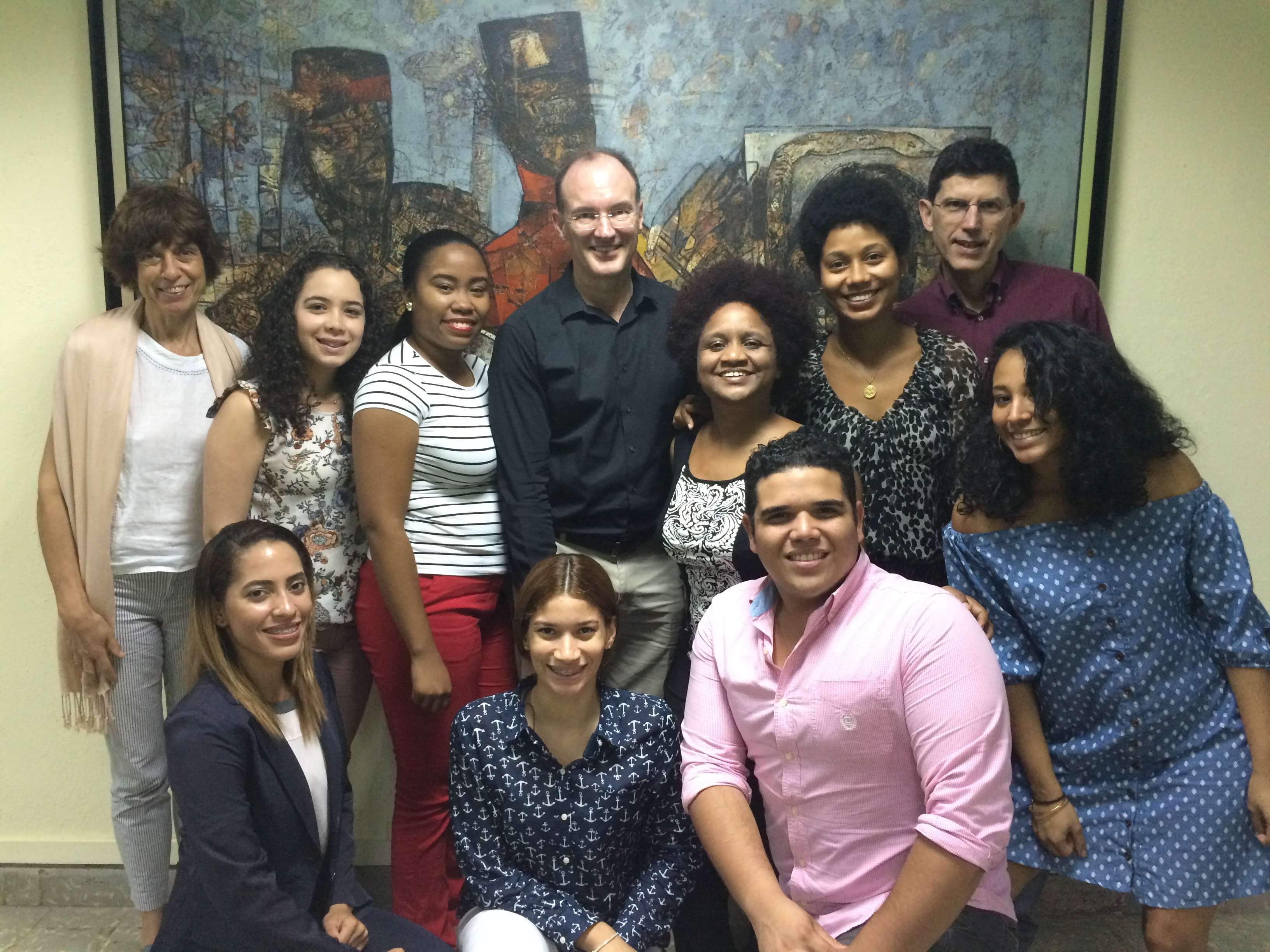
In order to deepen this pilot study, professors Thomas Craemer and Samuel Martinez from UConn sought OBMICA's collaboration to contact relevant departments at local universities in Santo Domingo whose students and/or graduates might be interested in learning the methodology used to carry out another quantitative study, with the same Dominican newspapers but expanding the period covered to 2014 and 2015. OBMICA was fortunate to find great enthusiasm for this initiative. In March, the team from the United States trained seven Dominican young people. Over the course of two months, a coding process is being carried out with the newly trained team. In a later bulletin, we will report on the analysis and findings revealed by this innovative media project.