Registration of Venezuelan Migrants in Trinidad and Tobago
Trinidad and Tobago, located about eight nautical miles east of Venezuela, has been the Caribbean country most affected in numerical terms. With a population of 1.3 million, it hosts around 40,000 Venezuelans, the highest number of these migrants per capita in the region. By Kamilah Morain | OBMICA Associated Researcher.
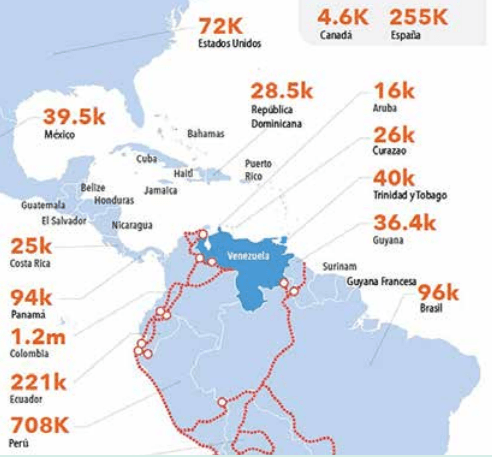
According to the UN, more than four million Venezuelans have fled their country in recent years. A mixture of economic sanctions, runaway inflation, deterioration of health services, oppressive political tactics, and human rights violations has led many Venezuelans to seek better living conditions beyond their borders.
Trinidad and Tobago, located about eight nautical miles east of Venezuela, has been the Caribbean country most affected in numerical terms. With a population of 1.3 million, it hosts around 40,000 Venezuelans, the highest number of these migrants per capita in the region.
Although it is a diverse country formed by migrants, in recent collective memory Trinidad and Tobago has never faced such a large influx of people. Unlike neighboring South American countries, it has no special agreement to host these migrants, and there are no domestic laws or mechanisms to ensure they are offered protection in accordance with obligations assumed under the international conventions to which the country is a signatory.
Following criticism from local and international human rights organizations, in January 2019 the government announced that it would initiate a two-week registration process for all Venezuelan citizens in Trinidad and Tobago who had not regularized their status. The registration would provide Venezuelans with documents for one year, granting them the right to work and reside legally in the country for a 12-month period. The process took place from May 31 to June 14, and by its conclusion 16,523 Venezuelans had registered.
THE PROCESS
On May 31, the Ministry of National Security of Trinidad and Tobago opened three centers, two in Trinidad and one in Tobago, to register and regularize the situation of Venezuelan nationals. Venezuelan citizens were required to complete an online form. Once this form was completed, they received a number and were asked to appear at one of the registration centers within the designated period with the following documents: passport, identity card for each family member present in Trinidad and Tobago, birth certificates, marriage certificates where applicable, proof of address in Trinidad and Tobago, two passport-size photos, and any other document considered necessary to complete the process.
NGOs, multilateral agencies, and civil society organizations were not included in the process, since the effort was conceived, designed, and carried out as a national security concern.
CHALLENGES
It should be noted that Trinidad and Tobago took a significant step in recognizing the rights of Venezuelan migrants. It is the first Caribbean country to grant legal recognition and status to Venezuelan citizens fleeing the terrible economic, social, and political circumstances of their country. That said, there were many shortcomings in the process that NGOs and civil society actors pointed out.
To begin regularizing their status, people had to complete an online form. The online registration form was not easily accessible for many, as not all eligible people had access to Internet services. In addition, the forms were initially not available in Spanish. As a result, people without a reasonable level of English could not understand and fill out the forms as needed.
Translation assistance for the forms was not initially provided at the registration centers, and this led people to pay for translation services and support in completing the forms. This problem was eventually corrected by making the document available in Spanish. In addition, the Ministry of National Security website crashed on several occasions because an unprecedented number of people attempted to access the online registration forms.
Migrants reported that none of the three centers made special arrangements for pregnant women, women or families with small children, or migrants with disabilities. Migrants with special needs were subjected to the same long lines and lengthy waiting periods. According to migrants' testimonies, during the registration process no specific information was shared about the rights that would be conferred by the work permit.
Although migrants expected to be able to access employment, health care, and education services, statements by government officials indicated that while they would be allowed to work and access primary health care services, Venezuelan migrants were not guaranteed access to public education or state social services. Migrants and civil society organizations also felt that the designated time frame for registration was too short and that the workforce assigned to the process was insufficient. Civil society organizations in particular regretted their exclusion from the process.
In light of the above, the concerned parties proposed the following:
- To ensure migrants' equitable access to the documents needed to complete registration, forms should be available online and in printed copies at specific locations before the start of the process. These forms should also be available to eligible persons in their mother tongue, and assistance should be provided at contact points to explain the requirements and how to fill out the forms properly.
- Special arrangements should be made to accommodate persons with disabilities, small children, and pregnant women during similar processes in the future. Information on the rights, duties, and obligations of the relevant parties should also be explained to migrants at the time of registration.
- Civil society organizations and NGOs specialized in this area of work should participate and work alongside the responsible government agencies to provide their expertise and knowledge in designing and implementing the registration process, addressing some of the concerns over extended waiting times and insufficient personnel.
- The presence of civil society organizations and NGOs can help ensure that migrants' rights and dignity are respected, as well as transparency and accountability on the part of state entities in the process.