
The Dominican Republic Includes Migrants: OBMICA and AJWS Promote Work to Integrate Hard-to-Reach Populations into the Fight against COVID-19
OBMICA, with the support of American Jewish World Service (AJWS), coordinates the #RDIncluyeAlMigrante campaign with communication and advocacy actions in favor of integrating migrants and their families into public health measures to contain and control COVID-19 in the Dominican Republic.
OBMICA, with the support of American Jewish World Service (AJWS), coordinates the #RDIncluyeAlMigrante campaign with communication and advocacy actions in favor of integrating migrants and their families into public-health measures to contain and control COVID-19 in the Dominican Republic.
The initiative, joined by around 15 community-based organizations belonging to the Dominican@s por Derecho Platform, the Jacques Viau Network, and the Venezuelan community, seeks to serve as a bridge for creating synergies among government actors, civil society, and international cooperation bodies in order to reach populations that, because of age or economic or documentary situation, could remain outside the National Vaccination Plan.
In the public sphere, "RD Includes the Migrant" seeks to generate conversation on social platforms and in the press about the benefits of a fair and equitable distribution of vaccines. The exclusion of groups or the selective or delayed application of the vaccine endangers collective health because more aggressive variants of the virus, resistant to medical treatments, may arise. It also implies a worsening of discriminatory state narratives that heighten stigmatization toward migrants, with negative effects on social cohesion.
Dialogue with the authorities
It is worth highlighting the window of dialogue with authorities in the health sector. At the design stage of "RD Includes the Migrant," consultations were held with organizations working on the ground accompanying Haitian and Venezuelan migrants and stateless populations. Based on their experience, they put forward suggestions and observations to strengthen the National Vaccination Plan, which were submitted in a report to the Ministry of Public Health and to the office of the Vice President of the Republic, Raquel Pena, who heads the Health Cabinet.
In response to advocacy from different sectors, government authorities gave the green light to proceed with the vaccination of all persons residing in the national territory, regardless of their migration or documentary status, through a public position taken by the Minister of Health, Dr. Daniel Enrique Rivera, widely welcomed by civil society. On June 22, the meeting "Toward Collective Immunization in the Dominican Republic, Good Practices for the Integration of Populations in Vulnerable Situations" took place, a space for reflection and intersectoral coordination between civil society and health authorities to join efforts in reaching hard-to-access groups.
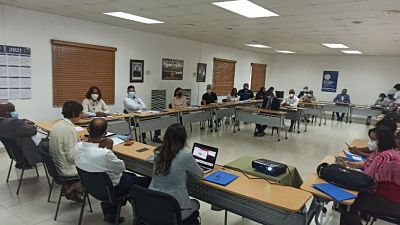
The intersectoral meeting took place at Centro La Salle Hermano Alfredo Morales and included the participation of Dr. Nicole Batlle, Director of the Expanded Program on Immunization (EPI) of the Ministry of Public Health; Manuel Robles, social-policy adviser to the Vice-Presidential Office; Dr. Jazmin Martinez, Focal Point for the Health Component and Migrant Persons of the Ministry of Public Health; Sara Matos Terrero and Diana Mejia representing the Office of the National Council for Older Persons (CONAPE); Dr. Ramona de La Cruz, Head of the Comprehensive Health Division of the National Council for Children (CONANI); Claudia Perez Gomez, Director of Migration of the Ministry of Labor; Ivanna Molina, Directorate of Education, Documentation and Information Center on Gender of the Ministry of Women; and Camilo Caceres Vargas of the Communications Department of the National Institute of Migration (INM).
Looking ahead
In coordination with civil society organizations and the United Nations system, the strategy includes a didactic component, the dissemination of audiovisual materials, and the use of community networks to raise awareness among groups in various vulnerable situations, motivate their active participation in the vaccination process, and overcome the lack of trust produced by misinformation. Currently, at the end of June, work is underway on how to scale the campaign through new strategic articulations promoted by UNICEF at the global level and including the Dominican Republic.