
Launch of Innovative Research on Gender and the Risk of Statelessness in the Dominican Republic
July 24, 2014--What does gender have to do with the risk of statelessness faced by the population of Haitian descent in the Dominican Republic (DR)? How does the lack of citizenship affect women in particular? A new OBMICA study seeks to explore these and other questions.
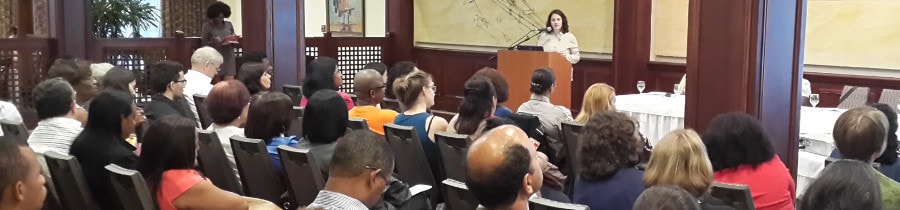
24 July 2014--What does gender have to do with the risk of statelessness faced by the population of Haitian descent in the Dominican Republic (DR)? How does the lack of citizenship affect women in particular? A new OBMICA study seeks to explore these and other questions. It is the book Gender and the Risk of Statelessness for the Population of Haitian Descent in the Bateyes of the Dominican Republic, launched on July 24, 2014 at the Sheraton Hotel, Santo Domingo.
The event was attended by representatives of the Dominican government, civil society, international organizations, embassies, as well as national and international academics.
The book, authored by sociologist and gender and migration specialist Allison J. Petrozziello together with associated researchers Amelia Hintzen and Juan Carlos Gonzalez Diaz, seeks to provide a timely analysis that helps reverse the gender discrimination that harms access to nationality for sons and daughters of Haitian migrants born in the DR.
A case study
"It is harder for the woman because the woman is the one who registers her children, because if it were up to the fathers the children would already be registered." - Maguie, 27 years old, Batey Aleman
The core of the book is based on a case study in the bateyes of San Pedro de Macoris and El Seibo, in which Haitian women and Dominican women of Haitian descent themselves narrate their experiences with documentation.
The findings are presented under three gender dimensions that intervene in the risk of becoming stateless for the affected population:
1) Risk of statelessness generated by the denial or deprivation of the right to nationality. It is argued that the use of gender discrimination in the birth registration process was a deliberate decision to create a tool of social exclusion that would block access to Dominican nationality for the population of Haitian descent.
2) Results or effects of remaining in that status. Although documentation problems negatively affect the life of any person impacted, regardless of sex, there are important differences that derive from gender condition and social position. The effects of lack of documentation/impossibility of exercising citizenship are analyzed in relation to education, health, and work. In addition, the study explains the limitations regarding life options for young women and the denationalization of professional women; the link between economic dependence and risk of violence; and the effects on the lives of elderly women in the bateyes.
3) Resistance strategies employed by the affected persons, both positive and problematic. The high participation of young women in the movement of affected persons is analyzed, noting that the very process of ceasing to be invisible and passive victims, isolated in their communities, and becoming activists empowers those involved.
It is concluded that gender discrimination, both in historical labor migration and in the contemporary birth registration process, increases the risk of statelessness for women of Haitian descent and their descendants. This has generated the phenomena of the matrilineal transmission of statelessness in the Dominican Republic and the deprivation of the Dominican father's right to transmit his nationality to his descendants.
Gender and statelessness offers a series of recommendations for state and non-state actors that are very timely in the current context. Applying a gender perspective reveals the particular needs of women and their families that must be taken into account during the parallel regularization and naturalization processes.
To download the book, enter here.