The Decent Work Project Recognizes Migrant Labor as a Driving Force in the Banana Sector of the Northwest Line
The consortium of organizations coordinating the "Decent Work Crosses Borders" project presented the exploratory situational study on the banana sector in the Northwest Line of the Dominican Republic, carried out by OBMICA between 2019 and 2020.
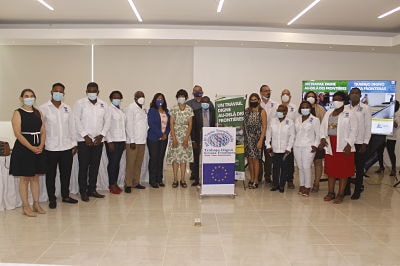
The consortium of organizations coordinating the "Decent Work Crosses Borders" project presented the exploratory situational study on the banana sector in the Northwest Line of the Dominican Republic, carried out by OBMICA between 2019 and 2020. This reference research supports the binational initiative that promotes better working conditions for migrant banana workers within fair-trade actions with Europe.
The findings and recommendations of the research, gathered in a printed publication in French and Spanish, were shared in a dialogue event held at Villas CODEVI, Dajabon, with the participation of government authorities from Haiti and the Dominican Republic, representatives of international bodies, business groups, and workers' associations from the border area.
At the event, the contributions of migrant workers to the banana sector were recognized. Banana production in the Dominican Republic is concentrated in the provinces of Valverde, Montecristi, and Dajabon, the so-called Northwest Line, where important migration flows are generated by this sector and where the workforce is mostly of Haitian origin. The results of the first phase of implementation of Decent Work Crosses Borders were also presented.
"Although there is a favorable difference for migrant workers employed by companies that comply with fair-trade standards, significant gaps persist in fully guaranteeing the protection of their rights and improving their living conditions in the Dominican Republic," said Bridget Wooding, OBMICA's director and coordinator of the study, who was in charge of the presentation.
As part of the head table, remarks were delivered by Dajabon Governor Rosalba Milagros Pena De Rodriguez; Father Robert Dery, National Director of the Jesuit Service for Migrants in Haiti; Marveliz Roa, European Union delegate in charge of the Human Rights Program in Haiti; Ronald Joseph, director of Haiti's National Migration Office; and, by video, Ambassador Gianluca Grippa, Head of the European Union Delegation in the Dominican Republic, who offered special greetings to the project, valuing it as an example of the synergy and exchange that favor productive activity and workers' rights in the border area.
Workers were represented by the testimonial intervention of Isael Alcis from Asociaciones Solidarias de Obreros Migrantes de la Linea Noroeste (ASOMILIN), while Neris Rica, Director of Human Resources, spoke on behalf of the business sector. The Theater Group of the Gender Platform at the border enlivened the gathering with a dance and theater performance.
"Decent Work Crosses Borders" is led by the Jesuit Service for Migrants in Haiti (SJM Haiti), AVSI Foundation, the international humanitarian organization CESAL, the Haitian National Episcopal Commission for Justice and Peace (JILAP), and the Migration Observatory and Social Development in the Caribbean (OBMICA), all with broad experience in research, policy advocacy, and direct support for migrants and workers. It receives financial support from the European Union (EIDHR/2018/155232-3/91) through the European Instrument for Human Rights.
About the study "Decent Work Crosses Borders: Focusing on the banana sector of the Northwest Line, Dominican Republic"
OBMICA's research describes the trajectories of workers from Haiti to banana farms in the Northwest Line, including details of recruitment and permanence from a gender perspective. It analyzes the living conditions of workers and their relatives, observing their sociodemographic profile, access to services, and financial situation related to remittances and indebtedness. It also takes stock of the National Migration Regularization Plan (PNRE) and its impact on improving labor conditions in the sector.
Although there is a favorable difference for migrant workers who labor within the framework of so-called fair trade, significant gaps remain in fully guaranteeing the protection of their labor, economic, social, and cultural rights. To close this gap, the study highlights the need to pay more attention to the regularization of workers and the improvement of their living conditions, and to deepen understanding of circular migration in this sector in order to provide more knowledge about this form of transnationalism in which many workers live.
The findings and recommendations of "Decent Work Crosses Borders" are collected in a printed publication in Spanish and French, also available for online reading and download at the following link: /index.php/publicaciones/informes/350-trabajo-digno-cruza-fronteras-enfocando-el-sector-bananero-de-la-linea-noroeste-republica-dominicana
About the Decent Work Project
"Decent Work Crosses Borders" has among its objectives the promotion of human-rights due diligence practices by companies in the banana sector, with a focus on labor rights. At the same time, the project deepens broad support for workers and their families, in Haiti and in the Dominican Republic, in close collaboration with the competent authorities and key actors in both countries. Adapting to the pandemic, the right to health and a component of integration are emphasized, from the perspective of interculturality and beyond mere tolerant coexistence.
Haiti
SJM Haiti and JILAP have been responsible for work in the sending country, Haiti, to strengthen migrants' knowledge of their labor rights when crossing the border to the receiving country, reinforce the capacities of competent authorities in Haiti, and provide humanitarian aid for migrants in vulnerable situations during border crossings, in association with the authorities.
Dominican Republic
AVSI Foundation and CESAL have been responsible for work in the receiving country with migrant workers themselves and their relatives so that they may better know their rights, foster their organization and integration, and at the same time engage employers according to the types of production carried out on the farms and their connection to so-called fair trade. The project also advocates with Dominican authorities as well as Haitian authorities, especially consular authorities in the Dominican Republic.