
At the OAS, They Call for the Countries of the Americas to Be the First Without Statelessness
June 16, 2016--Government and civil society representatives took a position on the need to seek durable solutions to the problem of statelessness that continues to affect Dominicans of Haitian descent, despite the measures taken by the Dominican government since 2014.
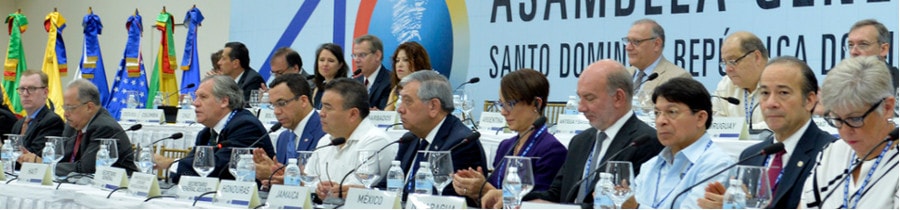
16 June 2016--Government and civil society representatives took a position on the need to seek durable solutions to the problem of statelessness that continues to affect Dominicans of Haitian descent, despite the measures taken by the Dominican government since 2014. These positions were voiced during the Forty-Sixth General Assembly of the Organization of American States (OAS) held in Santo Domingo in June.
U.S. Secretary of State John Kerry addressed the issue before President Danilo Medina on June 14. Kerry stressed the need to resolve the risk of statelessness affecting Dominicans of Haitian descent and called for stronger efforts to fight discrimination based on race, ethnicity, and origin.
For Saint Vincent and the Grenadines Foreign Minister Camilo Gonsalves, the efforts of the Dominican Republic and multilateral bodies to reverse the human rights crisis unleashed by Constitutional Court ruling 168-13 must be assessed. He acknowledged that the ruling generated a condition of statelessness for thousands of citizens born in the country. Likewise, Dominica's Foreign Minister Francini Baron believed attention should be paid to the challenges faced by Dominicans of Haitian descent. "We must protect the rights of all citizens of the Americas."
In this spirit, Uruguay's Mission proposed measures to prevent and reduce statelessness and to protect stateless persons in the Americas through the omnibus resolution on Promotion and Protection of Human Rights (AG/RES. 2887 (XLVI-O/16)) approved in the second plenary session during the General Assembly on June 14. Through it, the OAS resolves to:
- Welcome the Global Action Plan, the Brazil Declaration and Plan of Action, and the global campaign promoted by UNHCR known as #IBELONG, as the global and subregional strategic framework that will make it possible to end statelessness.
- Highlight the importance of the statelessness conventions, and invite Member States that have not yet done so to consider ratifying or acceding to them, as appropriate, and also invite Member States to establish fair and efficient procedures for determining statelessness and to facilitate the naturalization of stateless persons, as appropriate.
- Urge Member States that have not yet done so to eliminate discrimination against women from the legal regime relating to nationality, include appropriate safeguards to prevent cases of statelessness, promote civil registration, and duly resolve existing cases of statelessness, in line with their international obligations related to human rights and statelessness.
Before the Assembly, representatives of the Dominicans for Rights platform collaborated with civil society actors from across the Americas to incorporate their recommendations into the thematic declarations of the Human Rights, Afro-descendants, and Democracy working tables, which were read before the Heads of Delegation during their meeting with civil society on June 13 at the new convention center of the Ministry of Foreign Affairs (MIREX).
On behalf of the Afro-descendants Table, represented by spokesperson Jenny Moron of the Dominican-Haitian Women's Movement, the OAS was urged to "MAKE KNOWN the level of implementation of Resolution AG/RES. 2826 (XLIV-O/14) on Prevention and Reduction of Statelessness and Protection of Stateless Persons in the Americas approved at the 44th Session of the General Assembly in June 2014. This, in pursuit of Sustainable Development Goal 16 on Peace and Justice, whose target 16.9 proposes providing access to legal identity for all, in particular through birth registration".
Within the framework of the event, the Human Rights table called on the country to guarantee, without discrimination, the right to nationality and identity for all persons and compliance with the judgments of the Inter-American Court of Human Rights in this matter. In the same vein, they asked the OAS to move forward in guaranteeing that the Americas become the first continent free of statelessness and xenophobia. One measure proposed in this regard was the evaluation of its economic contributions to strengthening civil registries under conditions of non-discrimination.
Follow-up to the OAS Assembly
Shortly after the OAS Assembly in Santo Domingo, the heads of state of CARICOM met in Georgetown, Guyana in early July, where they issued a statement on the subject under discussion.
Relations with the Dominican Republic
The heads of state reiterated their deep concern regarding the human rights situation of Dominicans of Haitian descent left stateless under Constitutional Court Ruling 168-13. They agreed to pursue political advocacy in international forums and bilateral meetings to relieve the pressing situation of these persons, some of whom have been expelled to a country with which they have no ties.
The heads of state also expressed concern about the humanitarian situation of Haitian migrants deported from the Dominican Republic and other returned Haitians. They further agreed to engage directly, as necessary, with the Dominican Republic on the issue of statelessness and the remedies required.