
Organizations and authorities from Pedernales and Anse-a-Pitres marked International Women's Day with a binational program
For five days there were dance, theater, photography, and painting presentations. Topics affecting both countries on Hispaniola, and women in particular, were also addressed: human rights, gender-based violence, inequality and discrimination, the consequences of climate change, and disaster risk management, among others.
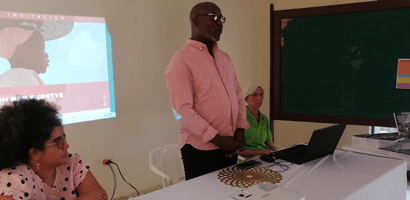
Community organizations from Pedernales and Anse-a-Pitres, institutions from the local and national governments of the Republic of Haiti and the Dominican Republic, and cooperation agencies commemorated International Women's Day with a program of educational, sports, cultural, and artistic activities that began on March 8 and concluded on the 12th. For five days there were dance, theater, photography, and painting presentations. Topics affecting both countries on Hispaniola, and women in particular, were also addressed: human rights, gender-based violence, inequality and discrimination, the consequences of climate change, and disaster risk management, among others.
These activities took place with the participation of the Pedernales City Council and Governor's Office, Civil Defense, the Ministry of Women, and the Ministry of Economy, Planning and Development (MEPyD) in the Dominican Republic. On the Haitian side, participants included the General Directorate for Civil Protection of the Ministry of the Interior and Territorial Communities, the Municipal Administration of Anse-a-Pitres, the Ministry for the Status of Women and Women's Rights, and the Office of the Authorizing Officer of the European Development Funds (BONFED).
The program was made possible thanks to funding from the European Union, which supports the Binational Cooperation Program Convivencia/Annvivansanm and the Trato Digno project; the Spanish Agency for International Development Cooperation (AECID), the United Nations Peacebuilding Fund, and Heifer International.
From civil society and the cooperation agencies, these activities were coordinated by the Cross-Border Dialogue Roundtable, Fundacion Frontera Sur, the German Cooperation Agency (GIZ), CESAL, the International Organization for Migration (IOM), Alianza por la Solidaridad, the Support Group for Refugees and Returnees (GARR), the Observatory for Caribbean Migrants and Social Development (OBMICA), the Technological Catholic University of Barahona (UCATEBA), and Plan International.
Fanm Nan Fwontye Workshop: Women, Markets and Art
This workshop was held at FUNDACIPE's facilities in Pedernales on March 9, with 45 participants, mostly from civil society organizations in Haiti and the Dominican Republic. It was promoted by the Trato Digno project, co-sponsored by OBMICA, CEDESO, and GARR. The purpose of the workshop was to encourage an exchange of good practices related to women traders in border markets and the realization of their rights. The workshop was framed within the broader European Union-funded project "Trato Digno," which seeks to promote, protect, and monitor respect for human rights in matters relating to arbitrary detention and overland deportations of Haitian nationals.
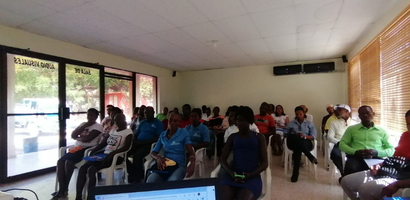 CEDESO Director Beneco Enecia gave an introduction on the importance of the event. Meanwhile, OBMICA Director Bridget Wooding briefly presented the challenges faced by women traders in border-market settings, drawing on OBMICA studies in the border area. She provided an update on the recent recommendations of the CEDAW report (see page 3 of this same bulletin) and highlighted the importance of Pedernales/Anse-a-Pitres because this border pair was chosen to pilot the border resident card, in accordance with an October 2021 resolution of the General Directorate of Migration on the border resident card to be implemented at this crossing.
Michelle Ricardo (Anti Canon) shared the 2021 experiences from the northern and central borders, where women traders were able to learn about their rights within the development of border markets in order to file complaints. She explained the dynamics they used through theater, art, and campaigns. She showed the posters used in Spanish and Kreyol to raise awareness among the women themselves and other key actors about abuses and the channels to use in order to be heard by the competent authorities. The workshop ended with a rich exchange with the audience, facilitated by Clara Morel (OBMICA communications officer), who showed great interest in the issues. In the end, it was suggested that even more local authorities be involved, beyond the Ministry of Women that participated in the workshop.