
Civil Society Organizations Demand a Regional Agreement for Greater Protection of Venezuelan Migrants
May 11, 2018.- Nearly 30 civil society organizations from the Americas asked the Inter-American Commission on Human Rights (IACHR) for greater coordination and technical support to the states of the region to confront the crisis of forced Venezuelan migration.
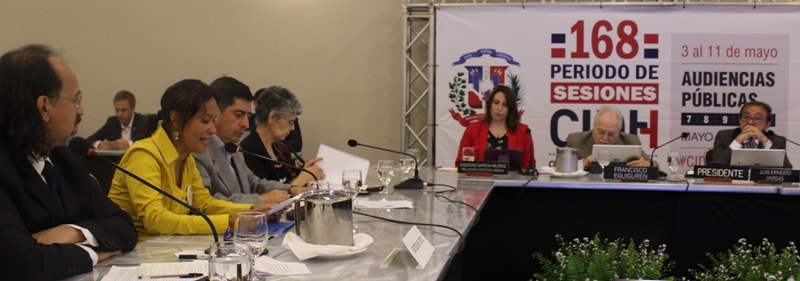
"Venezuelan migrants in Latin America, and the Dominican Republic is no exception, are in a situation of vulnerability," said Ana Maria Rodriguez, a Venezuelan migrant currently living on the Caribbean island. "We do not want to be given anything that we cannot achieve through our own effort. But we do want a concrete action plan, with judicial processes aligned with due process and the law, that do not lead to arbitrary detentions or deportations. We want to make it clear that if we could, we would return to Venezuela, but that is not possible now or in the near future."
Over the past two years, it is estimated that more than 1.2 million Venezuelans have emigrated from their country because of the severe crisis, insecurity, and shortage of medicines. By January 2018, according to the United Nations High Commissioner for Refugees (UNHCR), 133,574 Venezuelan persons had applied for asylum, and 350,861 had sought alternative ways to remain throughout the American continent and Spain. "The political and economic crisis taking place within the country, caused by an absence of the State, drove the great majority of these departures. However, this situation will not have an immediate solution even if a change of government occurs," said Ligia Bolivar, from the Human Rights Center of the Andres Bello Catholic University (UCAB).
"The region is not fully prepared for this migration process, and it is forecast that after the May 20 election there will be another sharp peak in Venezuelan migration," said Francisco Quintana, Director of the Program for the Andean Region, North America and the Caribbean at the Center for Justice and International Law (CEJIL). In this context, the petitioning organizations indicated that the countries of Latin America and the Caribbean, as well as international organizations, need a clear and concrete action plan that guarantees the highest standards of protection in matters concerning the rights of migrants, refugees, and asylum seekers, as well as economic, social, cultural, and environmental rights.
The petitioners also provided further analysis of the context and the risks faced by this migration throughout the continent and the Caribbean, highlighting the situation of women, children, lack of access to documentation and education, the militarization of borders and pushbacks of migrants, trafficking, human smuggling, forced labor and sexual exploitation, slavery, and migrant regularization and visa systems, among other issues.
"The rates of rejection or inadmissibility of refugee claims are far too high. For example, in Colombia, out of 2,073 applications, 57 have been approved; in Ecuador, out of 2,322 applications, six have been admitted. This, which is repeated in all countries, demonstrates the urgent need to provide special, effective, and durable protection," said Guillermo Rovayo of the Scalabrinian Mission of Ecuador.
Given this situation, the IACHR was asked to call for a concrete action plan that deepens the Global Compacts on Migration; directs the use of the IACHR's already existing SACROI (Rapid and Integrated Coordination and Response Room) on Venezuela to: 1) monitor the situation of Venezuelan migrants; 2) collaborate in identifying the scale of the problem; and 3) incorporate a rights-based approach that also makes it possible to provide technical assistance to states; and to work jointly with the United Nations Special Rapporteurship on the rights of migrants and refugees.