
OBMICA and Rutgers Devote Two Days to Discussing Deportations in a Symposium with Scholars of the Issue
September 21, 2018.- OBMICA and Rutgers University successfully held, between September 19 and 20, a symposium on deportations whose primary objective was to offer a broad framework for the rigorous study of these processes of displacement with powerful social, political, and human impacts across the world.
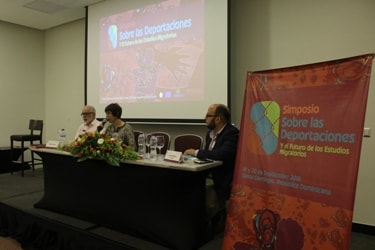
September 21, 2018.- OBMICA and Rutgers University successfully held, between September 19 and 20, a symposium on deportations whose primary objective was to offer a broad framework for the rigorous study of these displacement processes, which have powerful social, political, and human impacts throughout the world.
More than a dozen international experts and scholars of migration issues gathered at this symposium, held at the Crowne Plaza Hotel in Santo Domingo, which made clear the need to carry out studies on deportations as a phenomenon affecting the global mobility of people.
Although some presentations focused on case studies of deportations to the Dominican Republic and Haiti and between these neighboring countries, several interventions pointed to case studies in Central and South America in order to offer reference points for promoting transnational analysis.
Carlos Decena and Bridget Wooding, on behalf of Rutgers and OBMICA respectively, delivered the welcoming remarks on the first day, which was completed by a reflection from Professor Wilfredo Lozano. "To understand deportations, one has to understand the political links between states," said Professor Lozano.
Two keynote lectures and four panels complemented the program, which brought together Dominican and foreign experts who shared notions from their research on the subject, from a human rights perspective to the question of forced migration.
The first keynote lecture took place on the 19th and was given by Danish researcher Ninna Nyberg Sorensen, who spoke about the social changes in migrant populations at the international scale caused by private interests and the changing world political order. On Thursday the 20th, researcher Ulla Berg presented a map of the sensitive zones of deportations worldwide, with special emphasis on the Americas, in an analysis that reviewed the new deportation scheme developed by the Trump administration and its impact on the continent.
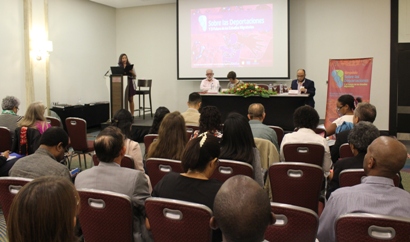
The first of the four panels, which took place on the first day of the program, reviewed the Dominican reality in the area of deportations and Haitian migration. Panelists spoke about the modus operandi of deportations, the concept of structural discrimination in these processes, and the perspectives of the Haitian border population on the reintegration of repatriated persons into their communities.
At the close of the first day, panel 2 of the seminar offered a look at the Central American and Latin American reality in the field of deportations, along with a discussion on new perspectives for returned Dominicans in vulnerable situations, led by Dominican researchers Marianella Belliard and Eddy Tejeda.
Two panels completed the second day of the seminar with a focus on the issue from the perspective of the island, addressing key themes of human rights, Afro-descendant identity, and the political commitment of the Dominican and Haitian states to guarantee due process.
The symposium was an opportunity for academics and activists from several parts of the Americas and Europe to present their research on a subject of international concern. A publication of the key papers presented at this international conference aims to support a new research agenda on deportations in a globalized world.
TO HIGHLIGHT
Highlights from the Symposium:
Forced return of Dominicans from the U.S.
The opening lecture by Dr. Ninna Nyberg Sorensen, principal researcher at the Danish Institute for International Studies, focused on Dominican migration since 1990 and the formation of new migration patterns and routes in the context of laws that criminalize immigrants within the United States. In the process of mapping Dominican migration, there is a multidimensionality that has created a transnational community and identity for many Dominicans outside their homeland. Recently, the deportation process has not only frustrated migration to the United States, but has redirected a new wave of immigrants and deportees toward Spain and other countries in Europe.
Recent phenomena have reshaped new patterns and outcomes in the migration and deportation process. In the past, forced return took place within the context of family networks and did not occur within the application of laws criminalizing immigrants for minor offenses. Even within this new migration policy, border control has pushed migration into more dangerous situations than before. Within U.S. policy, this pattern has manifested itself because many police officers have increasingly become immigration agents in order to criminalize immigrants.
Irregular migration is a precarious means of advancement, where the cycle of migration and deportation perpetuates the poverty it sought to alleviate. Non-citizens convicted of crimes also belong to families, and banishment to their homeland may hinder family ties and connections. The maintenance of family relationships through remittances can be broken overnight with a criminal sentence.
In addition, what often emerges as a central theme is family and community rejection and stigma. Deportees face a very particular kind of mistreatment and are subject to ubiquitous rejection by the state and its institutions. Another common trend is family disruption, by which all relatives remain in the adopted country, leaving deported persons brutally separated from their families.
One of the key factors driving deportation is the private prison industry in the United States and its growing transnationality. This phenomenon, among others, fuels the new wave of deportations. As a result, there is an increase in gang activity in prisons as a means of protection and social support for some immigrants.
The forced return of Haitians from the Dominican Republic
The presentation by the research team Alfred Pierre and Osee Olibri entitled "Opinions of the Border Population on the Reintegration of Haitian Deportees from the Dominican Republic since 2015" generated considerable interest based on the results of this study. Very relevant and necessary data on repatriated Haitian migration were presented, and Dr. Wilfredo Lozano even proposed the possibility of collaboration between Haitian and Dominican researchers. This emerged as a key example of the urgent need to continue developing these spaces for discourse and productive collaboration in order to promote a new social agenda regarding deportations.
The study's findings conclude that most of the participants left Haiti at a very early age and lived in rural areas of the Dominican Republic where they were exposed to mistreatment. After being exposed to social exclusion, they returned to Haiti through repatriation without resources and in worse conditions. Many eventually return to the Dominican Republic to recover resources they cannot obtain in Haiti. Many of the solutions promoted by NGOs are not sustainable over time, and circumstances in Haiti tend to force Haitian migration back toward the Dominican Republic. Surveys in Haiti reveal that people would stay in Haiti if they had access to resources and employment, but in reality many felt excluded in both countries.