OBMICA Reports on a Decade of Observation
Where does OBMICA come from? As a think tank for action, OBMICA understands its work philosophy or model as a cycle in which the research produced returns to the field in order to influence and motivate the work of key actors in the design and implementation of public policies.
It is a model that involves key actors, accompanies civil society, contributes to academic discussion, and in turn can influence public policies. This approach to research and the socialization of its results is a fundamental part of OBMICA's added value within the theme of the various migration issues in the country and the region.
It was founded in 2009, working on the migrations concerning the Dominican Republic from a gender perspective and with a rights-based approach. Initially conceived as a shared initiative between FLACSO-RD and CIES-UNIBE, since 2012 OBMICA has enjoyed its own legal status, registered under the name "Centre for Migration Observation and Social Development in the Caribbean."
Getting its first topic right.
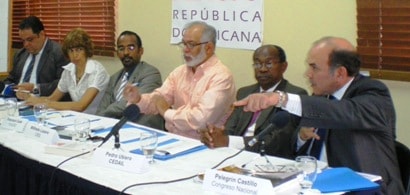
Looking again at the photograph above, one can observe that OBMICA was right with its first panel on the day of its inauguration, in March 2009. From its perspective, the absence of a regularization plan, eventually launched in 2014, was the greatest difficulty preventing orderly, regular, and safe migration. Today, observation continues to serve us well and monitoring persists on the part of the Observatory as we study why Haitian migrant women have been left behind in terms of the type of documentation they obtained, or the lack of documentation, putting them at a disadvantage compared to men, in the final stage of the National Plan for the Regularization of Foreigners (PNRE), which was completed in 2018.
The following years.
OBMICA's birth was marked by the earthquake in Haiti in January 2010, which occurred months after our launch and during which OBMICA's Director "disappeared" in Port-au-Prince, unable to communicate with her colleagues in Santo Domingo.
Since 2013, the country has gone through forceful processes in terms of migration and nationality policy that have placed international attention on the island, and whose outcome remains pending. Naturally, OBMICA has had to respond to these physical and political earthquakes with research-for-action and political advocacy.
New challenges are emerging in the insular Caribbean. The year 2017 exposed the Caribbean to the most intense hurricane season in more than a century, with serious consequences of forced migration in the archipelago. The crisis in Venezuela also has repercussions to which OBMICA directs its attention, in relation to the new immigration, significantly feminized, in Caribbean countries such as Trinidad and Tobago and the Dominican Republic itself.
Sustainability, "Tusen Takk"
Deep thanks to Norwegian Church Aid, with the Ministry of Foreign Affairs as back donor, for trusting OBMICA during 10 years. That sustained support has allowed us to diversify with a range of donors.
These include official aid from the European Union, Spain, Canada, and the United States; agencies of the UN system: UNHCR, UNICEF, UNESCO, IOM, UN Women; the World Bank; American Jewish World Service; universities such as Smith College, UCONN, and Rutgers in the United States, the University of Essex and the Refugee Studies Centre at the University of Oxford in the United Kingdom, and the University of Zacatecas in Mexico, among others. Many thanks to all of you.
Where it all began
Migration is a controversial topic on the island, posing a constant challenge for peaceful and productive bilateral relations between Haiti and the Dominican Republic. Among the challenges for insular development debated by academics and public policy makers at a conference in 2007, migration, especially Haitian immigration to the Dominican Republic, emerged as the most intractable.
In these circumstances, the idea of establishing an observatory was conceived, following a proposal by Fran Baez, dedicated to studying migration dynamics on the island in the context of the insular Caribbean and its diasporas, with the aim of producing timely, evidence-based inputs to improve migration and social policies that respect the rights of migrant persons and their relatives. With the support of Norwegian cooperation, a feasibility study was carried out at the end of 2008, on the basis of which OBMICA was formally launched on March 13, 2009.