
OBMICA Participates in the 1st International Academic Symposium at UASD
The Centre for Migration Observation and Social Development in the Caribbean (OBMICA) participated in the opening ceremony of the 1st International Academic Symposium: "Development, migration processes in the Caribbean, and Dominican-Haitian relations," organized by the Faculty of Legal and Political Sciences of the Autonomous University of Santo Domingo (UASD) on May 8 and 9.
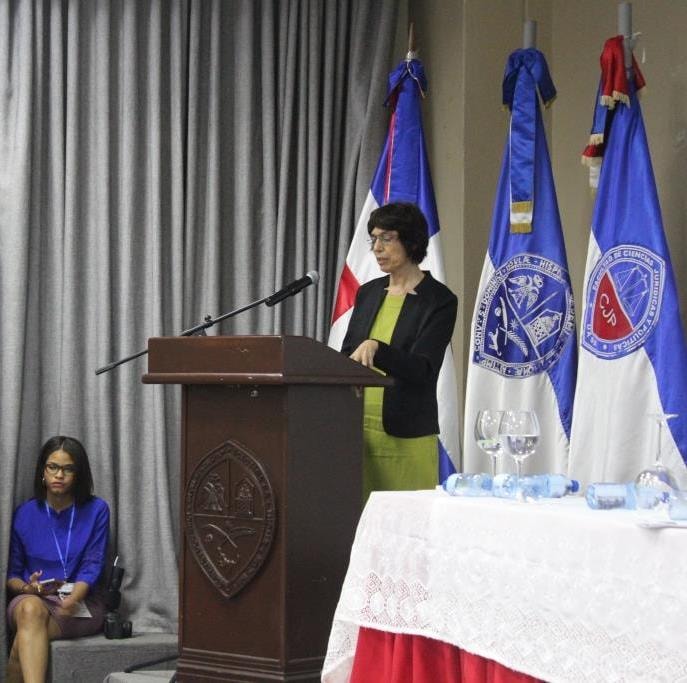
The Centre for Migration Observation and Social Development in the Caribbean (OBMICA) participated in the opening ceremony of the 1st International Academic Symposium: "Development, migration processes in the Caribbean, and Dominican-Haitian relations," organized by the Faculty of Legal and Political Sciences (FCJP) of the Autonomous University of Santo Domingo (UASD) on May 8 and 9.
Bridget Wooding, Director of OBMICA, delivered the keynote lecture that opened the symposium, entitled "Human development and migratory processes in the Caribbean." The symposium was dedicated to our ideologue Franc Baez Evertsz, teacher, sociologist, and pioneer in the study of migratory processes and Dominican-Haitian relations.
Before a large audience, Wooding gave a broad overview of the most important issues concerning development and migratory processes in the Caribbean, based on the seventh edition of the State of Migration concerning the Dominican Republic (EDM17), OBMICA's flagship publication. She began by explaining the importance of observatories in establishing and strengthening regional centers for research, training, and migration observation, as contemplated in Article 17f of the Global Compact for Migration (2018).
"The Caribbean has consolidated itself as a region of origin, transit, destination, and return for thousands of migrants, which entails a geographic diversity that goes hand in hand with a linguistic and cultural variety that adds complexity and presents major challenges for regional migration governance," she noted.
She continued by portraying a region characterized mainly by net emigration, with 8.2 million Caribbean people having left the region. Of these, 53.7% were women (UNDESA 2017). The main destinations were the United States and, to a lesser extent, Canada, Spain, and France. In recent years, however, there has been a significant increase in Caribbean citizens traveling to South American countries such as Brazil, Chile, and Argentina, driven by socioeconomic conditions in their countries of origin as well as natural disasters.
In that sense, she emphasized the importance of having hard data in order to understand migratory dynamics at the island level. She also addressed the effects of climate change and natural disasters on migratory dynamics in the Caribbean islands, pointing to 2017 as a year in which increased mobility was observed in the region, caused by Hurricanes Irma and Maria and storms Nate and Harvey, as well as the increase in deportations of Dominican and Haitian migrants, mainly from the United States, in 2017, according to data compiled in the EDM17 Yearbook.
About the Symposium
According to the Dean of the FCJP, Radhames Bautista Lopez, this International Academic Symposium seeks to strengthen links and relations among states and institutions, reinforcing cooperation and solidarity among peoples, respect for human rights, and the promotion of sustainable, inclusive, and comprehensive development.
On the second day, participants enjoyed five panels on the symposium theme, led by specialists in migration development in the Caribbean and Dominican-Haitian relations.
Representatives of the diplomatic corps accredited in the country, as well as representatives of governmental institutions, the military, and international UN bodies such as IOM, were present at the event, in addition to hundreds of UASD students and professors.