
OBMICA launches its 2023 yearbook
We are pleased to launch OBMICA's latest yearbook through a few brushstrokes from the book's five chapters, edited by Pauline Kulstad.
We are pleased to launch OBMICA's latest yearbook through a few brushstrokes from the book's five chapters, edited by Pauline Kulstad. This migration statistics yearbook is the research product, publication, and tangible result that best explains OBMICA's working model, which centers on "research for action."
We conceive our work as a cycle in which the research produced returns to the field in order to influence and motivate the work of key actors involved in designing, implementing, and monitoring public policies. It is a model that involves multiple actors, supports civil society, contributes to academic discussion, and in turn has the potential to influence evidence-based policymaking.
It is structured as follows:
- Migration trends in the Insular Caribbean
- Dominican emigration: figures and trends
- Immigration flows: figures and trends
- Migration governance in the Dominican Republic
- Human rights situation of migrants and their descendants
Responding to climate change at scale
In 2023, the insular Caribbean remained a focus of attention because of the ravages of climate change, which affect both internal and international migration trends. The intensity and frequency of hurricanes, unprecedented rainfall levels, and other effects make visible the damage associated with the characteristics of small island developing states, or SIDS. It is also noteworthy that the region is putting forward proposals to address inequalities in the global impact of this phenomenon. "Bridgetown 2.0" is the second update of the Bridgetown Initiative, a proposal by Barbados to reform the global financial architecture and improve the way rich countries help poor countries adapt to climate change, championed by Barbados Prime Minister Mia Mottley. It was presented in the context of the climate emergency and played an important role in the discussions and agreements of the Summit for a New Global Financing Pact in Paris in 2023.
TIME 2022: "Developing countries are right to demand that their wealthier neighbors do more, given the wealth they have gained from years of unrestrained fossil fuel burning." Mia Mottley
New trends in Dominican emigration
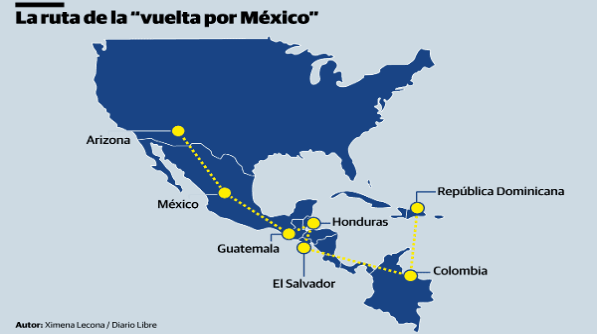
In recent years, Dominican emigration has received more attention than before because, despite major economic growth and political stability in the Dominican Republic, its inhabitants continue to emigrate significantly, nearly tripling the number of immigrants arriving in the country. However, studies such as LAPOP continue to focus on identifying macro-structural causes of this phenomenon, mainly in the political, economic, and citizen security spheres. There are three sub-corridors within the Dominican Republic-United States migration corridor, which remains by far the main destination. The first involves traveling legally to the United States and then remaining longer than allowed by the visa. The second is entirely maritime: traveling by yola to Puerto Rico with a view to continuing northward if possible. The third is the so-called "Mexico route," which involves a constant change of "stops" that can be reached by air, land, or sea, in either regular or irregular ways. This year, that third sub-corridor is analyzed in greater depth.
Page 5. Clues for new immigration policies in the Dominican Republic
The yearbook highlights an official study, a comprehensive proposal that gathers the essential elements of the agricultural labor market and criteria for designing a policy to be agreed upon with the main actors influencing that labor market, including cross-border labor. It underscores the three factors that persist in the immigration sphere and that must be managed by officials in charge of migration policy. It takes up an earlier proposal by researchers Wilfredo Lozano and Franc Baez, who argued that any policy aimed at regulating seasonal immigration flows should be designed to resolve three fundamental questions: a) stop the clandestine flow of undocumented workers, b) reduce the volume of immigration, and c) establish strict control over the return of laborers hired for agricultural work.
At the same time, Venezuelan migration to the country is the subject of an important analysis of women's integration, identifying the main barriers affecting female populations in relation to socioeconomic and labor conditions, regularization, access to livelihoods, financial inclusion, public vocational training, and the impossibility of certifying work skills. Access to labor justice, social protection, and gender-related problems constitute barriers that prevent Venezuelan women from achieving fuller development in Dominican territory. These kinds of studies on crucial issues affecting the two most important migrant collectives, those from Haiti and those from Venezuela, are vital to developing more up-to-date public policies suited to a global context.
Challenges for migration governance from a Dominican perspective
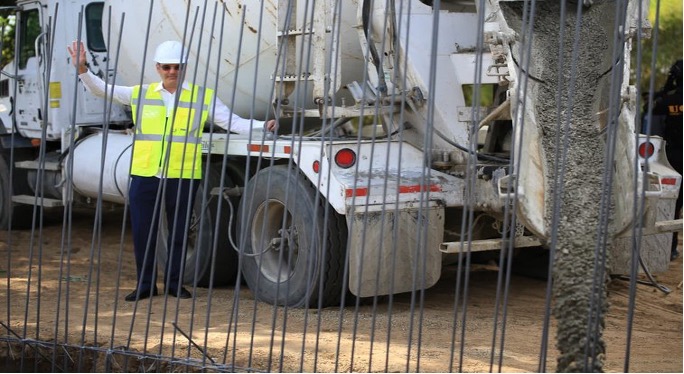
Caption: Construction of the wall between the Dominican Republic and Haiti underscores a securitization policy
For 2023, a weakening of the institutional framework of the Dominican migration system can be observed, set against the deterioration of the political and humanitarian situation in Haiti and the instrumentalization of Haitian immigration for political purposes ahead of the 2024 elections. The National Migration Council did not meet, leaving pending the definition of initiatives that had been under discussion in previous years, such as the National Plan for the Regularization of Foreigners in an Irregular Situation and other proposals for formalizing foreign labor linked to the border development strategy. This weakening is also reflected in the stagnation of the Labor Migration Table, the suspension of the Pilot Border Inhabitant Registration Plan, and the lack of action regarding legal provisions such as the opening of labor coordination offices and the establishment of quotas for labor migration. This scenario also led to the predominance of restrictive migration control practices and policies, including the suspension of visas and residence documentation for Haitians that began in September, alongside record deportation levels.
During 2023, the approach to migration continued to revolve excessively around control of Haitian migration from a national-security perspective, with a weak development and rights approach. The National Security Council, created by presidential decree in 2021 to coordinate the national security and defense strategy, continued in some ways to fill the vacuum created by the inactivity of the National Migration Council, although the latter is the legally mandated principal body for interinstitutional coordination of migration policies.
This weakened the institutional framework of migration governance because it resulted in fragmented communication and action among the multiple institutions with authority over migration management, causing important entities involved in developing multisector responses, such as the Ministry of Labor, the Ministry of Economy, Planning and Development, and the Ministry of Foreign Affairs, to lose weight. Under this securitized migration framework, interdictions and mass repatriations led by the General Directorate of Migration gained prominence, with record volumes presented as achievements against irregular migrant flows even though their effectiveness and impact continued to be criticized by rights organizations.
Acknowledgments: OBMICA congratulates the distinguished group of authors who prepared their respective chapters in the yearbook, namely Liliana Degiorgis, Pauline Kulstad, Rafael Antonio Duran, Natalia Riveros, and Tess Kulstad. The yearbook is available in print at the OBMICA office.