
New Resources Available: Border Transgression and Reconfiguration of Caribbean Spaces
This compilation of academic articles interrogates the border within the specificities of the Caribbean context, its socio-political dynamics, and its literary and artistic representations.
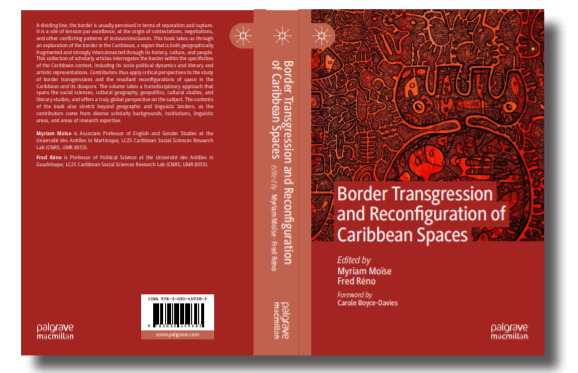
This book:
• Addresses themes of borders, boundaries, and migration from intra-Caribbean and external perspectives
• Offers interdisciplinary views that cross the humanities and social sciences
• Provides new knowledge on how transculturalism can be mediated and how it operates.
A dividing line is normally perceived in the border in terms of separation and rupture. It is a place of tension par excellence, where contestation, negotiation, and other conflictual models of inclusion and exclusion originate. The book takes us into an exploration of the border in the Caribbean region, both fragmented and firmly tied together through its history, culture, and populations. This compilation of academic articles interrogates the border within the specificities of the Caribbean context, its socio-political dynamics, and its literary and artistic representations. Border transgression and its consequent phenomena of reconfiguration are applied to the Caribbean and its diasporas through a transdisciplinary approach.
The book combines a multiplicity of fields of inquiry, including social sciences, cultural geography, geopolitics, cultural and literary studies, thereby offering a global perspective on the subject and transcending disciplinary categories. The text is illustrated by the image above, a beautiful work of art by the Martinican artist Ricardo Ozier Lafontaine. The editors are Myriam Moise and Fred Reno, from the University of the Antilles, Martinique, and the University of the Antilles, Guadeloupe, respectively.
THE DOMINICAN-HAITIAN BORDER
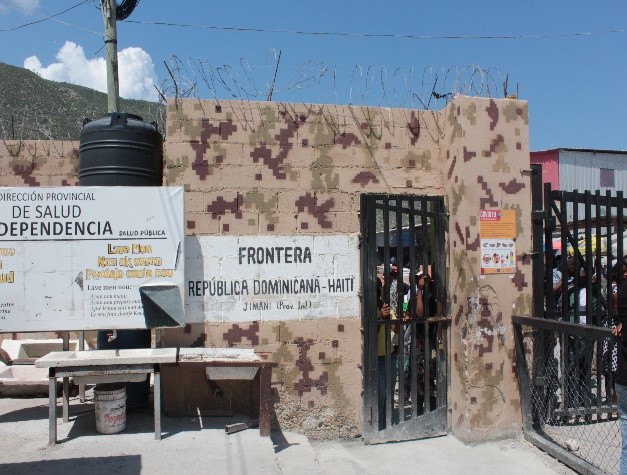 As the most important migration corridor within the insular Caribbean, the work devotes several chapters in its second section to issues related to the Dominican-Haitian border, which has seen a century of Haitian labor migration toward the neighboring country. Within this framework, OBMICA Director Bridget Wooding contributes an article to the collection entitled: “The Seeds of Cholera: Contemporary Issues of Forced Migration at the Dominican-Haitian Border.”
In 1949, the Haitian writer, journalist, and politician Anthony Lespes published a novel entitled “The Seeds of Cholera,” focusing on an agricultural resettlement on the Haitian-Dominican border devised by Haitian authorities in a failed effort to help some of the people who had fled the massacre of Haitians and Dominican-Haitians unleashed by dictator Rafael Leonidas Trujillo in 1937, above all on the northern border. Since then, border crossing has been instrumentalized during moments of political instability on the island of Hispaniola, when episodes of forced migration have fractured positive developments toward cooperation and a productive contact zone across the island.
This chapter considers how the border has been reconfigured at the beginning of a new century, with emerging challenges for Dominican-Haitian relations in light of migration policies evolving in the eastern part of the island under Dominican authorities. By examining a growing deportation regime, civil society transgression, and the role of the international community, the chapter places these issues in dialogue with the sovereignty the Dominican state underscores in this relationship.
More information about the book, in English, at the following link: https://www.palgrave.com/gp/book/9783030459383