
New Resources Available
Questioning the dominant narrative on migration and development. Raul Delgado Wise, Branka Likic-Brboric, Ronaldo Munck, and Carl-Ulrik Schierup are the co-editors of a new publication recently launched under the title Handbook on Migration and Development: A Counter-hegemonic Perspective, Elgar 2024.
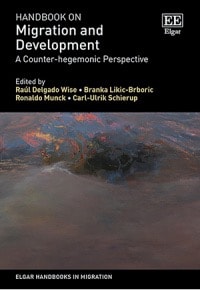
Raul Delgado Wise, Branka Likic-Brboric, Ronaldo Munck, and Carl-Ulrik Schierup are the co-editors of a new publication recently launched under the title Handbook on Migration and Development. A Counter-hegemonic Perspective (Elgar 2024).
Caption: cover of the publication
This summary of the publication is based on its introduction.
The relationship between migration and development has become a major academic and political issue reaching national, regional, and global contexts. So far, the discussion agenda has been dictated mainly by the governments of migrant-receiving countries in the global North, the United States and the European Union, and implemented by key international organizations such as the World Bank, the International Organization for Migration, and the Inter-American Development Bank, among others. This handbook proposes to listen to the voices of more critical and heterodox perspectives, as well as voices from the global South, in order to articulate a counter-hegemonic vision.
What is its hypothesis?
The publication argues that what is needed is a critical exploration of the strengths and weaknesses of existing strategies and practices linked to promoting the migration-development nexus in relation to an alternative model of development that questions accumulation by dispossession, forced migration, necropolitical securitization, hyper-exploitation, and the asymmetric power relations underlying structurally conditioned extractivism and the brutal politics of expulsion. The issue must be pursued through two critical perspectives:
- One relates to a critical scrutiny of the current appropriateness of a formal framework for action, ostensibly universal, in relation to a multitude of economic, social, political, and cultural conditions and discourses of national governments, local struggles, and civil society movements.
- The other concerns the transparency of emerging governance regimes, in terms of coherence of normative discourse, codification, institutionalization, implementation modalities, and sanctions.
What questions does it answer?
Are civil society movements confronted with a global model of migration governance embedded in asymmetric power relations that unilaterally privilege the interests of transnational corporations and financial capital? Are discourses of social justice doomed to the primacy of economic growth without access to sanctions or authentic implementation policies and practices? Or can we discern a more complex picture where the struggles and politics of external actors, particularly trade unions and other civil society organizations, might interconnect and positively interact with internal ruptures and developments within and between dominant governance frameworks? Can we discern an affirmative and multilaterally balanced positioning in terms of social policies and labor standards, with autonomous policy goals and cross-cutting scales of action from below, rooted in the region, the city, and the neighborhood?
Accordingly, the questions posed are:
- Who governs?
- Who sets the agenda?
- Who are the decision-makers?
- Who acts?
- Whose actions play a role?
- Who is responsible? For what and to whom?
By answering these questions, the book seeks to contribute to building a counter-hegemonic perspective.
The book, in English, can be downloaded from the internet.