
New Resources Available: Statelessness and Denationalization
Three new texts approach the issue of statelessness and denationalization from another perspective. We present a brief review of these resources: Statelessness, Governance and the Problem of Citizenship (Tendayi Bloom and Lindsey Kingston); Legal Identity, Race and Belonging in the Dominican Republic (Eve Hayes de Kalaf); A Coup d'Etat: Judgment 168-13 (Ochy Curiel).
Three new texts address the issue of statelessness and denationalization from another perspective. We present a brief review of these resources: Statelessness, Governance, and the Problem of Citizenship (Tendayi Bloom and Lindsey Kingston); Legal Identity, Race and Belonging in the Dominican Republic (Eve Hayes de Kalaf); and A Coup d'Etat: Judgment 168-13 (Ochy Curiel).
Statelessness, Governance and the Problem of Citizenship
When a person is not recognized as a citizen of any country, they are typically referred to as "stateless." From this, challenges may arise both for individuals and for the institutions that attempt to govern them. This book, Statelessness, Governance, and the Problem of Citizenship, breaks the mold by relocating the "problem" it addresses from one of statelessness to one of citizenship. It problematizes the governance of citizenship - and the use of citizenship as a tool of governance - and traces the "problem of citizenship" from global and regional governance mechanisms down to the national and even individual scale. With contributions from activists, affected persons, artists, lawyers, and national and international policy experts, this compilation rejects the idea that statelessness and stateless persons are themselves the problem. It argues that the reality of statelessness helps uncover a more fundamental reality: the problem of citizenship.
OBMICA Director Bridget Wooding is the author of a chapter in the book, and a virtual launch specifically for Latin America and the Caribbean will be organized at the beginning of November.
Legal Identity, Race and Belonging in the Dominican Republic
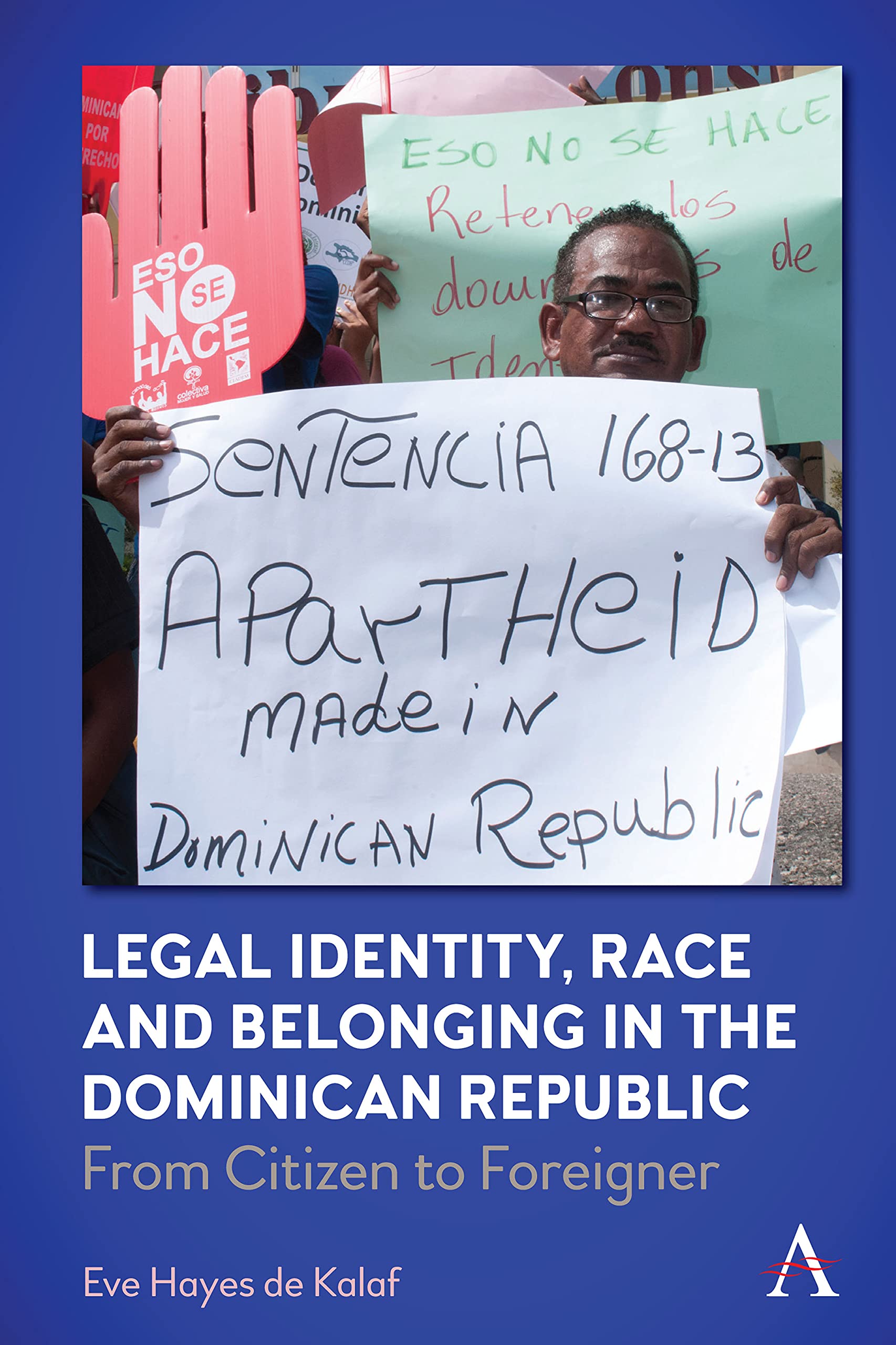 Legal Identity, Race and Belonging in the Dominican Republic makes a timely contribution to the debate over whether the sustainable development goal of legal identity for all is an opportunity or a threat by making visible the lived experiences of people stripped of their nationality. Eve Hayes de Kalaf, a socio-legal scholar, offers a cautionary narrative for development actors working to promote legal identity and birth registration as part of a sustainable development agenda. Where questions of racial national identity and belonging are disturbed, development solutions fostered to strengthen national identity systems can be used in a dual way. That is, on the one hand, to provide documents to those whom a state wants to recognize and, on the other, to deny, deprive, or differentially include those whom it does not want to recognize. Based on policy analysis, archival work, and interviews conducted as part of her doctoral research, Hayes de Kalaf demonstrates how this is happening on the Caribbean island of Hispaniola, shared by the Dominican Republic and Haiti.
The book's virtual launch will take place on December 1, 2021.
A Coup d'Etat: Judgment 168-13
From a decolonial perspective and from historical anthropology, this book examines the political, social, and economic circumstances that gave rise to Judgment 168-13 issued by the Dominican Constitutional Court, which denationalized thousands of Dominicans of Haitian descent in the Dominican Republic in 2013. It explores the continuities of racism resulting from the colonization processes between Spaniards and French that gave rise to two nation-states, Haiti and the Dominican Republic, and the enduring historical tensions between those countries, expressed in the latter as anti-Haitian state racism. The author also investigates its discontinuity, in that the Judgment expressed new racist practices and strategies resulting from the strengthening of nationalism, which provoked a civil genocide against the Dominican population of Haitian origin, Black and considered "other." This work shows the responsibility of literate elites, public officials, and nationalist politicians who were chiefly responsible for the denationalization project seeking to consolidate a Eurocentric, white, and Hispanophile national project. The author also narrates different forms of resistance by the affected persons who, through collective struggle, have become an important political subject in the Dominican context.
The book was launched in different settings in the Dominican Republic during August and September.