
Migrants and Elections
Six years ago, the eminent sociologist Stephen Castles referred to the contemporary tendency to include migration as a decisive element in electoral processes. His article on the subject suggests that this has become a global trend.

Six years ago, the eminent sociologist Stephen Castles referred to the contemporary tendency to include migration as a decisive element in electoral processes. His article on the subject, see citation below, suggests that this has become a global trend.
Caption: Stephen Castles, photo credit IMI
"International migration has become a central issue in international politics. At the same time, it is the top issue of domestic politics in many countries. Of course, migration has been a significant political issue for several decades, but it is only in the last 2 to 3 years that it has become a trend-setting issue that decides elections and makes or breaks alliances. The examples are familiar. Campaigners in favor of Britain's exit from the European Union claimed that workers from Eastern and Central Europe moving within the EU were taking 'British jobs' and that refugee flows from the Middle East posed a security threat. 'Sovereignty' became equated with migration restriction. In the United States, one of Donald Trump's most famous slogans was that he would order mass deportations of irregular migrants from Mexico, whom he labeled 'rapists' and 'criminals'. He also called for 'a very great wall' to keep irregular migrants out in the future. Stopping migration has become a rallying cry of the far right in the 2017 elections in the Netherlands, France, and Germany.
But migration control as a key element of populist nationalism is not limited to Europe and the United States: in February 2017, Mauricio Macri, president of Argentina, signed an executive order to keep migrants out and to deport those with criminal records. He also spoke about building a wall to stop irregular entry, Guardian Weekly, February 10, 2017." Source: Stephen Castles (2018) Social Transformation and Human Mobility: Reflections on the past, present and future of migration, Journal of Intercultural Studies, our translation from the English.
As is well known, 2024 has been the election year par excellence at the global scale, with both expected and unexpected contests. In this text we briefly comment on elections and the migration issue in four cases: two in Europe and two in the Americas.
France

Caption: Graffiti in Martinique, 2021, reading 'Haitians murderers of Martinicans'
French President Emmanuel Macron recently called snap legislative elections as a rapid and strategic response to far-right gains in the European elections. The French overseas territories have historically aligned with far-right trends, as was the case in the 2022 presidential elections in which President Macron was reelected. At first glance, this seems paradoxical because the French Antilles, Martinique and Guadeloupe, have produced major thinkers who defended the rights of migrants within an explicitly anti-racist discourse. Among them we can mention Frantz Fanon, Martinique 1925 to 1961, Aime Cesaire, Martinique 1913 to 2008, and Edouard Glissant, Martinique 1928 to 2011. Likewise, women writers with decolonial themes from Guadeloupe include Maryse Conde, 1934 to 2024, Simone Schwarz-Bart, 1938, and Gisele Pineau, 1956.
However, today these territories feel relatively abandoned by the Metropolis and conservative politicians have used the threat of Haitian migration to stir far-right sentiments, with corresponding political success. But it is not immutable. As seen in the second round of the most recent elections, the far right, Marine Le Pen's RN party, missed the train.
"La gauche sort gagnante des legislatives en Guyane et dans les Antilles ou les electeurs ont vote samedi. Le Rassemblement National, RN, a rate le coche." "The left won the legislative elections in French Guiana and the Antilles, where voters cast their ballots on Saturday. The RN missed the train." www.lepoint.fr
United Kingdom
General elections were unexpectedly called in May by Prime Minister Rishi Sunak, with a voting date of July 4, 2024. Although his Conservative government was increasingly unpopular, his calculation was that there would be no better moment, since elections constitutionally had to be held before the end of the year. One of the issues he tried to address was immigration. His flagship policy of sending migrants with irregular status to Rwanda to have their asylum claims adjudicated cost millions of pounds sterling despite the fact that a single person, voluntarily and paid to do so, made the trip. Added to this was the slogan 'Stop the boats,' through which he tried to halt fragile boats crossing the Channel from France carrying migrants seeking protection in the United Kingdom. The Labour Party's victory with an overwhelming parliamentary majority signals a change of direction in migration policy toward measures more respectful of the rights of migrants and refugees. This was illustrated by a performance at a festival in Glastonbury in late June, see the cover photo, orchestrated by the popular street artist Banksy. An inflatable boat carrying migrant mannequins was floated through the crowd during this annual contemporary arts festival, accompanied by an anti-racist song.
United States

Caption: President Biden inspects the Mexico-United States border
While the two previous examples of recent elections in Europe show how negative stereotypes about immigrants and their use as scapegoats for domestic ills do not always fool voters, two examples from our side of the Atlantic show the growing complexities of migration issues in electoral times.
More than 6.4 million migrants were stopped while trying to enter the United States irregularly from Mexico during Joe Biden's administration. This unprecedented rise leaves him politically vulnerable while campaigning for reelection. Regardless of the fact that migrant arrivals fell in 2024, he took the populist step in the middle of the year of stopping access to asylum at ports of entry when apprehensions exceed 2,500 per day, greatly limiting potential access for people in need of special protection. A few weeks later he announced a much more family-friendly measure in the United States, under which noncitizen spouses and their children may apply for permanent residence without leaving the country, intended to benefit approximately 500,000 people and 50,000 young people under the age of 21. The policies as a whole do not appear coherent regarding migrants in vulnerable situations. Likewise, the policies look inconsistent with regard to Haitians. On the one hand, temporary protection for certain people in the United States, TPS, was recently extended. On the other hand, deportations to Haiti of certain Haitians residing in the United States continue intermittently. Whatever happens in this campaign period, the truth is that migrants and their family members will remain political footballs in the months ahead.
Dominican Republic
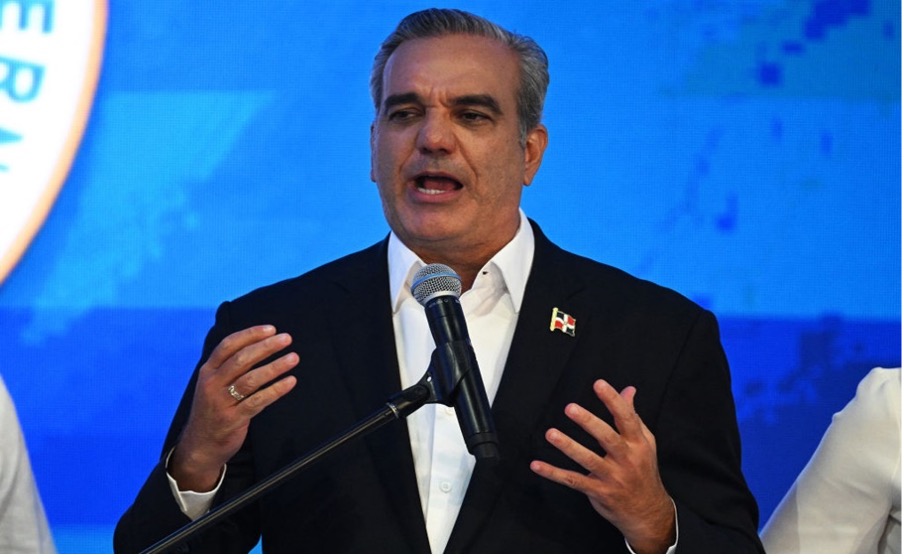
Caption: Luis Abinader speaks with supporters after preliminary general election results
In the general elections of May 2024, Luis Abinader's Modern Revolutionary Party won an overwhelming majority in Congress, in line with its favorable results in earlier municipal elections. After a widely praised management of the pandemic, Abinader's government added public posts and expanded social programs such as Superate, a conditional cash transfer initiative. Of particular note is his foreign policy, through which Abinader unified the nation around the idea that instability in Haiti constituted a 'threat' to the Dominican Republic, seeking to project firmness in defending Dominican sovereignty from foreign pressures and bringing back to prominence an issue that had not been as central since the elections of the mid-1990s.
Domestic policies
In addition, in 2023 the Dominican government carried out 251,000 expulsions by land, according to official figures, surpassing the total of all deportations between 2017 and 2021. Over four years the government conducted around half a million deportations of Haitians allegedly in an irregular migration situation. All of this occurred in a context in which all parties with electoral credentials, openly or not, critically or unconditionally, support this anti-Haitian policy.