
The Bateyes: A Historical Look at the Development of Migration Policies in the Dominican Republic
December 12, 2013--Over the course of a century, the Dominican state has gradually laid the foundations for the current migration and nationality policy by bringing Haitian labor to the country while seeking ways to confine its presence to sugar production and limit the enjoyment of the acquired rights of their daughters and sons.
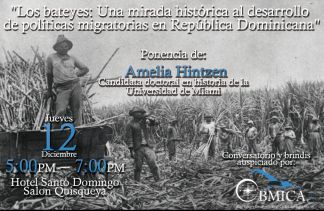
12 December 2013--Over the course of a century, the Dominican state has gradually laid the foundations for the current migration and nationality policy by bringing Haitian labor to the country while seeking ways to confine its presence to sugar production and limit the enjoyment of the acquired rights of their daughters and sons. This is affirmed by historian Amelia Hintzen, a doctoral candidate in history at the University of Miami, in her lecture "The Bateyes: A Historical Look at the Development of Migration Policies in the Dominican Republic," organized by OBMICA at the Hotel Santo Domingo on December 12, 2013.
Research in the General Archive of the Nation
Based on the analysis of historical documents in the General Archive of the Nation, Hintzen explained that the positions taken by various national and local rulers during the last century reveal conflicting opinions and practices that have gradually become state policies. Such is the case of the category "in transit," which, according to archival evidence, only in more recent years was decided to be applied to "non-residents" in the country as part of a "solution" to the Haitian question.
Hintzen affirmed that despite attempts to restrict the Haitian presence to the bateyes, there are chronicles confirming their labor contribution as teachers, entrepreneurs, and farmers throughout the twentieth century. The historian explained that the bateyes were not (and are not) entirely Haitian spaces either, but rather interethnic and bilingual communities with deep ties to nearby peasant communities.
"The information on the daily life of migrants and children of migrants that I have found in the archive offers alternative views to the official history," said Hintzen. "It is important that everyone know that the documents in the archive are part of Dominican heritage, and everyone has the right to see them."
Well-attended discussion
The event was attended by politicians, historians, sociologists, artists, representatives of civil society, and diplomatic missions in the country.
Dominican historian Quisqueya Lora served as moderator and commented: "History, what happened, is the supposedly legitimate basis on which migration policies, constitutional changes, and above all collective identities are built. Unfortunately, many 'historical' arguments are not fully substantiated; they have been self-interested, biased historiographical constructions or simply myths. That is where the importance of Amelia's work lies. Her talk this afternoon can help us in the search for other approaches, but above all to call into question the historical foundations with which discriminatory policies and human rights violations have been justified. In addition, Amelia's experience shows us that the archive has much to offer to research on these issues."