
Launch from the Dominican Republic of a New Book on Statelessness
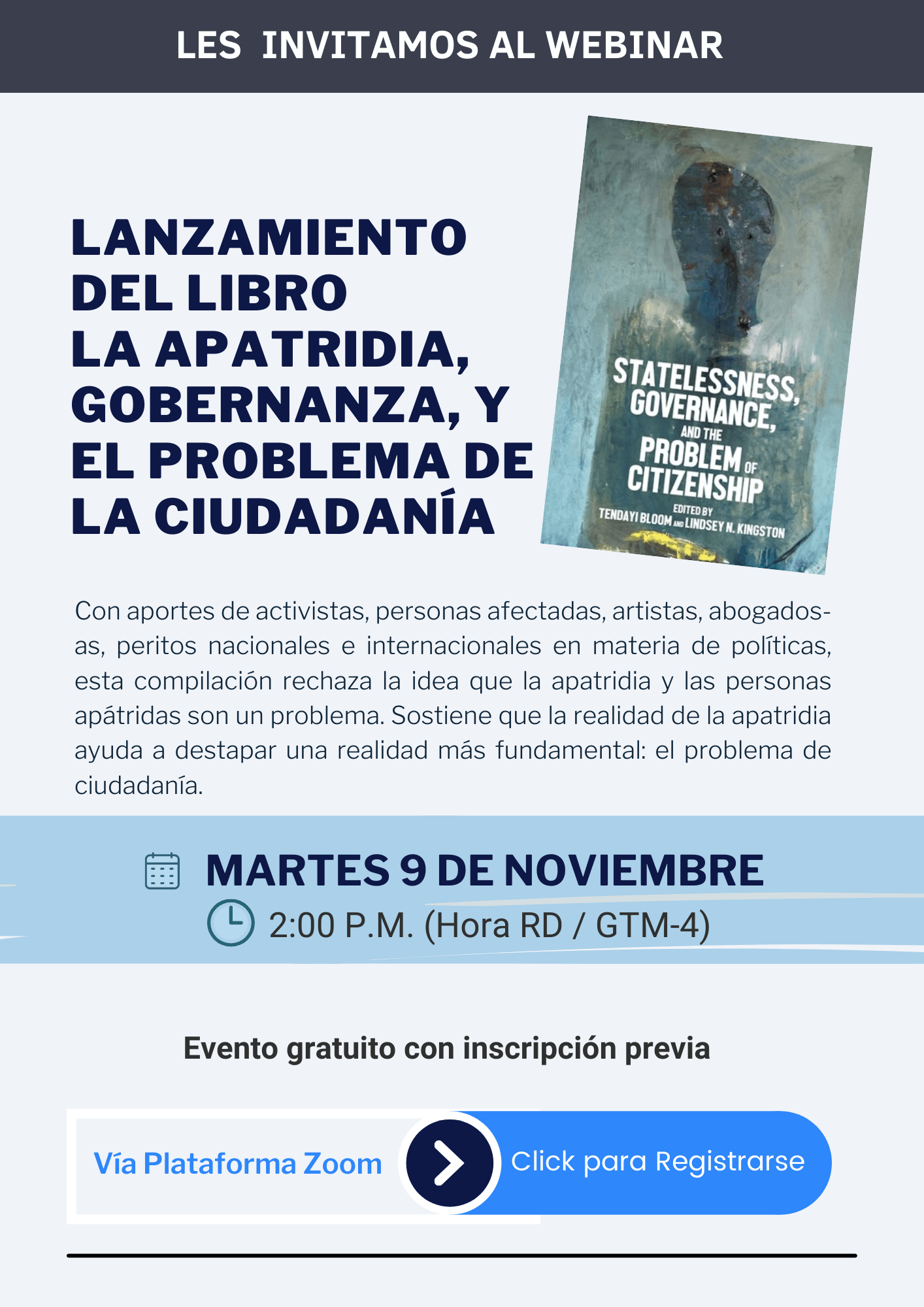
We share details from the webinar launch of the book "Statelessness, Governance and the Problem of Citizenship," edited by researchers Tendayi Bloom and Lindsey Kingston, an event organized by OBMICA last November. With contributions from activists, lawyers, artists, and affected people, the book places the discussion of statelessness as a question of citizenship.
To set the tone for the conversation, we opened the webinar with a poem by Danielle Legros Georges, included in the book and inspired by the denationalization in 2013 of more than 130,000 Dominicans, mostly of Haitian descent, in the Dominican Republic.
|
A Stateless Poem If you are born, and you are stateless, if your state and home are not what are you? Who are you? And who the streets I know, the blue corners Who am I to call myself citizen, and And who are you to call yourself landed and grounded, Who native? Who other? And who are we who move so freely without skin of identification, with gold seals of approval. With stamps of blameless birth. Who are we to be Danielle Legros Georges, Boston Poet Laureate 2015-2019 |
A Stateless Poem If you are born, and you are stateless, if you are born, and you are homeless if your state and your home are not yours - and yet everything you know - what are you? Who are you? And who am I without the dark fields I walk upon the streets I know, the blue corners I call mine, the ones you call yours Who am I to call myself citizen and human and free? And who are you to call yourself landed and grounded, and free. And who is judge enough? Who is native? Who is other? And who are we who move without accents of identification without skin of identification, with all kinds of identification. With gold seals of approval. With seals of good fortune. With the accident of blameless birth. Who are we that are so lucky? |
Poem read by the author for the webinar
Development of the event
Tendayi Bloom, co-editor of the launched book, is a political and legal theorist focusing in particular on non-citizenship from the perspective of UN processes and civil society related to migration governance. The academic summarized the book's argument. Maria Cristina Fumagalli (professor at the University of Essex, United Kingdom) and Bridget Wooding (Director of OBMICA) spoke in a joint presentation from the perspective of the Dominican Republic.
The central testimony was that of community activist and human-rights defender Violeta Bosico, who for more than 10 years has been part of the group of young women leaders of the Movimiento de Mujeres Dominico Haitianas (MUDHA). She was born in Sabana Grande de Boya, Santo Domingo, Dominican Republic. She is one of the girls in the famous Yean and Bosico case that MUDHA brought before the Inter-American Court with the accompaniment of CEJIL, concerning the responsibility of the Dominican State for denying birth certificates to Dominican children descended from migrants. She is a member of the anti-trafficking committee, the women's committee, and a social worker, and she enjoys important leadership in the community of Palave, Managuayabo, in Santo Domingo Oeste.
Then two commentators, OBMICA associated researcher Allison Petrozziello and UNHCR regional officer Fernando Bissacot, made comments from a gender perspective and from the regional context. To close the panelists' participation, the intervention of Helen Kerwin, CEJIL, shared with us a regional perspective from organized civil society activism. At the close of the activity, an interesting exchange took place with the public. On the one hand, a series of good practices regarding the right to nationality in Latin America were mentioned. On the other hand, the relevance of the reconceptualization highlighted in the book regarding the issues that concern us on the island was emphasized. Bridget Wooding, Director of OBMICA, brought up the phrase coined by academic Matthew Gibney, namely "unrecognized citizens," as a concept that perfectly captures the situation in the Dominican Republic of both deprivation and stripping of nationality.
The recording of the meeting is available on OBMICA's YouTube channel. To consult it, please follow the link:
Webinar Launch of the Book Statelessness, Governance and the Problem of Citizenship https://www.youtube.com/watch?v=k8ZfhkWVnN4