
Launch of the Decent Work Crosses Borders Study
The contributions of migrant labor in the Dominican banana sector were recognized in research supported by various national and international bodies.
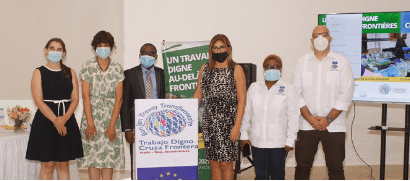
The Exploratory Situational Study Focusing on the Banana Sector of the Northwest Line is a reference study for the project "Decent Work Crosses Borders," which promotes the improvement of labor conditions for migrant banana workers within the framework of fair trade. It was carried out by Luis Cirito, Ivrance Martine, and Liliana Degiorgis, under the coordination of OBMICA Director Bridget Wooding.
With financial support from the European Union through the European Instrument for Human Rights, "Decent Work Crosses Borders" is a binational initiative led by the Jesuit Service for Migrants in Haiti (SJM Haiti), the AVSI Foundation, the international humanitarian aid organization CESAL, the National Episcopal Commission for Justice and Peace of Haiti (JILAP), and the Migration Observatory and Social Development in the Caribbean (OBMICA), institutions with broad experience in research and policy advocacy, as well as in accompanying migrant workers and their relatives.
The study highlights that providing effective continuity to the National Plan for the Regularization of Foreigners (PNRE) "is a key element in protecting the rights of migrant workers and their relatives." It also reaffirms "the need to establish reliable migration policies that strengthen controls at the land border and offer mobility conditions for Haitian migrant workers and their families, so that they are not exposed to raids and deportations without due process." In that sense, it recommends weighing the implementation of the legal category of "border inhabitant" enshrined in the 2004 General Migration Law.
International Workers' Day: May 1, 2021
The findings of the study and preliminary results of the "Decent Work Crosses Borders" project were shared in a dialogue event commemorating International Workers' Day, held in Dajabon. It brought together government authorities from Haiti and the Dominican Republic, representatives of international organizations, business groups, and workers' associations from the border area. "Although there is a favorable difference for migrant workers who labor under fair-trade standards, significant gaps persist in fully guaranteeing the protection of their labor, economic, social, and cultural rights," the study notes.
To help close these gaps, the recommendations of the study include the following:
- Establish reliable migration policies that strengthen controls at the land border and offer mobility conditions for Haitian migrant workers and their families, so that they are not exposed to raids and deportations without due process.
- Pay special attention to the migration regularization of workers and their relatives, in particular by following up on the PNRE, defined as progress although insufficient, and whose continuity remains in a kind of fog.
- Guarantee safe mobility in the border area through the incorporation of mechanisms such as the legal figure of the "border inhabitant."
- Undertake actions to improve the financial situation of workers by promoting acts of solidarity and community support.
- Design information campaigns about the rights to association and unionization of workers and give them negotiation skills and collective bargaining tools.