Launch of the 2019 OBMICA Yearbook
Throughout the year, every year since 2011, OBMICA staff and its team of associated researchers have monitored migration dynamics both in the insular Caribbean and at the binational level between Haiti and the Dominican Republic. This effort culminates in the production of the State of Migration Affecting the Dominican Republic.
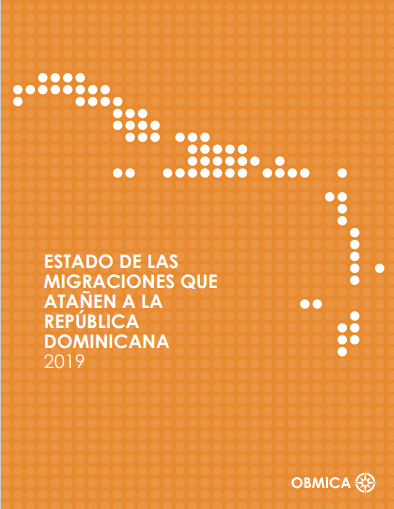
Throughout the year, every year since 2011, OBMICA staff and its team of associated researchers have monitored migration dynamics both in the insular Caribbean and at the binational level between Haiti and the Dominican Republic. This effort culminates in the production of the State of Migration Affecting the Dominican Republic.
We congratulate the distinguished team of authors - Adriana Salcedo, Rafael Antonio Duran, Masaya Llavaneras, Allison Petrozziello, and Natalia Riveros - supported by the editorial team of Liliana Degiorgis and Bridget Wooding for the launch of the 2019 OBMICA yearbook. Throughout the year, every year since 2011, OBMICA staff and its team of associated researchers have monitored migration dynamics both in the insular Caribbean and at the binational level between Haiti and the Dominican Republic. This effort culminates in the production of the State of Migration Affecting the Dominican Republic.
This yearbook is the research, publication, and tangible result that best explains OBMICA's working model, which focuses on "research for action." We conceive our work as a cycle in which the research produced returns to the field to influence and motivate the work of key actors in the design, implementation, and monitoring of public policies. This model involves multiple actors, supports civil society, contributes to academic discussion, and in turn has the potential to influence evidence-based policymaking.
The Insular Caribbean
The lack of economic opportunities and political and criminal violence, frequently associated with drug trafficking, are key elements in explaining the migration flows that intensified in some parts of Latin America in 2019. The Caribbean region has not escaped these dynamics, with this subregion playing a key role as a place of origin, transit, destination, and return for tens of thousands of migrants. The first chapter follows the new challenges faced by the Caribbean region during 2019, especially those related to climate change and natural disasters - particularly the effects of Hurricane Dorian in The Bahamas - and the significant increase in Venezuelan emigration to Caribbean countries and territories.
Emigration and Immigration
The second and third chapters provide data, respectively, on migration flows leaving and entering the country. Four complementary studies were identified on the content provided by the Second National Survey of Immigrants in the Dominican Republic (ENI-2017). The publication of the report on the Venezuelan immigrant population represents the latest study based on the ENI that had been planned by the United Nations Population Fund, UNFPA.
Additionally, three reviewed academic studies analyze: the labor conditions of foreign labor and their descendants (2008-2018); human capital and other determinants of labor insertion and income among immigrants in the Dominican Republic; and a description of the sociodemographic and labor characteristics of boys, girls, and adolescents between 10 and 17 years old of Haitian origin residing in the Dominican Republic. The production of new knowledge stands out for providing inputs for public policy on migration on the basis of official foundational studies.
Governance
The fourth chapter provides us with an expansive overview of migration governance in the Dominican Republic. The year 2019 began under the impact of the debate over the Global Compact for Safe, Orderly and Regular Migration, which the government decided not to sign at the last moment at the end of 2018, despite having participated in all intergovernmental negotiations for nearly two years. Nevertheless, despite coordination difficulties at the macro level, progress was made on specific issues such as labor migration, strengthening consular assistance, prevention of trafficking in persons, and the design of a pilot program to support the reintegration of returning Dominicans.
Human Rights
The unfinished issue of the regularization of foreigners is taken up again in the final chapter of the yearbook, tying together the threads of previous chapters and documenting the modest progress toward sustainability in 2019 in the Dominican Republic. It also assesses progress in implementing Law 169-14 for those Dominicans stripped of their nationality in 2013. In short, this chapter records the main events, advances, and challenges regarding the protection of migrants and their families in the country, in light of the prevalence of discrimination and the sociopolitical context described. It seeks to outline the impact of this reality on recurring violations of security and personal integrity, effective access to due process during deportations, labor-rights violations, and access to identity documentation and Dominican citizenship.
We invite you to read the yearbook, available at: www.obmica.org