Civil Society Proposes a Broad View of the Mobility Situation of Venezuelan Migrants
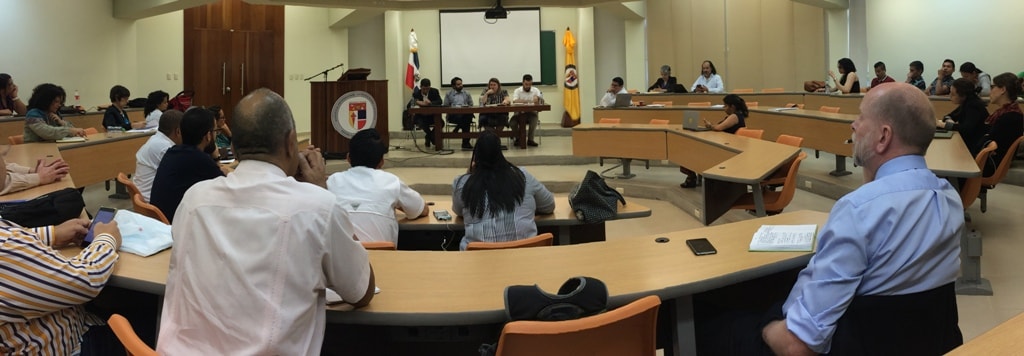
May 10, 2018.- The Pontificia Universidad Catolica Madre y Maestra (PUCMM) hosted on May 10 a meeting in which organizations working on the Venezuelan migration phenomenon from a human rights perspective presented the main issues surrounding the exodus and its repercussions for migrants and receiving countries.
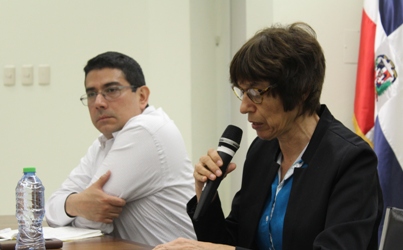
"Is the region prepared for this exodus of Venezuelan people?" This was the recurring question, and most of the answers offered through the three panels that followed throughout the debate pointed, with little optimism, to no. "The situation is unprecedented, and if President Maduro is re-elected this coming May 20, up to 2 million people are expected to leave the country," said Francisco Quintana of the Center for Justice and International Law in that regard.
 The first of the three panels, "Causes of Emigration from Venezuela and Impact on Receiving Countries," focused on revealing the situation that "originates this flow, which has grown exponentially in recent years," due to multiple factors of insecurity and difficulty in accessing basic goods, as Carlos Patino from Provea and Belissa Guerrero from Amnesty International agreed. Also in this space was Marco Romero, from the Consultancy for Human Rights and Displacement (CODHES), who began to introduce a more international perspective with an account of how this exodus is being felt in neighboring Colombia, in terms of public policy and the protection of human rights for newly arrived migrants.
The second panel, "Characteristics of Migration in the Main Destination Countries: Brazil and Ecuador," helped continue the analysis of the impact of this migration in Latin American countries, with an emphasis on these South American countries. Guillermo Rovayo (of the Scalabrinian Mission of Ecuador) and Xavier Gudino (Asylum Access) focused on the Ecuadorian reality, while Cleyton Abreu, from the Jesuit Service for Migrants and Refugees in Brazil, and Leticia Carvalho, from Missao de Paz, offered interesting perspectives on the northern borders of Brazil. The recurring element for each of these groups is the need for speed in registration processes for migrants. One specific emphasis regarding Brazil was the monitoring of respect for the rights of indigenous peoples living on both sides of the border.
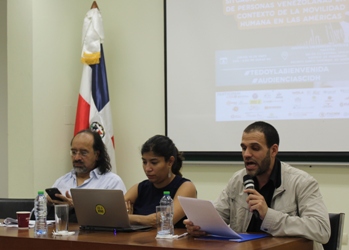
The final panel, "Solutions that Promote Greater Protection: Migration and the Caribbean," brought together Bridget Wooding, director of the Centre for Migration Observation and Social Development in the Caribbean (OBMICA), Francisco Quintana, from CEJIL, and Ligia Bolivar, from the Human Rights Center of the Andres Bello Catholic University (CDH-UCAB), to discuss durable solutions identified from a protection perspective.
During the question-and-answer session, members of the audience, notably representatives of the Venezuelan Diaspora in the Dominican Republic, exchanged ideas with the panelists regarding, for example, the need for the Dominican government to commit itself to a process of improving its regularization procedures for Venezuelan migrants and, at the same time, its asylum application system.
The meeting was organized by OBMICA, the Dominican chapter of the Latin American Council of Scholars of International and Comparative Law (COLADIC-RD), CEJIL, together with a group of non-governmental organizations working on human rights and migration, with the support of PUCMM.