
Exchanging with the House of Cultural Diversity of Camaguey
July 12, 2018.- 'Although we have only one language, Spanish, we are a country with cultural diversity, because Cuba is made up of Spaniards, Africans, Chinese, Yucatecans: without these elements we are not Cuba.' These are the welcoming words in the House of Cultural Diversity, Agramonte Park, quoting the distinguished Cuban author Miguel Barnett, who inaugurated this pioneering House on December 30
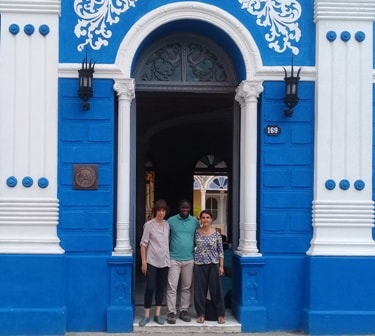
July 12, 2018.- "Although we have only one language, Spanish, we are a country with cultural diversity, because Cuba is made up of Spaniards, Africans, Chinese, Yucatecans: without these elements we are not Cuba." These are the welcoming words in the House of Cultural Diversity, Agramonte Park, quoting the distinguished Cuban author Miguel Barnett, who inaugurated this pioneering House on December 30, 2010.
Founded in February 1514 as one of Diego Velazquez's seven sacred "villas," Santa Maria del Puerto Principe was originally established on the coast, near the present-day city of Nuevitas. It was finally established in its current location in 1528. Its name was changed to Camaguey in 1903, in honor of the camagua tree from which all life derives, according to an indigenous legend. Despite sustained attacks by corsairs, it developed rapidly in the 1600s with an economy based on sugar production and cattle. As the director of the House, Yoelxy Pilliner Lopez, explains to us, Camaguey has the good fortune of being the cradle of Cuban literature, because it was from here that a poem from the beginning of the seventeenth century emerged. "Espejo de Paciencia" is a heroic poem written in 1608 by Silvestre de Balboa Troya Quesada, born in the Canary Islands but living in Puerto del Principe (today Camaguey).
Pilliner Lopez tells us: "the House was born with the aim of promoting knowledge of the city's multicultural plurality as an expression of Camagueyan identity, based on the study of the everyday practices of ordinary people, centered through cultural dialogue with, from, and for members of associations, communities, and groups descended from different cultural heritages, and through the sociocultural management of tangible and intangible heritage."
It is noteworthy that this young director of the House, who has held the position for two years, is of Haitian descent on his maternal grandmother's side and of Jamaican descent on his paternal side. He speaks proudly of his ancestors and their struggles when they arrived as laborers for the sugar industry. Every year a massacre of more than 20 laborers who were shot in 1933 while demanding better working conditions in the sugarcane fields is commemorated: an uprising of Haitians with the notable participation also of a Jamaican, Jamie Brown. Of course, these Caribbean immigrants knew how to organize their lives beyond the interstate agreements that governed their arrival for the sugar harvest in Cuba, since the archives show that they also worked in coffee production and in urban areas.
OBMICA exchanged with the House in June 2018, making the 500-kilometer trip from Havana, on the occasion of the launch of Professor Fumagalli's book on the Dominican-Haitian border before a diverse audience, including a conversation on current Dominican-Haitian relations. The dialogue highlighted the benefits of the Revolution for the integration of different minorities and their descendants in the country. For example, a 1967 law in Cuba was key insofar as it extends social security benefits to all individuals on the island, regardless of whether they have personal documentation. Thus, all Haitians who had migrated a generation earlier, with or without legal documentation, could from then on receive a monthly pension from the Cuban government.
Today attention is focused rather on Haiti's debt to Cuba for sending Cuban doctors who help provide health services in the face of the exodus of Haitian doctors abroad. This House, unique in Cuba, represents an important effort to rebalance history and recognize Cuba's debt to these ethnic minorities that helped in such important industries as sugar and coffee. Their cultural heritage is no less important. In addition to gathering oral histories, especially from older adults, the compilation of the legacy of Haitian music in Cuba stands out. As the Camagueyan musicologist Heidy Cepero told us at our meeting: "Haitian music is my passion and I aspire to catalogue all Haitian genres from this part of Cuba."