
Childhood in Motion
At the end of 2023, OBMICA launched a new publication based on research supported by UNICEF: A New Look at Children in Motion on the Dominican-Haitian Border.
At the end of 2023, OBMICA launched a new publication based on research supported by UNICEF: A New Look at Children in Motion on the Dominican-Haitian Border.
This study seeks to:
- Generate greater knowledge about the profile of the child and adolescent population that regularly crosses from Haiti into the Dominican Republic, including their conditions, motivations, risks, and the care and protection they receive.
- Help strengthen UNICEF's capacity for dialogue with government authorities linked to the System for the Protection of the Rights of Children and Adolescents, with a view to protecting and restoring the rights of minors in border transit or migratory movement.
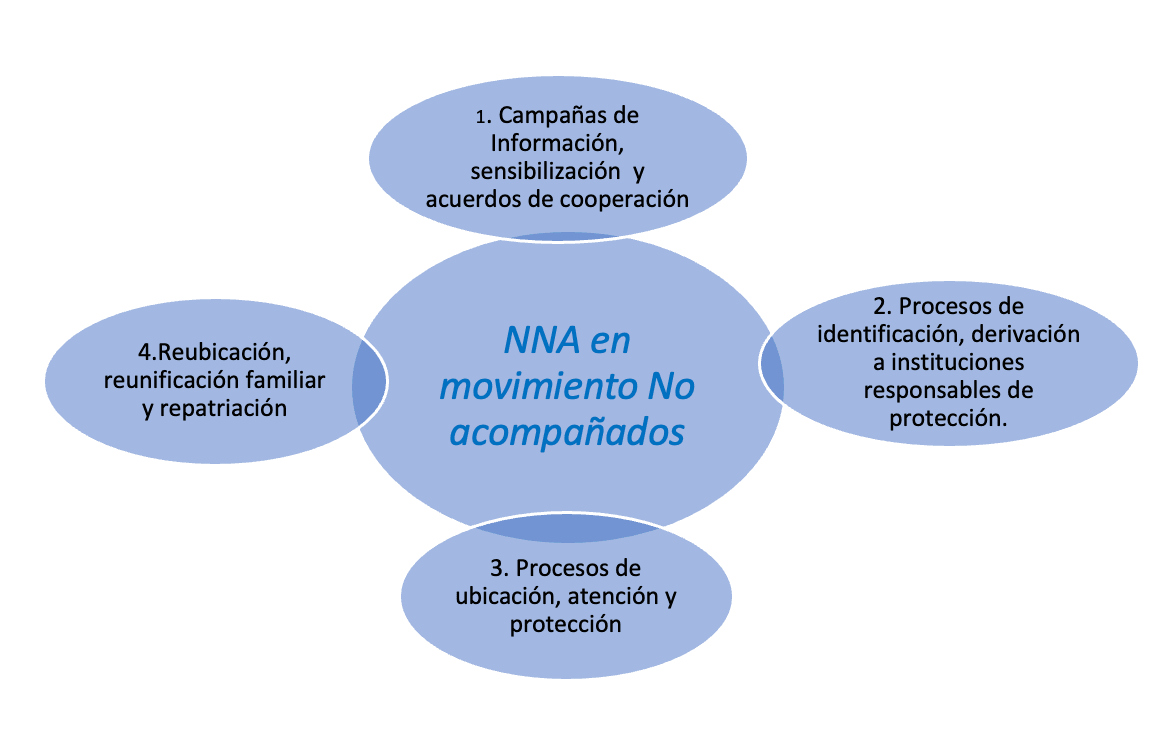
The dimensions studied were the following:
The people consulted for this study as primary sources were key and strategic actors related to children's rights in government entities, UN international agencies, non-governmental organizations working on children's rights, as well as community and social participation bodies at the main offices of these organizations and at the four official border crossing points between the Dominican Republic and Haiti. Mainly, and in complement to the information provided by these key and strategic actors, interviews were conducted with children and adolescents located in Dominican territory who had migrated from Haiti in recent years, reconstructing their educational and social profile in Haiti, their reasons for migrating, their trajectory through the border area, their current situation and outlook, and their future plans. It was decided to concentrate the interviews with children in mobility inside the Dominican Republic, rather than at official border crossing points, in order to gain a broader understanding of the protection available to this population. The interviewed children and adolescents were between 14 and 18 years old and were either living on the street or staying in shelters or foster families in three areas of the country: Boca Chica (urban tourist setting), Bahoruco province (batey setting), and San Pedro de Macoris province (batey setting).
Factors driving cross-border migration
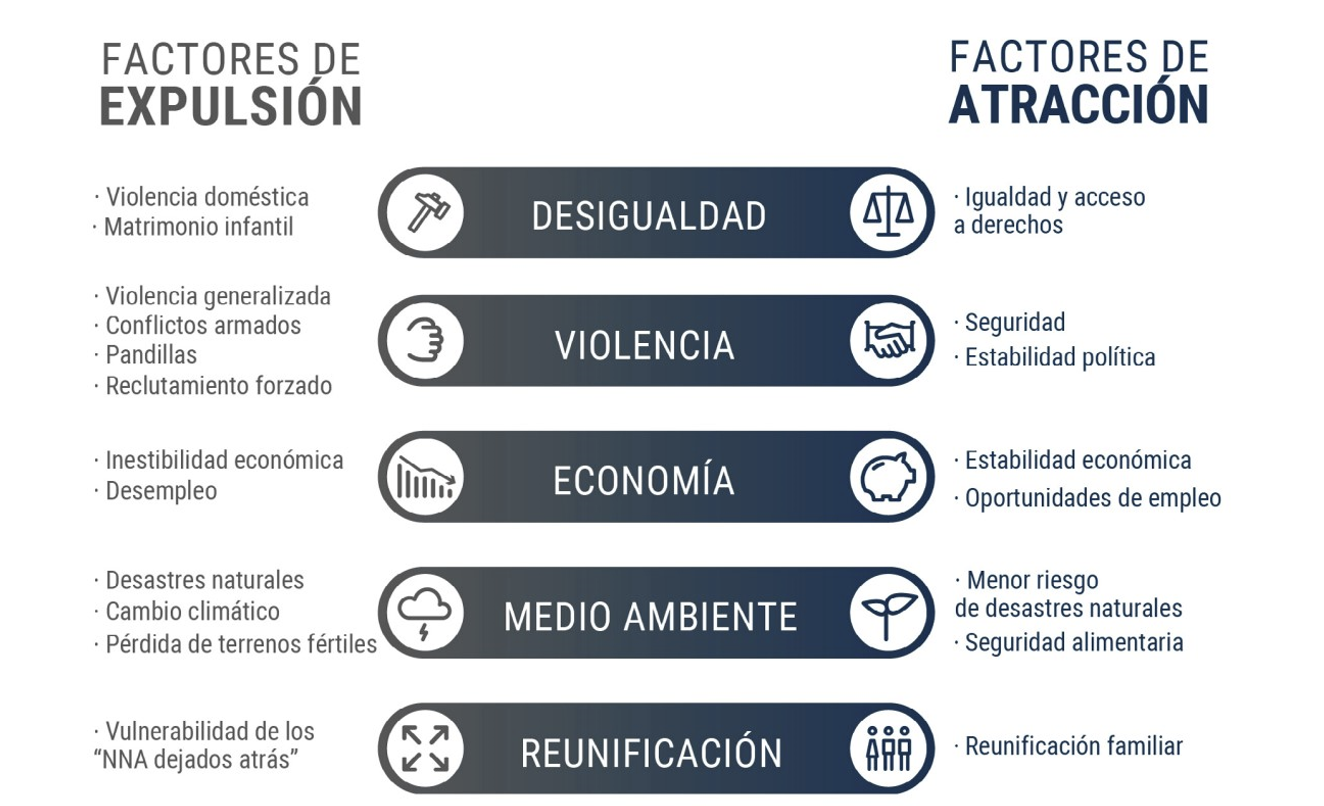
Source: Protecting Migrant and Refugee Children in the Americas. Botero 2022
These push and pull factors are evident in different contexts. In the case at hand, the migration of young people from Haiti to the Dominican Republic, access to education stands out as an increasingly important motive in the rise of this type of movement. The chart below reflects the current situation in Haiti with regard to access to education.
- Violence by armed groups targeting schools and displacement pressures result in inaccessibility of education. Many schools remain closed because of violence, particularly in Port-au-Prince and the Artibonite department. Others are not operating because they are housing displaced persons or because armed groups are using the buildings as bases for criminal operations. The government has not made adequate efforts to facilitate school reopening or support schools that cannot reopen because they are serving as informal displacement sites. Schools that remain open are not necessarily safe. For example, 400 students and teachers were trapped for several days in mid-October inside their school in Port-au-Prince because fighting between armed groups prevented them from leaving. Many children do not attend class because they do not want to risk a dangerous journey through territory controlled by armed groups to reach school.
- A chronic lack of resources and dysfunction within Haiti's school system further complicate access to education. The national education budget fell for the second consecutive year, dropping to 10.3 percent of the national budget for fiscal year 2023-2024. Many teachers have gone on strike to protest poor teaching conditions and the government's persistent failure to pay them on time. Others have fled the country, raising concerns about a possible teacher shortage.
- Approximately 85 percent of schools in Haiti are private and charge fees that low-income families cannot afford. Around one million children are at risk of dropping out because they cannot pay private school fees, with poor families forced to choose between food and education.
Source: IJDH, December 2023 (our translation from English)
Findings
It is commonplace to say that young people have become a "new migration actor" (Suarez 2006) for at least two decades. The rise of this type of movement between Haiti and the Dominican Republic corresponds to child and adolescent mobility from Central America and Mexico toward the United States and, more recently, between South America and the United States (Penuelas 2023). It is therefore not surprising that the design of public policies adequate to this new challenge continues to face major difficulties, not only in terms of basic procedures but also in relation to good practices. This study sheds light on the factors driving forced migration from Haiti and the strong pull factors in the Dominican Republic, regardless of a context of more restrictive migration policies in the host country. Notably, at the time of the interviews none of the children or adolescents had regular legal status in the country, highlighting the challenges for their integration into Dominican society, the obstacles to accessing basic services on an equal footing with Dominican children, and even the possibility of family reunification on one side or the other of the border.
In light of the findings and research results, a series of recommendations is issued in order to strengthen attention and responses to this population from a rights-based approach, aimed at all public and social institutions responsible for the care and protection of children in mobility. These recommendations are grouped into six areas:
- Prevention of forced child migration
- Development of public policies for child protection
- Protection of rights in migratory transit
- Social protection and access to basic rights at destination
- Generation and transfer of knowledge on children and adolescents in motion
- Transnational cooperation
Caption for the book cover (above)
The research team was composed of Bridget Wooding, Liliana Degiorgis, and Ivrance Martine. The publication is available online on the OBMICA website and in print at the OBMICA office.