
COVID-19 Impacts on Migrant and Undocumented Populations: Webinar of the Dominican@s por Derecho Platform on June 18
The opening remarks of the event were delivered by Laura Van Waas, co-director of the Institute on Statelessness and Inclusion (ISI), who provided an overview of the issue at the international level, commenting on joint efforts to promote the inclusion of stateless persons in COVID-19 control plans through a consortium of organizations of which the Dominican@s por Derecho Platform is part.
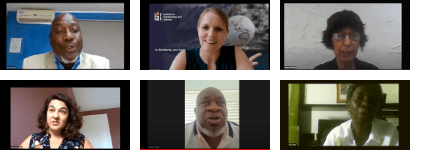
The opening remarks of the event were delivered by Laura Van Waas, co-director of the Institute on Statelessness and Inclusion (ISI), who provided an overview of the issue at the international level, commenting on joint efforts to promote the inclusion of stateless persons in COVID-19 control plans through a consortium of organizations of which the Dominican@s por Derecho Platform is part.
The OBMICA report launched during the activity is based on the voices of migrants and their descendants, who describe the impacts of the pandemic in their communities. It shows the link between international migration, statelessness, and other global challenges, including the fair and necessary public-health approach of protecting and vaccinating everyone during pandemic times. Bridget Wooding, OBMICA's director, and associated researcher Allison Petrozziello, co-authors of the Study on the Impact of COVID-19 on the Haitian Population and Their Descendants in the Southern Area of the Dominican Republic, presented the findings of the research carried out in the south of the Dominican Republic, in the Enriquillo Region, with the support of the Centro de Desarrollo Sostenible (CEDESO).
Testimonies
The launch event included testimonies from DXD organizations that accompany migrants and their Dominican relatives on the ground. Dr. Joseph Cherubin, president of the Movimiento sociocultural para los trabajadores Haitianos (MOSCTHA), spoke about the challenges of the health system and the mobilization of civil society in the country. Franklyn Dinol, leader of the Movimiento Reconoci.do, offered the perspective of youth: documentation, access to and exclusion from social-assistance programs, employment, and schooling in the COVID-19 context.
Meanwhile, Michael Abreu, legal technician of the Asociacion Ascalabriniana al Servicio de la Movilidad Humana (ASCALA), referred to the difficulties of access to documentation in the context of the health emergency, with a focus on under-registered or unregistered groups, and also addressed the case of older adults, especially former workers in the sugar sector who are pensioned or awaiting a pension. The director of the Movimiento de Mujeres Dominico Haitianas (MUDHA), Sirana Dolis, spoke from a gender perspective, elaborating on the situation of women and girls in the COVID-19 context. She brought to the fore the increased violence and the economic and logistical burden borne by mothers heading households, caring for school-age children, older adults, and the sick, all of whom are often overlooked by humanitarian-assistance and vaccination plans.
On the other hand, Mayelin Abreu spoke about the work of UNHCR in pandemic times.
"COVID-19 Impacts on the Haitian Population and Their Descendants in the Dominican Republic" is available for online reading or free download in two versions, a combined or back-to-back English-Spanish format and a French edition. Please consult the links on OBMICA's website.
The recording of the webinar is available on OBMICA's YouTube channel for consultation: https://www.youtube.com/watch?v=Y7DPyzf7eQc&ab_channel=Centrodeinvestigaci%C3%B3nOBMICA
On the following page of this newsletter there is a summary of one of the findings of OBMICA's research. It analyzes the interviews from the perspective of access to civil registration for parents of children born in recent years, and the ordeals they go through in this relationship according to their documentary status at the time of the birth of their children. It concerns the ongoing under-registration of children of migrants and their descendants.