
FLACSO's Inequality and Power Forum Addresses, through EDM 2017, Migration Flows To and From the Country
February 11, 2019.- The Centre for Migration Observation and Social Development in the Caribbean (OBMICA) presented on Thursday, February 7, the 2017 edition of its 'State of Migration concerning the Dominican Republic (EDM)' at the headquarters of the Latin American Faculty of Social Sciences Program Dominican Republic (FLACSO-RD).
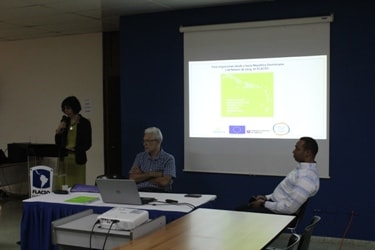
February 11, 2019.- The Centre for Migration Observation and Social Development in the Caribbean (OBMICA) presented on Thursday, February 7, the 2017 edition of its "State of Migration concerning the Dominican Republic (EDM)" at the headquarters of the Latin American Faculty of Social Sciences Dominican Republic Program (FLACSO-RD).
Led by OBMICA Director Bridget Wooding and FLACSO-RD Director Ivan Ogando, the event was framed within the eighteenth Inequality and Power Forum "Migration From and To the Dominican Republic" and brought together a broad audience of scholars on the topic, members of civil society organizations and the state, and the general public.
Distinguished authors, researchers, and experts on migration took part in the preparation of the 2017 "State of Migration concerning the Dominican Republic (EDM)." This is the case of the well-known sociologists Rafael Antonio Duran and Juan Montero, who were also part of the yearbook presentation panel. This edition of OBMICA's flagship publication was supported by the European Union, Norwegian cooperation, and American Jewish World Service.
Montero highlighted the increase in recent years in emigration of Dominican nationals, underscoring the notable growth this has represented in terms of remittances. He also noted that the United States and Spain continue to be the main destinations of Dominican migrants and therefore the places from which the greatest volume of remittances originates, while also highlighting the rise of other destinations such as Chile.
Rafael Duran, another invited author for EDM 2017, focused on the immigration the country receives. Duran stressed that Haitian immigration continues to demonstrate dynamism, "although not at the levels popularly imagined," while migration from other destinations "increased more than that of neighboring countries because its overall variation was 10.1 percent, mainly due to the increase in Venezuelan migrants, which shows a quite significant rise" between 2012 and 2017, the period in which the two editions of the National Survey of Immigrants (ENI) were conducted.
Both experts agreed that ENI 2017, whose details are exhaustively collected in EDM2017, is a key tool for studying migration behavior in the country.
At the forum, Bridget Wooding commented on the effects of climate change and natural disasters on migration dynamics in the Caribbean islands, highlighting 2017 as a year in which new mobilities were observed in the region caused by Hurricanes Irma and Maria and storms Nate and Harvey. In fact, the cyclone season was the most intense the insular Caribbean has experienced in more than a century.
Agreeing with Duran on the rise in Venezuelan mobility, Bridget Wooding stated that Trinidad and Tobago is one of the nations that has received the largest Venezuelan population from a demographic perspective, although it has not been studied as much as other countries in Latin America. "The situation facing the Venezuelan population in Trinidad and Tobago places them in a situation of vulnerability to human trafficking, smuggling networks, and other conditions linked to the island's geographic location just a few kilometers from the Venezuelan coast," she said.
This is the seventh edition of the EDM, produced since 2012, which gathers the details of migration in the insular Caribbean area and its diasporas, offering an updated perspective on the dynamic migration flows affecting the country. It also analyzes new trends in the archipelago such as migration, environment, and climate change; and the arrival of displaced Venezuelans in the southern Caribbean.
Bridget Wooding announced that OBMICA will present this month a web space containing all editions of the "State of Migration concerning the Dominican Republic," from its first edition corresponding to 2011 up to the one presented at the forum. She said that this web space will offer "more user-friendly access to the content of this report, which is the cornerstone of our research work as an Observatory."
The activity encouraged lively participation from the audience present. OBMICA hopes that the different perspectives gathered in this yearbook and in discussion spaces on these issues will contribute to the construction and management of migration policies capable of maximizing the benefits of immigration while guaranteeing the human rights of migrants and their relatives.