
Studies and Pilot Initiatives to Promote Environmental Sustainability in the Dominican Republic and Haiti
October 2013--During the last 3 years OBMICA has been co-executing the project "Studies and pilot initiatives to promote environmental sustainability in the Dominican Republic and Haiti," financed by the European Union.
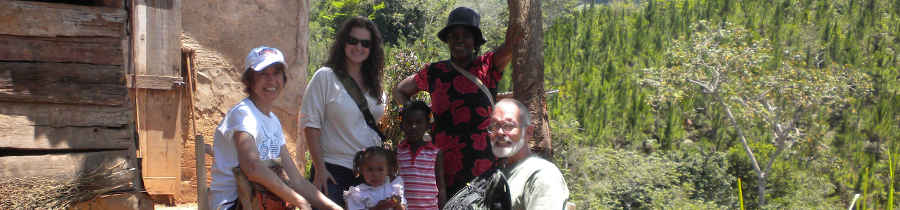
October 2013--During the last 3 years OBMICA has been co-executing the project "Studies and pilot initiatives to promote environmental sustainability in the Dominican Republic and Haiti," financed by the European Union. For the project, it is fundamental to improve the management capacity of the natural resources available to communities near Pic Macaya National Park in Haiti and Nalga de Maco in the Dominican Republic, so that this management can become a sustainable source of income for the communities.
At the beginning of 2011, the project was able to benefit from the research of an associated OBMICA researcher, geographer Dr. Tim Brothers of Indiana University, within the framework of his postdoctoral work supported by a Fulbright grant. His meticulous fieldwork has supported us by allowing us for the first time to count on a history of environmental degradation in Nalga de Maco National Park and the buffer zone located on the Dominican-Haitian border. His study nuances the factor of migration as an element to be taken into account in this process.
OBMICA is mainly in charge of the components related to research, technical support, and the dissemination of the project's results. Recently, OBMICA's Director Bridget Wooding and associated researcher, geographer Marcos Morales, supported an important field workshop to take a preliminary stock of the results of the small pilot projects financed on the ground through a competitive process. At the end of October 2013, representatives of the six projects gathered in Rio Limpio to exchange and draw lessons from the experiences.
It was a very fruitful meeting, revealing the need to encourage even more synergies among the different supported projects. One of the most motivating experiences was the project of the Santa Maria de Guayacayuco Mothers' Center in which, although they had radically changed the nature of their project for a series of understandable reasons, they had emerged more empowered and more autonomous than before.
The two community women informed us with great pride about the crops planted so far: 13 tareas of tindora, 41 tareas of peppers, and the use of three types of fertilizer. One of the project members said: "I did not know tindora, what it was, or how to grow it, much less how to eat it. This has changed and we feel satisfied to have started something new in the community."
To learn more about the project, click here.
More information: "Two parks of enormous importance: In Nalga de Maco (DR) and in Pic Macaya (Haiti) efforts are being made to protect water sources and biodiversity".