STATE OF MIGRATION 2016: OBMICA's Main Annual Publication Released with a New Design
Throughout the year, every year since 2011, a select team of OBMICA staff and associated researchers has monitored migration dynamics both in the insular Caribbean and at the binational scale between Haiti and the Dominican Republic.
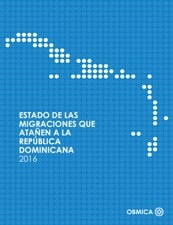
This effort culminates in the production of the State of Migration concerning the Dominican Republic, whose sixth edition is available in print and in PDF on OBMICA's website www.obmica.org.
The yearbook offers an updated and realistic perspective on international movements of people to and from Dominican territory, while also providing an overview of the main trends and events affecting flows at the regional level in the insular Caribbean, as well as the principal and emerging destinations for Dominican emigration abroad. Whenever possible, the statistical data are based on information requested from and provided by the main state and non-governmental institutions that collect data on the migration phenomenon in the country, such as the National Migration Institute (INM-RD), the General Directorate of Migration, the Ministry of Interior and Police, the Dominican Navy, the Ministry of Education, the International Organization for Migration (IOM), among others. The analysis of the sociopolitical context is based on the main news and publications on migration released during the year covered by the report, as well as complementary interviews conducted with key state and non-state actors, in order to ensure an inclusive balance. Following our working model based on research for action, we seek to return the results gathered in the yearbook to key actors, in order to stimulate dialogue and evidence-based policy building.
In this edition covering the year 2016, we highlight the new trend in Latin America and the Caribbean whereby Venezuela, given the prolonged political, economic, and social crisis it is experiencing, is becoming a country of emigration, in contrast to the role it played in previous decades as a host country. This new immigration poses challenges for receiving countries, including the Dominican Republic (DR), which according to the official figures presented had received more than 20,000 citizens from that country, pending the results of the second national immigrant survey of 2017 that would shed more light on its scale and characteristics. In order to raise awareness in Dominican society about the challenges and opportunities associated with the arrival of Venezuelan women and men in the country, OBMICA released a video on "The New Venezuelan Diaspora" that also accompanies the dissemination and distribution of this yearbook.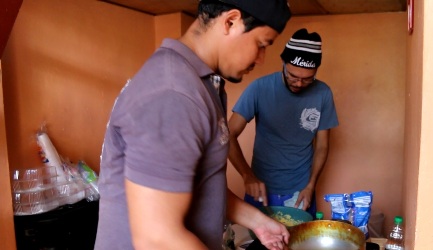
In examining migration dynamics in the insular Caribbean, the DR continued to stand out as the main receiving country for migrants in this subregion, due to the significance of flows from Haiti, which remained stable in the absence of significant changes in demand for Haitian labor in specific economic niches and because of Haiti's fragile economic and political situation, compounded by the humanitarian crisis generated by Hurricane Matthew (as it is known in Haiti). There was also an increase in attempts by Haitian and Cuban citizens to enter through the southern border of the United States. In the first case, this is estimated to be part of the process of diversification of Haitian migration destinations, mainly toward Brazil and Chile, whose evolution we have been covering in this yearbook, where a contraction of the Brazilian economy may be causing a redirection of flows toward North America. In the case of Cuba, these movements seem to have been encouraged in anticipation of changes in favorable U.S. reception policies toward Cuban migration, which materialized in early 2017. Chapter I of the report narrates these journeys in detail, showing how they involve long and dangerous crossings through all of Central America, where some migrants become stranded when faced with the closure of official crossings, while others are deported or die along the route.
On the other hand, the report shows how the intention to migrate among Dominican women and men remains worryingly high, encompassing approximately half of the population according to Gallup data (2017), while the volume of Dominican emigration remained one-third of immigration in the country. There is also an ongoing diversification of destinations toward Chile and Argentina, while the second chapter gathers some new information on Dominicans in Canada.
 The report also follows the evolution of two important issues: the National Plan for the Regularization of Foreigners (PNRE) and the implementation of Law 169-14 concerning descendants of immigrants affected by ruling 168-13 of 2013. Regarding the PNRE, the report highlights how the low number of people who had managed to obtain a migration category protected under the Migration Law (approximately 6,000 out of more than 249,000 accepted applications according to 2016 data) continued to pose challenges for both the authorities and the people who applied. As for Law 169-14, it is observed that its implementation continued to pose challenges for some descendants of migrants who had been registered in the civil registry as Dominicans (the so-called Group A) and were trying to recover their documents, while among the unregistered (Group B), their vulnerability linked to lack of documentation remained evident, given that only a minority (8,755 people) managed to benefit from the regime established for this population in Law 169-14.
These are only some of the many issues addressed in the report, so we invite you to read it more closely and thus continue generating informed debate and proposals on migration and the people affected by it. Finally, we note that the yearbook is available in print from OBMICA and that soon the first chapter on the insular Caribbean will also be available in English on OBMICA's website.