Regional Meetings with Community Promoters in the East and South of the Country
Within the framework of a three-year project supported by the European Union, OBMICA, with the support of MUDHA, has been systematizing some of the obstacles faced by descendants of mixed couples (Dominican persons united with foreign persons) in gaining timely access to the Dominican civil registry to which they are entitled under the Constitution and Dominican laws.
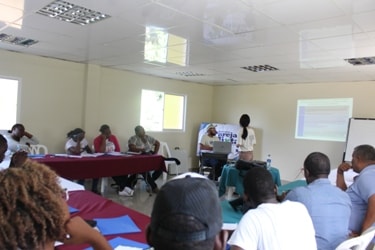
During January 2018, two regional meetings were held for promoters coming from communities with a significant historical presence of mixed families: a first one on January 15 in the Eastern region with support from the Scalabrinian Association in the Service of Human Mobility (ASCALA), and a second one focused on organizations from the country's southern border, held on January 26 with the support of the Center for Sustainable Development (CEDESO).
The general objective of these meetings was to go beyond the geographic area where the project is implemented in order to validate and exchange experiences and good practices that OBMICA is incorporating into a protocol for assisting mixed couples, to be published soon.
During the meetings, facilitated by Natalia Riveros and Domingo Rincon of OBMICA, participants shared experiences of legal accompaniment for mixed couples. In the discussions, among other things, the requirement to present the Dominican identity card and passport of the parents continued to stand out as one of the main obstacles to being able to register the births of their children.
At the same time, some cases were identified in which registration was exceptionally achieved through presentation of the card from the National Plan for the Regularization of Foreigners (a case reported by a CEDESO promoter) or through presentation of a Haitian identity card (a case reported by an ASCALA promoter), showing that the discretion available to civil registry officers can be exercised positively when administrative provisions appear to hinder access to fundamental rights contained in laws of constitutional rank. These exchanges reaffirm the need to continue identifying barriers and possible solutions that may in the future simplify and standardize processes to eliminate the under-registration of births of children of mixed couples.
These regional visits were also used to conduct media tours as a way of raising awareness and guiding affected families in communities in the East and South of the country.