
OBMICA Commemorates the Events of 1937 in Elias Pina through Music and Art
Music, lectures, and photographic exhibitions were the key elements of the schedule of gatherings and activities in Comendador that OBMICA developed between October 23 and 27 as part of the activities held in commemoration of the 1937 border events.
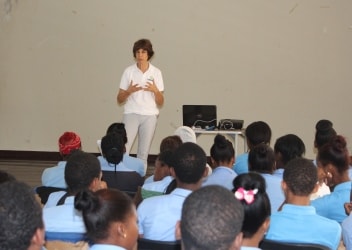
Music, lectures, and photographic exhibitions were the key features of the schedule of gatherings and activities in Comendador that OBMICA developed between October 23 and 27 as part of the activities held to commemorate the 1937 border events.
The program began with the opening of an exhibition entitled “Haitian Migrant Women in the Dominican Republic,” a compilation of 20 photographs by Hillary Petrozziello that highlights the lives of women for whom border markets have become a means of livelihood.
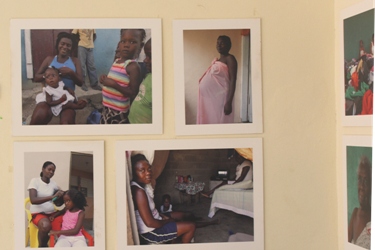
In her opening remarks, OBMICA director Bridget Wooding stated that Petrozziello's photographs are “a powerful exhibition with documentary capacity (…) that helps us enter the worlds of these lives devoted to trade” and that they reveal the border markets as important points of encounter and harmony between the two countries.
“Petrozziello's images speak of everyday life, inside and outside the market, of intimacy, of a positive attitude toward life in order to earn a livelihood for their families. Hillary Petrozziello focused her eye on women as a special group, as the group most involved in petty trade in this zone of contact,” Wooding added.
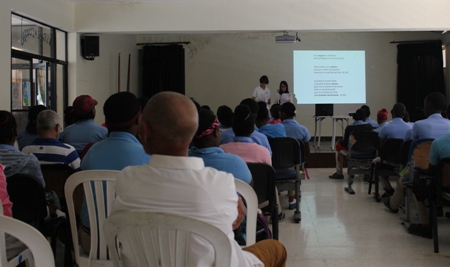 Then, on Tuesday the 24th, the lecture “The Haitian-Dominican Border: Past and Present” took place, delivered by Wooding and Maria Cristina Fumagalli, the latter an expert in literary creation on the Dominican-Haitian border. In their intervention, the experts used literary creation to describe the harmony and peaceful coexistence experienced by both countries and, more specifically, the border communities before 1937.
Before an audience made up almost entirely of students at the Juan Pablo Duarte Cultural Center in Elias Pina province, Fumagalli and Wooding sustained, title by title, an interesting and solid intellectual dialogue on the Border, harmony, and artistic creation.
Music
 To close the agenda on Tuesday the 24th, OBMICA also organized a major concert with the vibrant music of the binational band Azueï and rapper and activist Delma T1: a musical event in the heart of Comendador that got dozens of people dancing on a warm night.
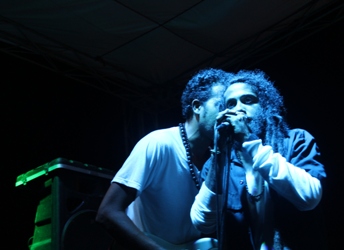
Both musical offerings fully embraced the idea of “building the future” of the border. Delma and his music got those present dancing, with hip hop enriched by the music of the island and with lyrics narrating the country's realities.
The binational artistic movement Azueï lit up the stage with its music, a reflection on a culture of peace between Haiti and the Dominican Republic. An allegorical mural was also created by two artists who are members of Azueï and still remains in Comendador.
This Friday the 27th, the photographic exhibition closed very successfully, thus bringing the cycle of activities to an end.