
The Windrush Scandal: Colonial Heritage Meets 21st Century Immigration Control
Jean Pierre Murray, OBMICA's associated researcher based in Jamaica, discusses the impact of increasingly restrictive migration policies on minority groups in the United Kingdom. These harsh measures pose a latent threat of uprooting migrants who have lived in the country for more than 40 years.
The Windrush Scandal: Colonial Heritage Meets 21st Century Immigration Control
By Jean Pierre Murray, OBMICA associated researcher based in Jamaica
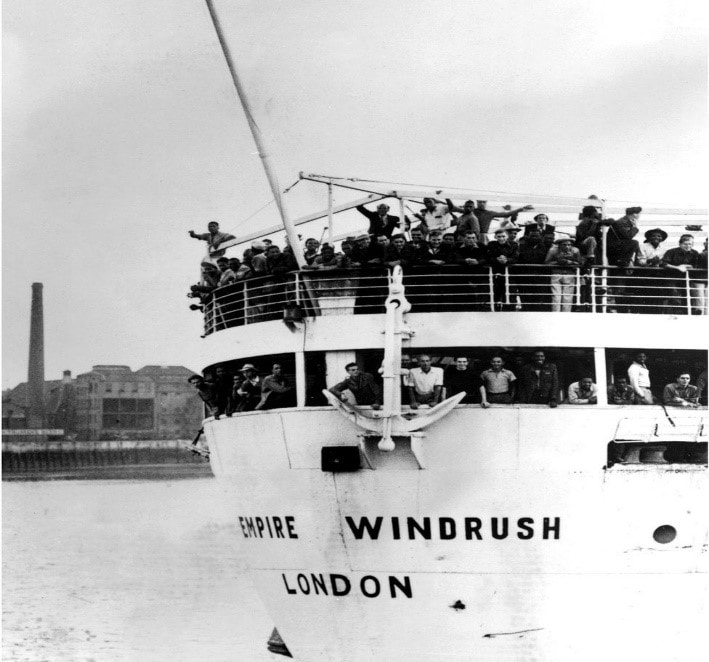
In June 2018, the 70th anniversary of the arrival of the Empire Windrush was commemorated. The ship brought the first group of British citizens to Great Britain in the postwar era. The so-called Windrush Scandal revealed failures in British narratives of multiculturalism, where increasingly restrictive migration policies have weighed on minority groups. The implementation of these policies in the United Kingdom threatened to uproot citizens who had arrived there under the rules in place before 1971.
CONTEXT
In 1948, the Empire Windrush arrived in London from Kingston, Jamaica, with a total of 492 Caribbean migrants. It was the first stage in a series of migration movements from the Commonwealth to Great Britain, where these migrants played an important role in postwar reconstruction. According to data from the University of Oxford, more than half a million Commonwealth migrants living in the UK had arrived before 1971. Before the adoption of the Immigration Act 1971, the British government had granted Commonwealth citizens the right to remain indefinitely, effectively regularizing their migration status. This enabled the formation of several diasporic groups in the UK and inspired discourse and policies around multiculturalism. However, multiculturalism obscured racialized divisions that came to light in the 2000s amid growing anti-migrant sentiment. In addition, Commonwealth migrants and their descendants found themselves in vulnerable conditions as more restrictive migration rules and increased surveillance exposed them to being labeled irregular or illegal immigrants. This happened because documentation before 1971 was weak, leaving many migrants without the documentary proof to demonstrate their status. In fact, of these half a million migrants, more than fifty thousand people had a non-British passport or no passport at all. Since 1983, children born in the UK can acquire nationality only on the basis of their parents' status. In other words, the uncertainty surrounding the Windrush generation's status is passed on to their children, who may find themselves without British citizenship or, worse, exposed to deportation.
THE SCANDAL
This new policy, known as the "hostile environment," led to a series of surveillance mechanisms in which ordinary citizens had to monitor one another's migration status. These actions included checks by landlords, banks, and even doctors. As part of these policies, Windrush migrants had to prove that they had lived continuously in the UK since 1973. Once again, the burden of documentary evidence fell on the migrants themselves, and some of those involved were unable to prove it. On top of this, in 2013 the government launched a more aggressive campaign with newspaper ads and flyers in areas inhabited by minority groups.
IMPACTS OF THE WINDRUSH SAGA
According to data from the UK's Home Office, 164 people of Caribbean descent from the so-called Windrush generation were detained or deported during the implementation of these new migration policies. With regard to Jamaica alone, the government had identified around 30 people who were deported or "returned voluntarily" as a result of Operation Vaken announcements. The Guardian reported the scandal, highlighting that the policy systematically affected people who were lawful residents, especially those of Caribbean descent. This showed that policy makers should have been concerned both about the general effects and the particular effects of the policies. For example, Paulette Wilson, who had moved to the UK at the age of 10 in 1966 and had lived there as a lawful resident her entire life, received a letter from the Home Office in 2017 notifying her of her status as an "illegal immigrant." This happened despite her arrival as a Commonwealth citizen with indefinite leave to remain, and despite growing up and working in the UK, even serving as a cook in Parliament. She was detained and placed under threat of deportation. In a recent documentary she told her story.
However, official apologies in 2017 came late, and the remedies were disproportionate to the gravity of what had happened. While the government announced in 2018 a compensation package of 200 million pounds sterling for affected populations and established a roadmap to citizenship or regularization for them, the scandal remains a huge wound. On the one hand, the timetable for compensation appears uncertain for some people, and barriers persist for people trying to prove that they actually belong to the Windrush generation. On the other hand, due to the lack of documentary evidence to support their cases, many people may not acquire citizenship or regularize their status. By mid-2018, more than 5,000 people had received documentation from the Home Office and nearly 4,000 had received citizenship. Even so, that is only a tiny fraction of the more than 50,000 people who do not possess British documentation.
In addition, among those who were wrongly detained or deported, some died without receiving the proper apology or compensation. In late November, Hubert Howard, a Windrush victim born in Jamaica, died without compensation after continuing to fight to prove his citizenship from his hospital bed. Not everyone has had the same luck as Paulette Wilson, who, after her struggle, obtained her documentation and citizenship and had the opportunity to travel to Jamaica and reconnect with her family and roots. Financial compensation, however, will not be enough to repair the fractures of a deeply divided British society. Fractured multiculturalism remains in limbo, with poor prospects for short-term solutions, as Brexit further threatens racialized and anti-migrant divisions.