Border Dialogues: Building Bridges for Island Coexistence
At these activities, the mandates of UNHCR and UNICEF and their work on the Dominican-Haitian border were presented, drawing on talks about Afro-descendancy and ethnically mixed couples. CONTACT ZONE. The Dominican-Haitian border is an important contact zone in which different dynamics of human mobility are highlighted.
The Dominican-Haitian border is an important contact zone that brings different dynamics of human mobility into focus. Since the formal opening of the border in 1986, it has served as a transit point for migrants seeking to reach the interior of each country and for border residents who regularly cross the border strip where they also live.
PROTECTION FOR POPULATIONS OF INTEREST
Regarding the respective mandates of UNHCR and UNICEF, the protection of people in mobility who are subject to migration review processes, the prevention of wrongful expulsions of Dominicans of Haitian descent, and issues concerning universal access to birth registration in border areas between the Dominican Republic and Haiti are especially relevant.
After the registration process for the National Plan for the Regularization of Foreigners (PNRE) ended in mid-2015, there was a significant movement of Haitian nationals returning to their country when they were unable to join the Plan.
Since that moment, both civil society organizations and the competent authorities on the border, supported by the United Nations system, have scaled up their work to ensure respect for the rights of migrants, Dominicans awaiting a nationality solution, and border residents.
2019
In 2019, in coordination with UN agencies and cooperation with the competent migration authorities, it was possible to identify and prevent the expulsion of 186 persons of interest to UNHCR toward Haiti. UNICEF also assisted 948 cases of girls, boys, and adolescents in mobility. Of this total, 328 were reunified with their families in the country, and 620 were administratively referred to Haitian consular authorities for family reunification in Haiti because they had no relatives in the Dominican Republic nor roots in the country. In addition, the deportation of 147 pregnant women was prevented.
2020
During the months of 2020 in which migration operations were implemented, thanks to collaborative efforts put into practice, it was possible to identify and prevent the wrongful expulsion of 30 Dominicans awaiting a nationality solution. In addition, 162 children were assisted and reunited with their families in the Dominican Republic, while 311 children without family in the Dominican Republic were referred to Haitian consular authorities for family reunification; and the deportation of 53 pregnant women and 7 nursing mothers was prevented.
DEVELOPMENT OF THE BORDER DIALOGUES
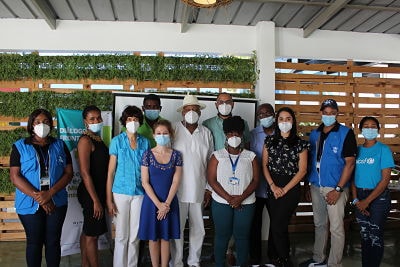
With the purpose of sharing new knowledge and seeking synergies between the Dominican Republic and Haiti on migration matters and access to Civil Registry services, the United Nations High Commissioner for Refugees (UNHCR), the United Nations Children's Fund (UNICEF), supported by the Migration Observatory and Social Development in the Caribbean (OBMICA), organized "Border Dialogues: Protecting Rights in Border Movements" on February 19 at the City Hall of Comendador in Elias Pina and on February 25 and 26, 2021 at CODEVI, Dajabon. At these activities, the mandates of UNHCR and UNICEF and their work on the Dominican-Haitian border were presented, drawing on talks about Afro-descendancy and ethnically mixed couples.
These meetings generated considerable interest and active local participation by the competent authorities (civilian and military) on both sides of the border, international organizations, local, church-based, and professional organizations, consular officials, and interested members of the public. In order to make the topics addressed in the border setting more visible, OBMICA was invited to participate in a television program called "Visiones Fronterizas" in Dajabon, where it was possible to focus on the universe of ethnically mixed couples and the registration of their children born in the Dominican Republic in the Dominican Civil Registry as a constitutional right. Lawyer Domingo Rincon, a specialist on the subject, discussed it in great detail, stressing that this is an important profile because, according to official figures (ENI 2012 and ENI 2017), there are approximately 25,000 unresolved cases. In short, these dialogue spaces show the desire of all local actors to continue conversing and building bridges toward peace and human development in this very important contact zone that is the Dominican-Haitian border.