
Dialogue on Migration Control Policies, Gender Violence, and the Rights of Migrant Women
On December 3, 2021, the Centers for Migration Observation and Social Development in the Caribbean (OBMICA) and for Sustainable Development (CEDESO) launched the Dialogue Series ?Migration Control Policies, Gender Violence and the Rights of Migrant Women.?
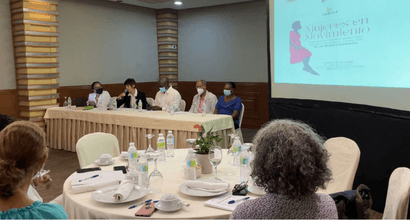
On December 3, 2021, the Centers for Migration Observation and Social Development in the Caribbean (OBMICA) and for Sustainable Development (CEDESO) launched the Dialogue Series "Migration Control Policies, Gender Violence and the Rights of Migrant Women." It was an exchange of experiences among civil society actors on arbitrary deportations, with a focus on the recent operations violating the rights of pregnant foreign women in the Dominican Republic over the last weeks.
The discussion was led by a panel of specialists who addressed different aspects of migration policy and the restrictions applied by the Dominican government since September to migrant women. The activity forms part of the Trato Digno Project, an initiative combining actions to promote respect for the human rights of migrants and their families with monitoring of compliance with due process in deportation matters in the border zone.
At the meeting, Bridget Wooding, Director of OBMICA, offered the historical context of the gender perspective in government migration policy, which invisibilizes the contributions of foreign women as workers in the agricultural, industrial, tourist, domestic, and care sectors, projecting exclusively their reproductive capacity and health needs as a threat to national security.
Anthropologist Ochy Curiel, founder of the Latin American Group for Feminist Study, Training and Action (GLEFAS), delved into the racist narrative affecting women by virtue of being poor, Black, and foreign workers. She analyzed the campaign of rejection against pregnant women as part of a complex web that must be interpreted beyond the island, at a moment when the international anti-racist movement is gaining greater force and meaning.
Juana Mercedes, general coordinator of the National Confederation of Peasant Women (CONAMUCA), spoke about the precariousness of the public health system in the country, which has commodified services, making them increasingly exclusionary and economically inaccessible for low-income persons, especially women living in rural communities.
For his part, Beneco Enecia, director of CEDESO, reported on due-process violations in the case of pregnant migrants and their children in the Enriquillo Region and border area where the Trato Digno Project is being implemented. He spoke of the spirit of solidarity shown by certain medical personnel and by communities in the midst of adversity.
Video report / Exchange
The report "Undignified Deportations" by journalist Tony Pichardo was screened, collecting the testimonies of three deported pregnant migrants, two of them separated from underage children who remain in Santo Domingo. The videographer commented on the audiovisual material gathered in Belladere, Haiti, on the political implications of these human-rights violations, and on the Dominican sorority that has accompanied the affected women. In the open section for exchange and debate, activists and representatives of organizations working with children and adolescents, peasants, women, and migrants described unheard-of field experiences that have taken place in recent months, from incursions by General Directorate of Migration personnel into hospital rooms and bathrooms to the separation of dozens of families, the rushed deportation of pregnant women and infants, attempts to expel pregnant Dominican women, and the difficult situation experienced by deported pregnant women at border points. Great concern was also expressed regarding the number of pregnancies among girls and adolescents involving men older than 40.
The "Trato Digno" initiative will continue this cycle of meetings, also addressing the image of migrants in the media, the reality of arbitrary operations, and their impact on families and communities.