
Final Declaration of the Series of Events Commemorating the 1937 Events
Final declaration: '80 Years After the 1937 Massacre: Reconstructing Memory.' The organizations convening and sponsoring the international seminar '80 Years After the 1937 Massacre: Reconstructing Memory,' together with participants and those of us who have voluntarily joined this initiative, consider it appropriate to issue the following declaration: 1) We consider the dialogue that has begun to be of extraordinary importance
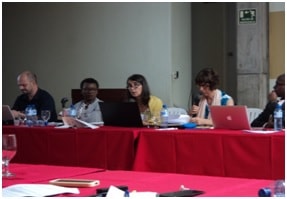
Final declaration: "80 Years After the 1937 Massacre: Reconstructing Memory"
The organizations convening and sponsoring the international seminar "80 Years After the 1937 Massacre: Reconstructing Memory," together with its participants and those of us who have voluntarily joined this initiative, the undersigned, consider it appropriate to issue the following declaration:
1) We consider the dialogue that has begun to be of extraordinary importance, as evidence of our determination to keep alive the historical memory of the tragic events of 1937 and to draw lessons from them for the present and future of the nation, of the Dominican and Haitian peoples, of Latin America, and of humanity as a whole. A program of future actions should give continuity to this worthwhile effort.
2) Reconstructing memory is an urgent task. Our societies have accumulated chains of prejudice, violence, and repression in pursuit of the unchecked power of tyrants, elites, and big capital, accompanied by silence and impunity. This only contributes to the endless repetition of violence, discrimination, and injustice. Reconstructing memory means seeking truth, recognizing and resignifying ourselves as human beings and as peoples who relate to one another through new logics of democratic and humane coexistence, committed to the Non-Repetition of crimes against humanity in any of their forms or justifications.
3) We promote the creation of a broad community of inquiry on this issue and related ones, with the objective of contributing well-founded and demonstrable historical evidence that can restore historical truth regarding the most complex moments in relations between Haiti and the Dominican Republic, moments that have been deliberately understudied or ignored, as well as the acts of repression and human rights violations committed in the name of "national defense."
4) We approve the proposal that the newly constituted community of inquiry should contribute, as a primary task, to clarifying the true causes, consequences, and scope of the massacre of Haitian and Dominican citizens promoted by the Trujillo regime in 1937, which will be the subject of appropriate national and international dissemination.
5) We reject attempts by far-right circles and power elites in our countries, and in other parts of the world, to justify massacres such as that of 1937 and to use them as examples of "patriotic action" in order to support anti-democratic and inhumane measures of racial segregation and denial of rights for immigrants and for citizens considered second-class. We likewise reject the use of racial and nationalist prejudices on either side of the border for partisan and media interests that only intensify the most dehumanizing behaviors.
6) We advocate formal, systematic, and organized cooperation between peoples, while supporting the assistance that the Dominican Republic has historically provided to Haiti in its most urgent difficulties. We also call for the border to cease being a territory of abandonment, extraction, repression, and conflict, and to become instead a territory in which both the Dominican people and the Haitian people live with dignity on either side of the island, and in which social, cultural, political, and economic relations are fostered, protected, promoted, and channeled in an enriching way for all.
7) We will work to promote greater mutual knowledge and more academic and cultural contacts, as well as greater communication between peoples, in pursuit of peaceful coexistence and solidarity among nations connected by geography and history. We propose to the universities of the island, of the Americas, and of the world, as well as to their institutions and academic networks such as CLACSO, UNESCO, FLACSO, among others, that they act as bodies that facilitate and promote research, study, and collaboration on fundamental matters such as historical memory, peace, democratic values, cooperation, and regional integration.
8) We consider it extremely grave and reject the measures arising from the Dominican Constitutional Court's ruling 168-13 and the implementation of Law 169-14, as acts of power directed against descendants of Haitians and Dominicans that constitute processes of racial segregation, denial of fundamental rights, and, ultimately, give legal appearance to, justify, and prolong the genocide of 1937.
9) We declare the need to move from a culture of concealment, impunity, fear, and distrust to one of cooperation, dialogue, and justice in Dominican-Haitian relations.
10) We consider it urgent that the Dominican Republic establish a formal and rigorous process for reconstructing truth and historical justice with regard to all crimes against humanity and human rights violations throughout its life as an independent state, as has been done in other countries of Our America and should continue to expand. This should include the search for victims' remains, including the construction of physical memorial elements that honor and dignify their memory. This reconstruction of truth and justice must be accompanied by educational and cultural renewal that, through teaching and systems for spreading values and knowledge, fosters the full commitment of children and young people to democracy, peace, human rights, and human dignity.
SIGNATORIES TO THIS DECLARATION:
ORGANIZATIONS AND INSTITUTIONS
1. JUAN BOSCH FOUNDATION, Dominican Republic - ASSOCIATE CENTER OF THE LATIN AMERICAN COUNCIL OF SOCIAL SCIENCES
2. ESCUELA MULTITEMATICA, Dominican Republic - ASSOCIATE CENTER OF THE LATIN AMERICAN COUNCIL OF SOCIAL SCIENCES
3. LATIN AMERICAN FACULTY OF SOCIAL SCIENCES DOMINICAN REPUBLIC (FLACSO) - ASSOCIATE CENTER OF THE LATIN AMERICAN COUNCIL OF SOCIAL SCIENCES
4. WORKING GROUP "INTERNATIONAL HEALTH AND HEALTH SOVEREIGNTY," OF THE LATIN AMERICAN COUNCIL OF SOCIAL SCIENCES
5. WORKING GROUP "CRITICAL CARIBBEAN THOUGHT," OF THE LATIN AMERICAN COUNCIL OF SOCIAL SCIENCES
6. WORKING GROUP "CRISIS, RESPONSES, AND ALTERNATIVES IN THE GREATER CARIBBEAN" (GTCRAGC), OF THE LATIN AMERICAN COUNCIL OF SOCIAL SCIENCES
7. INSTITUTO SUPERIOR BONO, Dominican Republic
8. HISTORY INSTITUTE OF THE AUTONOMOUS UNIVERSITY OF SANTO DOMINGO, Dominican Republic
9. MECACB (MEXICO, CENTRAL AMERICA AND CARIBBEAN RESEARCH GROUP), University of Brasilia, Brazil
10. MOVIMIENTO RECONOCI.DO, Dominican Republic
11. TEATRO GULOYA, Dominican Republic
12. DOMINICAN SOCIETY MANOS SOLIDARIAS (SODOMANSOL), Dominican Republic
13. CONVITE POLITICAL COLLECTIVE, Espaillat province, Dominican Republic
14. FUNDACION FRONTERA DE LUZ, United States - Dominican Republic
15. INTERNATIONAL CENTER FOR HAITIAN, CARIBBEAN AND AFRO-CANADIAN DOCUMENTATION AND INFORMATION (CIDIHCA)
16. CENTRE FOR MIGRATION OBSERVATION AND SOCIAL DEVELOPMENT IN THE CARIBBEAN (OBMICA), Dominican Republic
INDIVIDUAL SIGNATURES (in alphabetical order)
1. Alexis de Ganges Lopez, academic at the Center for Studies of Culture and Identities of the Southeast (CECIS), Mexico
2. Ankhi Ken-Herou, writer, Haiti
3. Ana Maria Belique, social activist, Dominican Republic
4. Any Lafontaine, historian and academic, Dominican Republic
5. Aristinete Bernardes, University of Brasilia, Brazil
6. Atilio A. Boron, academic at the "Floreal Gorini" Cultural Center of Cooperation, Argentina
7. Camila Valdes, academic at Casa de las Americas, Cuba
8. Catherine Bourgeois, researcher, Free University of Brussels, Belgium
9. Clara Cruz, Dominican Republic
10. Claudio Rivera, artist, Dominican Republic
11. Daniel Montanez, Graduate Program in Latin American Studies, National Autonomous University of Mexico
12. Dario Tejeda, Caribbean Studies Institute (INEC), Dominican Republic
13. David Ortiz-Alburquerque, Dominican Republic
14. Deisy Toussaint, writer, journalist, activist, Dominican Republic
15. Eddy Tejeda, academic, Dominican Republic
16. Edgar Garcia Cabrera, lawyer and researcher, Dominican Republic
17. Edward Paulino, academic at John Jay College of Criminal Justice, United States
18. Elsa Alcantara, academic at INTEC University, Dominican Republic
19. Felix Valdes Garcia, academic at the Institute of Philosophy, Cuba
20. Franklin Pimentel-Torres, educator, Dominican Republic
21. Frantz Voltaire, academic, Haiti - Canada
22. Ginetta E.B. Candelario, academic at Smith College, United States
23. Ivan Ogando, academic, Dominican Republic
24. Jahaziely Martinez Corporan, social worker, Dominican Republic
25. Jaime L. Rodriguez, lawyer and academic, Dominican Republic
26. Jean Jean, artist and filmmaker, Dominican Republic - Haiti
27. Jehyra M. Asencio Yace, University of Brasilia, Brazil
28. Jennifer Lantigua De La Rosa, Dominican Republic
29. Jenny Torres, social worker, Dominican Republic
30. Johanne Gomez Terrero, filmmaker, Dominican Republic
31. Jose Antinoe Fiallo Billini, academic at UASD and INTEC, Dominican Republic
32. Jose Matos Arevalos, Fernando Ortiz Foundation, Cuba
33. Josefina Zaiter, academic, Dominican Republic
34. Juan Carlos Gonzalez Diaz, filmmaker, Venezuela - Dominican Republic
35. Maria Cristina Fumagalli, academic at the University of Essex, England
36. Maria Teresa Cabrera, Escuela Multitematica, Dominican Republic
37. Marion Werner, academic at University at Buffalo, SUNY, United States
38. Maritza Martinez, Latin American Association of Social Medicine, Dominican Republic
39. Matias Bosch Carcuro, social scientist and educator, Cuba - Dominican Republic
40. Max Michel, priest, Belgium - Dominican Republic
41. Mely del Rosario Aristegui, Central University of Las Villas, Cuba
42. Orlidy Inoa Lazala, lawyer, Dominican Republic
43. Pablo Mella, philosopher, Dominican Republic
44. Pamela Marconatto Marques, academic at the Federal University of Rio Grande do Sul, Brazil
45. Rafaelina Segura, physician, Dominican Republic
46. Ramon Ant. Victoriano Martinez, academic at the University of Toronto, Dominican Republic - Canada
47. Raymundo Gonzalez, researcher and historian, Dominican Republic
48. Reina Rosario, historian, academic at UASD, Dominican Republic
49. Ricardo Seitenfus, academic and writer, Brazil
50. Richard Turits, academic at the College of William & Mary, United States
51. Roberto Almanza Hernandez, academic at the University of Magdalena, Santa Marta, Colombia
52. Robin Lauren Derby, academic at the University of California - Los Angeles, United States
53. Roldan Marmol, singer-songwriter, sociologist, president of Fundacion Cultural Cofradia, Dominican Republic
54. Segundo Marte, Dominican Republic
55. Simone Rodrigues Pinto, academic, University of Brasilia, Brazil
56. Valentina Salinas Carvacho, academic at the University of Chile, Chile
57. Viena Gonzalez, artist, Dominican Republic
58. Waldemiro Velez-Cardona, professor at the University of Puerto Rico, Rio Piedras Campus
59. Yohanka Leon de Rio, Institute of Philosophy, Cuba