
Culture of peace and citizen empowerment: key to development in the border area
The study 'Border situation and conflict resolution' was presented by Frontera Sur and OBMICA within the framework of the Binational Cooperation Program Convivencia, funded by the European Union.
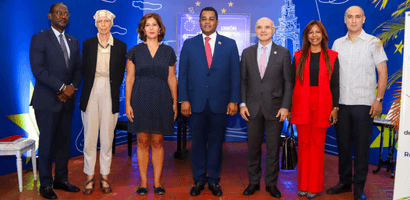
The study "Border situation and conflict resolution" was presented by Frontera Sur and OBMICA within the framework of the Binational Cooperation Program Convivencia, funded by the European Union
Along the Dominican-Haitian border, positive interactions occur on a daily basis, ranging from sports and cultural encounters to dialogue roundtables and good-neighbor relations among individuals, researchers Bridget Wooding and Katy Civolani highlighted. The social scientists spoke while presenting the preliminary results of the study "Border situation and conflict resolution", which analyzes how a culture of peace and citizen empowerment are key to the development of the border area.
"Along the Dominican-Haitian border, experiences of positive interaction and the construction of exchange spaces have occurred for many years, resulting in the strengthening of commercial, organizational, and neighborhood relations that are important for the region. However, coordinated intervention by both states is essential for transforming the structural violence present in the territory," Wooding explained.
The research was disseminated within the framework of the Santo Domingo International Book Fair (FILSD) by Fundacion Frontera Sur and the Observatory for Caribbean Migrants and Social Development (OBMICA). It was sponsored by the project "Social cohesion and a culture of peace at the border through the promotion of sports", which forms part of the Binational Cooperation Program Convivencia, funded by the European Union. The results of the diagnostic baseline, which discusses challenges and opportunities for building a culture of peace as a key to development in the border area between the Republic of Haiti and the Dominican Republic, will serve as input for awareness-raising campaigns on the benefits of commercial, cultural, social, environmental, and sports exchanges between the two countries.
Reactions to the research
Ambassador Espensel Fragoso Furcal, director general of the National Border Council (CNF), reviewed the government initiatives focused on border development that are currently being implemented and the prospects for deepening work in the area through the different bodies responsible for public policy.
For his part, Dr. Decatrel Mirville, minister counselor at the Embassy of Haiti in the Dominican Republic, representing Ambassador Smith Agustin, identified regulated and orderly migration, environmental care, and economic policies as key aspects for good coexistence. He stressed that work must be carried out jointly through the Bilateral Mixed Commission, a binational coordinating body.
Meanwhile, Maria Luisa Donoso, head of the European Union Policy Section, in her welcoming remarks said that by supporting dialogue, the European Union strengthens cooperation ties between the two peoples on issues such as sports, education, and culture.
About the research
Katy Civolani and Bridget Wooding, OBMICA's associate researcher and director respectively, shared the findings and recommendations. They recommended that Haitian and Dominican authorities take into account the particularities of the border area, as well as its richness, diversity, and the potential of its economic, political, and social dynamics to drive development and improve people's quality of life.
Despite the many challenges, Wooding pointed to opportunities for cooperation and development in the area, such as binational exchanges and networks, the renewal of the Incentive Law for Economic Development in the Border Area, the value of biodiversity, and the commitment to expand ecological tourism. In addition, there are ongoing initiatives that help chart guidelines for bilateral efforts toward the peaceful resolution of conflicts, such as the Cross-Border Dialogue Roundtables (MDT) at the four formal crossing points along the border.
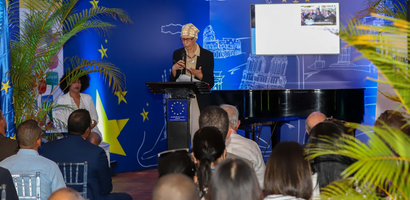 Civolani, an expert in creating dialogue spaces and transforming conflict, emphasized that community mediation is a key tool for conflict resolution and empowerment: "It is essential to create more spaces that promote intra-community and inter-community coexistence; foster capacities for peaceful response in the event of violent crisis; and define and strengthen common spaces, such as sports, cultural, religious, and educational spaces, that promote dialogue and decision-making."
The closing remarks were delivered by Pedro Cano, director of Frontera Sur, who said that the study can contribute to the design of public development policies for the border and to dialogue spaces such as those promoted by the Ministry of Economy, Planning and Development (MEPyD), as well as to the Border Roundtables, coordination spaces with direct influence in the territories. Building development, Cano argued, requires a local, collective, and binational perspective and the building of bridges toward mutual understanding and citizen empowerment that gives full protagonism in the process to border communities.
The launch event took place in the European Union Pavilion, guest of honor at FILSD 2022, located in the Chapel of Los Remedios in the Colonial Zone, where the fair was being held. It included the participation of United Nations resident coordinator Mauricio Ramirez, Sonia Vasquez, UNFPA country representative, Wilfredo Lozano, director of the National Migration Institute, Erick Dorejo, director of Border Area Development Policies at MEPyD, and Telesforo Isaac, bishop emeritus of the Episcopal Anglican Church, as well as a large representation of civil society organizations and cooperation agencies based at the border.