
How Do Dominican Newspapers Narrate Migration?
April 10, 2019.- This March, OBMICA and the University of Connecticut (UCONN) presented at the Friedrich-Ebert-Stiftung (FES) foundation the results of their joint study on the quality of media coverage that the Dominican press gives to migration issues.
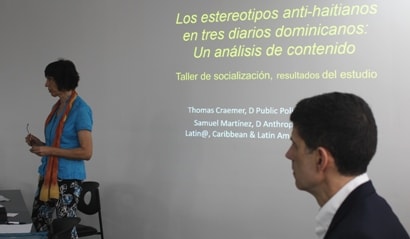
April 10, 2019.- OBMICA and the University of Connecticut (UCONN) presented this March, at the premises of the Friedrich-Ebert-Stiftung (FES) foundation, the results of their joint study on the quality of media coverage that the Dominican press gives to migration issues.
This process began exactly one year earlier, in March 2018, with training for young local journalists interested in learning the methodology used to carry out this quantitative study, this time analyzing coverage in Listin Diario, El Caribe, and Diario HOY between 2014 and 2015.
For UCONN, professors Thomas Craemer and Samuel Martinez had already developed a similar process in 2010, but focused on representations of Haitians in U.S. media following the tragic events of January 2010.
The presentation of the study "Representations of Immigrants in Dominican Newspapers" also included OBMICA's Director, Bridget Wooding, who emphasized that this kind of initiative enriches knowledge about the imaginaries surrounding migration flows to the country, where distorted visions come from, and above all how to correct them from the media. She therefore welcomed the guests attending the presentation: directors of communication schools from some of the leading Dominican universities, journalists, social researchers, and people interested in migration issues.
Results
Samuel Martinez reviewed the methodology, which examines each article by contrasting it with references to racial stereotypes, with emphasis on common anti-immigrant stereotypes and specifically anti-Haitian stereotypes.
In short, according to Martinez, the study concludes that there is a high predominance of stereotypes associating Haitian migration with crime and violence in the country. From this it can be affirmed that the national press is indeed anti-Haitian, based on these stereotypes and on how frequently they appear in media information narratives.
However, still according to the results of this study, no narrative numerically predominates that stimulates or contributes to fears about the sadly frequent version of plans for the fusion of the two countries on the island.
After the presentation, an exciting debate took place, where those present, beyond congratulating the OBMICA and UCONN initiative, even encouraged repeating the experience while trying to focus on election years in the Dominican Republic.