
Five Key Issues to Retain from the Second National Survey of Immigrants (ENI-2017)
July 12, 2018.- The survey studies the volume, general characteristics, living conditions, and economic contribution of the foreign-born population in the Dominican Republic. Over-time analysis of migration processes allows states to make evidence-based decisions.
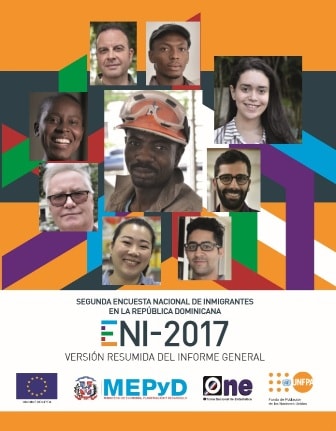
July 12, 2018.- The survey examines the volume, general characteristics, living conditions, and economic contribution of the foreign-born population in the Dominican Republic. An analysis over time of migration processes allows states to make evidence-based decisions.
Surveys are estimates based on a probabilistic sample about the characteristics of a population studied at a given moment. In order to generate trust and help achieve the highest possible degree of acceptance for the survey, links and alliances were established before fieldwork with social groups, churches, NGOs, community groups, immigrant organizations, business groups, and representatives of central government institutions. In the ENI, people living in sheds, makeshift shelters in the middle of farms, and buildings under construction, among other places referred to as "habitats," were surveyed with the aim of obtaining accurate results for the sampled areas.
Based on the results of ENI-2017, the pace of immigration growth between 2012 and 2017 was moderate. During that period immigration grew by 9.4%, while the population's relative growth was 4.7%. At the time the survey was carried out, the migration balance for the 2012-2017 period was 46,301 people and, in the specific case of Haitian immigration, 39,592 for the same period. The highest balance was that of Venezuelan immigration, which multiplied by seven between 2012 and 2017, going from 3,435 immigrants in 2012 to 25,872 in 2017.
In speaking with Dr. Wilfredo Lozano, the principal analyst of ENI-2017, he emphasized five issues that, in his view, deserve further study. Below are some highlights from our conversation with him at OBMICA.
Circular Migration: Wilfredo Lozano points to the need to complement this Survey with studies that account for what is transnational in the lives of the immigrant persons under study, especially in the case of Haitian immigration (which is the majority), given the land crossings involved.
Migration and Gender: The migration specialist refers to the growing feminization of migration affecting the country and the need to continue examining the nature of this immigration, including issues related to the new Venezuelan immigration, which has a fairly diverse profile in terms of female migration.
New Topics: One of the new features of ENI-2017 is the sexual and reproductive health module for immigrant women and their descendants. This is an important aspect because knowledge of it will serve for the development of public policies in this field.
Another novelty is that the Survey takes into account the respective processes for immigrants (the National Regularization Plan) and their descendants born in the DR (Naturalization Law 169-14), promoted as a consequence of Ruling 168-13 and which occurred since the previous Survey. Regarding the first process, the conclusion is that it is too early to have a clear view since the vast majority of regularized persons still do not have a migratory status according to the 2004 Migration Law. With respect to the second process, it becomes evident that the number of beneficiary descendants is small. On the contrary, the data show the disadvantages faced by persons deprived of their documents, in contrast with those who managed to recover their Dominican identity documentation.
Logics of Inclusion: Dr. Lozano believes it is necessary to continue exploring issues related to the economic contributions of migrants, including analyses recently conducted by the OECD (see the New Resources section in this same bulletin).
Future Challenges: The analyst recognizes that ENI 2017, in its expanded final version, is a very valuable tool to stimulate dialogue among key actors on issues that can be sensitive in the country. At the same time, it opens new windows of opportunity for dialogue with interlocutors from neighboring Haiti, in a context in which academic sectors and civil society actors are close on these matters at the binational level.
Finally, the ONE (with support from MEPyD), backed in turn by UNFPA and the European Union, must once again be praised for having carried out ENI 2017, which bodes very well for follow-up in the years to come.