
Progress and Challenges in the Dominican Civil Registry: Awareness Sessions on the New Civil Status Acts Law No. 4-23
In June and July 2024, two awareness sessions organized by the Center for Migration Observation and Social Development in the Caribbean (OBMICA), with support from UNICEF, were held. These sessions took place on June 28 at the Catholic Technological University of Barahona (UCATEBA) and on July 5 in San Pedro de Macoris, Dominican Republic.
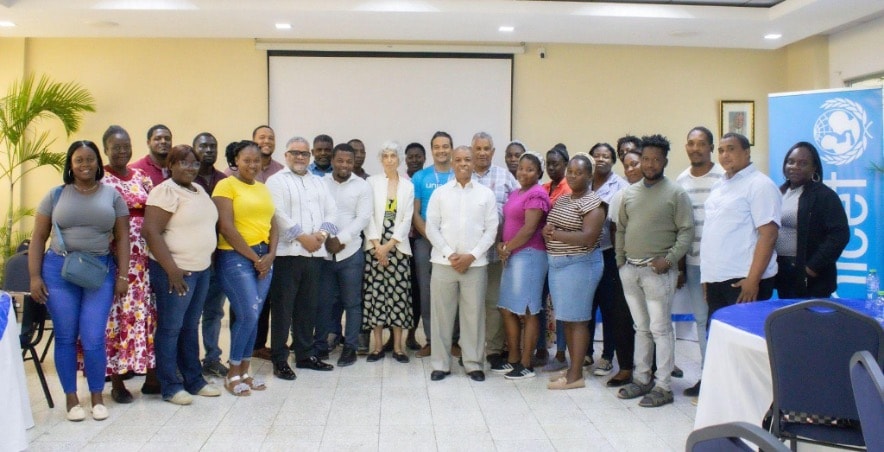
In June and July 2024, two awareness sessions organized by the Center for Migration Observation and Social Development in the Caribbean (OBMICA), with support from UNICEF, were held. These sessions took place on June 28 at the Catholic Technological University of Barahona (UCATEBA) and on July 5 in San Pedro de Macoris, Dominican Republic. Both activities sought to inform and train different social and government actors on the new Civil Status Acts Law No. 4-23, promoting equitable access to civil registration for populations that have historically faced difficulties obtaining identity documentation.
Awareness session held on June 28, 2024, at UCATEBA University, Barahona, Dominican Republic
UNICEF contributions and challenges in strengthening the Dominican civil registry system
Birth registration is a fundamental human right that grants people a legal identity from birth, said Jonathan Palatz, UNICEF Protection Officer, who emphasized the importance of this registration not only for obtaining identity documents, but also as a gateway to other essential rights such as access to education, health care, justice and legal protection.
Palatz explained that, although birth registration does not automatically grant nationality, it does facilitate its acquisition by documenting a person's existence and relationship to the territory. In this regard, he stressed that Civil Status Acts Law No. 4-23 represents a significant step forward in the Dominican Republic by modernizing the legal framework of civil registration and adapting it to the social and technological changes that have taken place since the previous law was enacted in 1944.
Despite recent efforts, the Dominican Republic faces a major challenge in its birth registration rate, which remains below the regional average. This context led UNICEF to work with the Dominican state on the creation of new manuals and the training of hospital staff and civil registry office personnel to ensure that births are registered in a timely manner. Palatz also mentioned the creation of registration promoters in hospitals, who play a crucial role in raising awareness among mothers and medical staff about the importance of registering newborns.
During his presentation, Palatz also referred to the international legal frameworks that support the right to birth registration, including the Convention on the Rights of the Child (1989), the Universal Declaration of Human Rights (1948), and the International Covenant on Civil and Political Rights (1966). These international instruments guarantee that every child has the right to be registered at birth and to have a name and a nationality. In line with this, target 16.9 of the Sustainable Development Goals seeks to ensure that all births are registered by 2030.
However, the UNICEF official noted that, although Law No. 4-23 is an important advance, challenges remain in its implementation. One key issue is the approval of the law's implementing regulations, which will establish the specific procedures and guidelines for civil registration.
Late declarations, progress and challenges
Another of the central presentations of the sessions was delivered by Benito Abreu, a lawyer specializing in Family Law and Civil Status Acts, who addressed the progress and challenges of late birth declarations under the new law. Abreu explained that Law No. 4-23 extends the period for registering births to 180 days, eliminating the distinctions between "timely" and "late" registrations. This extension facilitates the registration process for families, especially those living in rural or hard-to-reach areas, where distance and lack of infrastructure have historically prevented births from being registered on time.
One of the advances is the introduction of biometric data capture in the civil registration process, which helps prevent fraud and ensures data security. In addition, Law No. 4-23 regulates not only birth registration, but also other civil status acts such as marriages, divorces and recognition of children. These changes are essential to modernize the country's civil registry system and align it with international standards.
Likewise, the new law guarantees that all children who have at least one Dominican parent have the right to nationality, regardless of the migration status of the other parent. However, he acknowledged that in practice bureaucratic barriers and other difficulties still prevent many ethnically mixed families from exercising this right.
Challenges identified among hard-to-reach populations
The third presentation was given by Dr. Bridget Wooding, director of OBMICA, who presented an in-depth analysis of the barriers faced by migrant women, especially those living in the bateyes, in accessing civil registration. Wooding explained that these women have historically been marginalized because of restrictive policies and sexist views that see them primarily as reproducers rather than as workers with rights. These barriers have limited their ability to regularize their migration status and obtain official documents, affecting not only the women themselves but also their children.
Wooding highlighted that one of the main difficulties for migrant women is distrust of state institutions, especially health services. Many fear being detained or deported if they go to those services, which leads them to restrict their movements and thus hinders the registration of their children. The COVID-19 pandemic worsened this situation, as the closure of migration offices and the centralization of services made access to documentation even more difficult.
Recommendations and conclusions
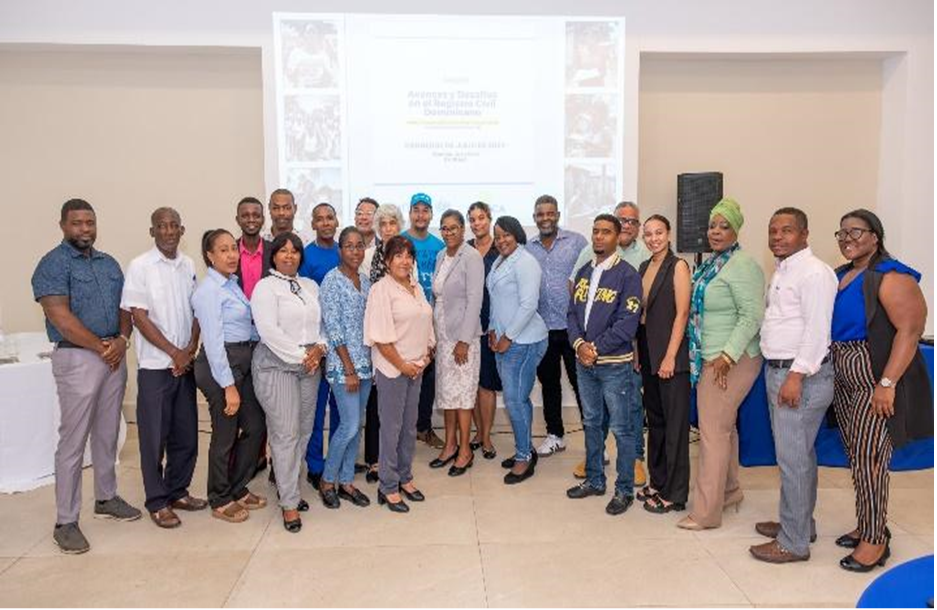
Awareness session held on July 5, 2024, in San Pedro de Macoris, Dominican Republic
The sessions concluded with a question-and-answer period in which participants were able to express their concerns and share their experiences. One of the most important recommendations was the need to strengthen training for civil registry office staff, as well as for registration promoters in hospitals and other public services. The speakers agreed that ongoing training is essential to ensure that officials understand and correctly apply the new law.
In addition, they recommended the implementation of awareness campaigns that clearly explain the rights and procedures established by Law No. 4-23. These campaigns should target both the population in general and the most vulnerable communities, including migrant women and rural populations, in order to ensure that all citizens have access to official documentation.
The awareness sessions on Law No. 4-23 highlighted both the progress made and the challenges facing the civil registry system in the Dominican Republic. The presentations by Palatz, Abreu and Wooding underscored the importance of guaranteeing the right to birth registration and nationality, especially for the most vulnerable populations. Through inter-institutional cooperation, staff training and public awareness, Law No. 4-23 has the potential to transform the country's civil registration system and ensure that all citizens can fully exercise their rights from birth.
The implementation of the new law, with the support of international organizations and the participation of civil society organizations, marks a decisive step toward the universalization of civil registration in the Dominican Republic. However, for this change to be effective, it will be necessary to overcome the structural barriers that have prevented many people from accessing their right to identity.