
Amin Perez Interviews Jesus Nunez: “We Fight for a System of Social Justice”
September 14, 2017. “If there is no struggle, there is no progress. Power grants nothing without demands. It never has and it never will.” This statement by Frederick Douglass, a former slave, key figure of abolitionism in the United States and diplomat on our island, defines the project pursued by the Union of Sugarcane Workers.
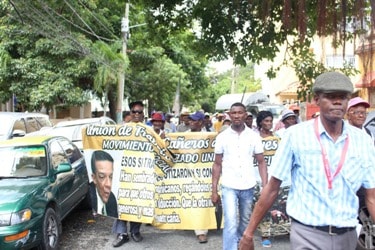
This organization carries the mission of securing justice for the social and labor rights historically and currently denied to sugarcane workers in the country. In my recent research, I was able to confirm the political significance of this struggle. It is about reversing decades of invisibility, economic exploitation, spatial segregation, and social silencing. Their determination is to continue claiming their right to have rights. For this reason, the UTC is one of the most significant social struggle movements in the country. Its representative Jesus Nunez speaks to us about the history and purposes that define its demands.
Tell me about the Union of Sugarcane Workers. How did this struggle for the rights of sugarcane workers begin in the country, and why was it formed?
The Union of Sugarcane Workers, UTC, was born in 2009 in the Lecheria batey of the Palave colony and later expanded nationally to all the sugarcane communities known as bateyes. It was formed with the objective of demanding pensions from the authorities of the Social Security Institute.
What are the lines that define the UTC? How are you organized and what are your main objectives?
First of all, the sugarcane workers of the UTC understand that our lines are defined by our confrontational action against the symbols of power in order to defend the acquired rights of sugarcane workers. We are organized through assemblies in the bateyes, and our main objectives are pensions, health insurance, and permanent residency.
Tell us, what has happened with the pension and health insurance of sugarcane workers? What consequences does this indifference have for their lives?
The Dominican social security system is discriminatory, and what we have achieved has been the result of major mobilizations. As for the consequences of not granting pensions, thousands of sugarcane workers have died without receiving them; thousands of others have applied, but the state denies them through its institutions.
What are the biggest challenges facing this struggle for pensions and health insurance, as well as for permanent residency?
The greatest challenge is to demand that the state comply with the laws and what is established in the Constitution of the Republic. This struggle of the sugarcane workers is one of the most difficult because more than 80% of them are Haitian immigrants who contributed to social security and are now denied a pension.
Tell us about the social achievements won through your mobilizations, for example with presidential decrees on pensions or permanent residency. How many people still lack them?
We sugarcane workers are a successful social movement with great mobilizing power, and through our permanent demonstrations, vigils, and marches we compelled the government to issue two pension decrees benefiting more than five thousand sugarcane workers: one granted by former president Leonel Fernandez (245-12) and another (666-12) granted by current president Danilo Medina. We still have more than 17 thousand people who have yet to obtain them. But in June 2015, we also achieved for the first time 2,709 permanent residencies for Haitian immigrant sugarcane workers.
What are the next steps to be taken?
Our organization held its seventeenth assembly on September 16 and among its main resolutions agreed to continue targeting the symbols of power, Congress, the Treasury, Social Security, and the Presidential Palace, because they are responsible for the misery of the sugarcane workers. These institutions abandoned them and today they have no social protection, that is, neither pension nor health insurance, among other vital protections. We are currently preparing a march of sugarcane workers to the National Palace on October 3, 2017, to demand a third pension decree, under the slogan that sugarcane workers neither grow tired nor surrender, and without sugarcane workers there is no sugar.
Tell us a little about yourself, Jesus Nunez. How did you become involved in this struggle? Why do you consider it crucial in the current context? What do you think is still needed for justice finally to be done to the lives of these generations?
First of all, I am no invention in the leadership of social movements. I worked at the Rio Haina sugar mill in the 1980s as a union activist and later in the bateyes as an organizer of the workers dedicated to cutting and hauling sugarcane in pursuit of their demands. I also worked as a teacher, giving classes to sugarcane workers so that they could learn to read their receipts and payment slips and not be deceived.
The UTC is a socio-political movement affiliated with the World Federation of Trade Unions that defends class-conscious trade unionism and fights neoliberal policies, and that means we fight for a system of social justice. In that sense, we are not lost on the road.
by Amin Perez