One Year after Ruling 168-13: OBMICA on the International Stage
September 23, 2014--The first Global Forum on Statelessness in The Hague was the milestone of the year, bringing together three hundred people from 70 countries. 'Refreshing, giving the idea that together we can make a difference,' was one participant's impression.
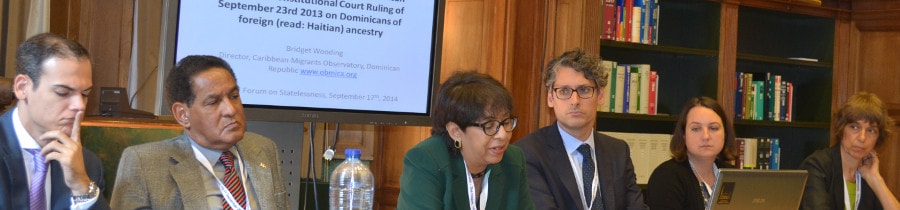
23 September 2014--The first Global Forum on Statelessness in The Hague was the milestone of the year, bringing together three hundred people from 70 countries. "Refreshing, giving the idea that together we can make a difference," was one participant's impression. From September 15 to 17, under the auspices of Tilburg University and UNHCR, representatives of governments, academics, civil society, international organizations, people who have been stateless, and the media gathered at the Peace Palace.
The discussions were deep and, as a result, many people began to question the issue as never before. Necessary follow-up was discussed, including collaborative research and exchange efforts, already partially embodied through the creation of the Institute on Statelessness and Inclusion as well as the online forum that allows the dialogue to continue. Likewise, the need to repeat this type of activity regularly in order to measure trends over time was identified. This forum preceded the launch of an international campaign to eradicate statelessness within 10 years in London at the beginning of November 2014.
OBMICA took part in a panel on the issue of statelessness in relation to the Dominican Republic, including a high-level representation from the Dominican Foreign Ministry on that panel. The presentation by Bridget Wooding, OBMICA's director, focused on civil society responses to the humanitarian crisis in the country.
Immediately afterward, the conference Hispaniola 2014: Justice, Nationality and Migration was held in Oslo, Norway. On September 18 and 19, at the University of Oslo campus, international and island-based academics took part (lawyers, sociologists, anthropologists, economists, political scientists, among others), along with a high-level delegation from the Dominican Foreign Ministry and a representation from Norway's Foreign Ministry. It was an international opportunity to discuss bilateral issues relevant to the Dominican Republic and Haiti, including matters related to the documentation of Haitian immigrants in the Dominican Republic and of the descendants of immigrants.
OBMICA's director took part in a panel in which several speakers addressed the most critical risk of statelessness in the Dominican Republic after the events of the past year. A video of Bridget Wooding's presentation is available here.